![[Philip Emeagwali]](../../gifs/African_June_1996.jpg)
+ p h i l i p e m e a g w a l i , 1 9 5 4 - +
+ p h i l i p e m e a g w a l i , 1 9 5 4 - +
RELATED Interviews You said it ... This Man
RELATED |
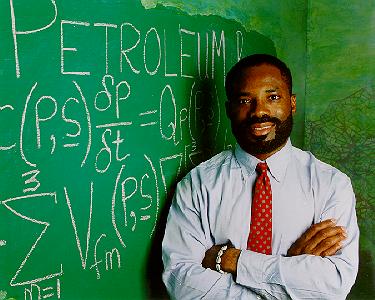
By McLord Obioha Suddenly the class "froze" with shock and unbelief. The high school physics teacher could not go further. He has ran out of ideas. He was stumped. So, he stood just there for those longest trying minutes of his career starring at the problem on the chalkboard --- amidst the embarassment of his befuddled students. Then, a student walked up from behind and grabbed the chalk from the exasperated teacher and finished off the problem. It was like magic. That student was Philip Emeagwali. And he was only 15. Twenty-five years later, Philip Emeagwali is performing magic but this time in various fields of sciences --- computing science, Mathematics, Engineering, etc. "He could always challenge the instructor," fellow classmate, Peter Ozoh, a chemical engineer at Hercules Aerospace in Desoto, Kansas, told Ann Arbor News in a 1990 interview. He said that Emeagwali was such a mathematics genius that his fellow classmates nicknamed him "Calculus" because he helped them solve their mathematical problems.
Philip Emeagwali PhD, who has picked up awards,
honors, commendations, citations, medals, there
is in the field of computing and other sciences is
perhaps Africa's best known scientist in the field
today. Currently, he is the recipient of the most
prestigious award of Gordon Bell prize in the field
of computing --- an award which was handed over to him
before a gathering of over 6,000 renown scientists.
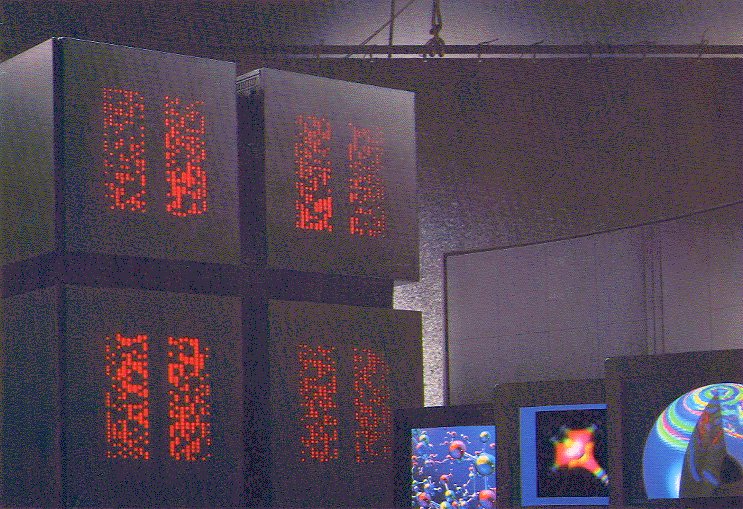
He earned that prize by using a $6 million massively
parallel computers to develop $30 million super
computers which hit a hitherto unknown speed of 3.1
billion calculation per second speed.
"When he told me about the result, I thought he had made a mistake," William Martin, director of the U-M's laboratory for Scientific Computation, told The Ann Arbor News.
"He has made a significant accomplishment in a Computer
sense," Alvis E. McDonald, a research scientist who
simulates oil fields at Mobil Research and Development
Corp., Dallas said in an interview.
Born in Akure, Ondo state, Nigeria, this
Umudei, Onitsha native who is married to an African
American, Dale Brown Emeagwali PhD, is not resting on
his past achievements. He is continuing in his
endeavor to show the world that the field of sciences,
computers, and Internet is not the exclusive reserve of the
likes of Albert Einstein and Bill Gates. His wife, a molecular
microbiologist is listed in the Who is Who in the
American Education, Who is Who in Science and
Engineering and American Men and Women
of Science.
Emeagwali subscribes to the idea of transfer of technology. On why Nigerian engineers are not besting their western counterparts, Emeagwali submits that the prohibitive cost of funding science is the reason for this. He doubts if he could have been able to achieve these feats if he were still in Nigeria. Dr. Emeagwali who sees himself as a role model for the black race especially Nigeria and the African American in particular, says their is no such thing as a superior race. "All that any particular group or race needs is exposure and necessary tools to operate. Unlike the white people, the blacks have not had the tools for years and if given the right tools, they will perform creditably. I can tell you that some blacks I have seen, make better PhD's that their white counterparts," he added. The renown computer scientist has an advice I for those parents who are worried about their children being hooked on TV. He advises parents to get their children on the Internet as a way to make them learn. Has Nigerian government contacted him for his services? He said that his contact with the government was only "informal" adding that only Chief Shonekan during his brief administration started plans to bring him home then.
Emeagwali's success story began some 35 years in the
little town of Akure where he was born.
"Chike Obi was my idol then and he is still my idol even as of today. My father admired him. He was like Albert Einstein to us," Emeagwali said. As is typical with most family, Emeagwali's had problem financing his education so he dropped out after eight grade so as to give his other siblings a chance. At 17, he gained admission into Oregon State University. His resume says that he supported his education with his many varied jobs. He was at one time a day care worker, short-order cook, night watchman, landscape maintenance helper etc.
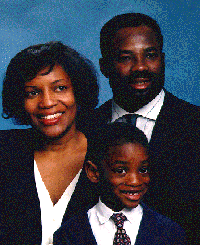
In 1981, he married Dale Brown and together they
have a six-year old son - Ijeoma. Would he advice
him to take after him?
Emeagwali's parents and his four brothers and four sisters now live in Washington DC area. He has been able to see all his seven siblings through college and he has designed programs which teach children how to use the Internet, among other computer skill. At 41, Philip Emeagwali is already an accomplished scientist. He has a PhD in Scientific Computing from Ann Arbor, Michigan, a degree in Ocean and Marine Engineering, from George Washington University, a Master of Art in Applied Mathematics from University of Maryland, a Master of Science Degree in Civil and Environmental Engineering also from George Washington University and a Bachelor of Arts Degree in Mathematics from Oregon State University-a school he first set foot on when he arrived America. And if you think that Emeagwali is one of those engineers who think, talk and breathe science and know only screws and bolts all day, think again. Infact he has a General Certificate of Education in English from the University of London. "I don't talk technical when I am discussing science," he told The Nigerian. Not only that, unlike a typical Nigerian who has such basketful of accolades, his success has not affected his demeanor. He is a very humble man. This reporter discovered these features during the course of the interview. He is not only courteous but demonstrates what his former Dean at George Washington University, once wrote about him that "he is extremely pleasant and contagiously enthusiastic about his work."
Emeagwali is really a source of pride to
all blacks in the diaspora.
Reported by McLord Obioha for the June 1996 issue of The Nigerian Philip Emeagwali's Honors
1. Nigeria Prize, (Africa's
largest scholarly prize)


Click on emeagwali.com for more information.
|

![[Only 30 percent of oil can be recovered]](../../gifs/www_cmgroup_com_why_sim_htm.jpg)