RELATED You said it ... Hotseat
RELATED |
 When you're given the nickname
"Calculus" as a junior high school student, the phrase, "destined for success" tells the whole
story. For Onitsha, Nigeria, native Philip Emeagwali, this story is his life.
When you're given the nickname
"Calculus" as a junior high school student, the phrase, "destined for success" tells the whole
story. For Onitsha, Nigeria, native Philip Emeagwali, this story is his life.
As is the case with most talented people, Emeagwali's math abilities came the old fashioned way --- he inherited them. His father, James, developed his passion for math, in part, due to his past relationship with Chike Obi, a former college roommate, premier mathematician, and first Nigerian Black recipient of a Ph.D. in mathematics. The elder Emeagwali encouraged and cultivated his son's math abilities by tutoring him until he reached the sixth grade. Then the tutoring stopped because the talents of the son began to rival those of the father. "Our tutoring sessions had developed into a competition --- who knew more, me or him," the younger Emeagwali recalls.
It was in junior high school that Emeagwali began to emerge in the public's eye. His classmates in Nigeria recognized his unusual ability in math in the seventh grade and nicknamed him Calculus. "I think some of them didn't even know my real name," he says laughing. "To this day, if I hear someone call me Calculus, I know without looking it's an old friend from home." With a desire to learn even more, Emeagwali purchased a Calculus book and tutored himself in mathematics. This constant studying placed him years ahead of most other 14-year-old students. However, disappointment soon followed. Emeagwali, the oldest of nine siblings, was forced to drop out of school because his father no longer could afford to send all the children to school. High schools in Nigeria were private, expensive and not located in every city. It became quite apparent to Emeagwali that the only way to continue his education was to "study and work hard." It paid off. By studying on his own, he finished high school and earned a General Certificate of Education from the University of London in Nigeria. When he was 17, Emeagwali scored in the 99 percentile on the American SAT exam. This won him a scholarship to Oregon State University in Corvallis, OR, where he majored in math. After receiving an undergraduate degree in mathematics --- usually while working two jobs --- he earned two Master's degrees from George Washington University in Washington, DC --- one in civil engineering and the other in ocean, coastal and marine engineering. He also earned a Master's degree in mathematics from the University of Maryland in College Park, MD. His degrees have led to positions as a civil engineer in Maryland and Wyoming, and for the National Weather Service, for which he wrote a thesis on mathematical calculations used in forecasting floods. Today, much of the academic and computer world is amazed by some of the discoveries of this young "Nigerian genius." In February of 1989, he the prestigious Gordon Bell Prize for programming supercomputers to work faster than ever before and for helping to solve one of the nation's toughest oil recovery problems.
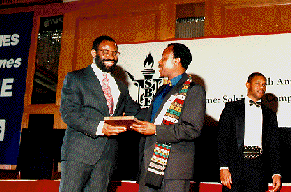
To capture the $1,000 prize, awarded each year by the Institute for Electrical and
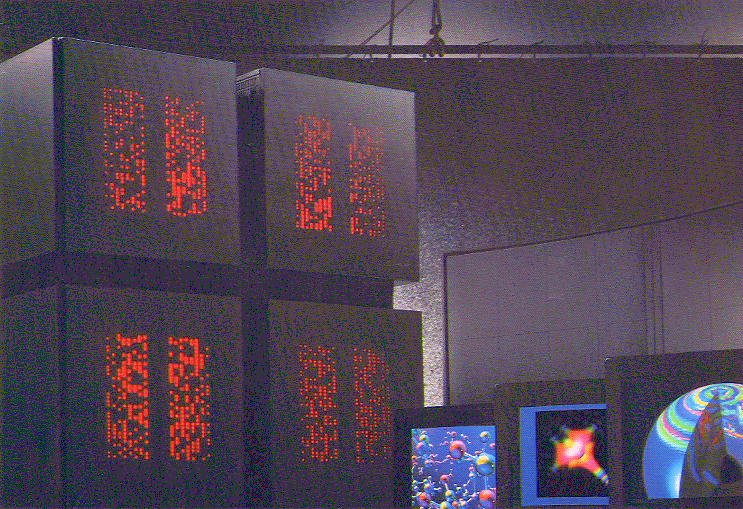
Electronic Engineers (IEEE), Emeagwali programmed the Connection Machine, a
supercomputer made by Thinking Machines Corp. in Cambridge, MA, to perform
calculations at the rate of 3.1 billion calculations per second. This accomplishment is twice
the speed of the previous Bell prize winners, 24 times faster than the '87 winner, and above
all, supasses even the theoretic peak speed of the more expensive and widely accepted supercomputer
marketed by Cray Research Inc.
As a result of Emeagwali's research, the engineers who use computers to simulate oil fields and track oil's flow, will be able to determine the percentage of oil trapped in reservoirs more quickly and accurately. "I chose this problem to tackle because in this field, in order to have the most impact, you have to work on the most serious problems," Emeagwali says, "I've always wanted to work on something that was useful." Most recently, Emeagwali, currently working on his Doctorate in scientific computing and civil engineering at the University of Michigan in Ann Arbor, MI, discussed his plans for future research. Interest in weather forecasting has opened new ideas to his supercomputer atmosphere. "In regular forecasting, the idea in supercomputers is to use only one or a few processors. What I am anticipating on happening is that there will be tens of thousands of millions of processors used," he explains. Emeagwali says that this procedure will allow weather forecasting to be more accurate. To do this, he says, "the requirement is to perform more than a trillion calculations per second. If you have a computer that will only perform one billion calculations a second, and you're trying to predict tomorrow's weather forecast, it will take you a billion seconds or so to do so. To put it into non-scientist terms --- by the time you finish computing the forecast, the weather you predicted would have been past." Emeagwali expects his computations to be applicable to a number of other significant problems, including: calculating the movement of buried nuclear waste, tracking the spread of AIDS and testing for automobile safety. All of which, he says, can be accomplished inexpensively and quickly through computer simulation. "Some research is so esoteric that researchers are reluctant to step down and explain it to the average person, but we have to be able to explain our goals and relate them to everyday life." Emeagwali has been known to work 13-hour days, seven-day-a-week schedules. Many who are close to him know that he recently assumed even more responsibilities. He and his wife, Dale, a research biologist at the University of Michigan, had an addition to the family last summer --- a baby boy. Also, as is the Nigerian tradition, he brought seven brothers and sisters to the Washington, DC, area, where they now attend school.
"Since I am the sole source of my project, I really don't mind all the
recognition. This is what every scientist wants. I would like to continue in
research and contribute to the solving of important problems," says the
35-year-old. In terms of his long-range goals, Emeagwali says that he would like
to teach at the university level, particularly to minority students.
"They are so few Black students in science, engineering and mathematical
fields, that it saddens me.
"In half of the years, through the last 20, we have not produced a single
Black Ph.D. in computer science, according to the ACM Computer Magazine. My
objective is to help wipe away this statistics and encourage students to
continue their education and go through the Ph.D.
program."

Click on emeagwali.com for more information.
|