Emeagwali
|
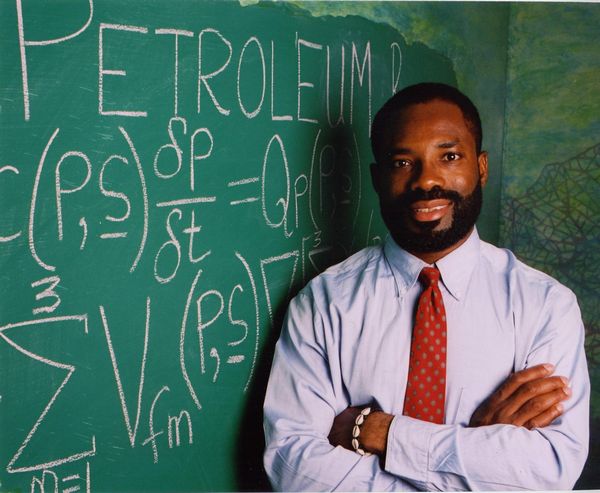
The laws of the universe is to us physicists what the constitution is to lawyers. The constitution is the supreme laws of the land and all laws must be consisent and subservient to it. Similarly, the laws of nature are the supreme laws of the universe. During the early 1980s and at the mathematics department of the University of Maryland at College Park, I encoded some laws of the universe in mathematical symbols called partial differential equations. Since universal laws are encoded within these equations, all physical observations must obey them but within the limitations of certain assumptions that I made while deriving my equations. An oilfied reservoir consists of matter such as sedimentary rock, oil, gas and water. The law of conservation of matter tells me that matter within the oilfield reservoir can neither be created nor destroyed. In other words, no matter how an oil company operates a petroleum reservoir, the matter within it will be conserved. Loosely speaking, operating a petroleum reservoir without an understanding of the laws of conservation is akin to visiting England without a knowledge of the English language. How does the law of conservation of matter help the petroleum industry recover more oil? The first step is to use an advanced form of calculus called partial differential equations to reduce the statement that "matter cannot be created or destroyed" into a set of mathematical equations with several unknowns. Depending on the complexity of the formulations, we may get anywhere from four to two dozen unknowns. If I have four unknowns, then I must have four equations. Otherwise, it will be impossible for me (or my computer) to solve my equations. Similarly, two dozen unknowns requires two dozen equations. The law of conservation of momentum gave me nine partial differential equations - one for each of the three primary spatial directions of our universe and one for the oil, water and gas. The law of conservation of matter yields another partial differential equation. The law of conservation of energy yields another equation. I also obtain additional equations by incorporating some well known and established principles of matter and thermodynamics. Again, my scriblings shown in the images below might look like a strange hieroglyphics of numbers and symbols. What I am doing is using the language of mathematics to derive new and powerful results and make predictions that are consequences of the axioms and postulates of mathematics which also satisfy the underlying universal laws of science.
One of these laws, is called Newton's second law of motion.
I reformulated it as nine coupled partial differential equations.
The law of conservation of momentum states that the total amount of motion within an oilfield remains the same, irrespective of the
number of pumping and injection wells.
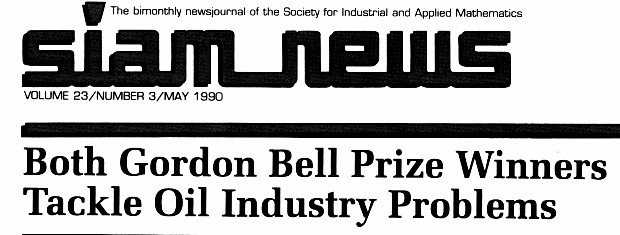
The Society for Industrial and Applied Mathematics (SIAM) is the world's largest applied mathematics society and SIAM News is its flagship publication.
In describing new equations formulated by Emeagwali, the May 1990
issue of SIAM News reported:
The implementation of a petroleum reservoir simulation (in general,
a system of multidimensional PDEs) on a massively parallel supercomputer
poses enormous mathematical and programming challenges:
The excessively small time-steps required by explicit finite-difference
models of oil reservoirs make such models highly inefficient.
Theoretical analysis has shown, however, that the magnitude of the
allowable time-steps is directly proportional to the
square root of the magnitude of the temporal inertial
force of the flowing fluid. In many practical situations the acceleration
force (the temporal and the convective inertial forces) is several
orders of magnitude smaller than the other forces and is therefore
neglected in the currently used reservoir equations.
Emeagwali's approach was to retain the original convective
inertial force and to increase the temporal inertial force
artificially. Surprisingly, increases of more than a thousand-fold
did not significantly reduce the accuracy of the model. In
fact, the stability of the explicit approximations used
to discretize the different governing equations was improved
drastically, making it possible to use time-steps of
several hours instead of a few seconds. In addition, the
resulting governing equations were hyperbolic rather than
parabolic.
In addition to the improved stability properties, the new formulation has
other good properties:
Excerpted from Emeagwali's mathematical notes while at the Department of Mathematics of the Univeristy of Maryland at College Park, May 1981 to August 1986. Emeagwali derived the nine system of partial differential equations in 1981; solved them numerically on a mainfram computer in 1983; solved them on a massively parallel computer in 1986; and won the Gordon Bell Prize in 1989. Emeagwali was later invited to give a lecture on his Gordon Bell Prize-winning research to mathematicians attending the International Congress on Industrial and Applied Mathematics (ICIAM) conference, held in Washington, D.C. His lecture on July 8, 1991 ended with a thunderous applause from the audience.
The ICIAM, which is the largest gathering of applied mathematicians,
takes place once every four years and attracts about 10,000
mathematicians.
Click on emeagwali.com for more information.
|