RELATED You said it ... Hotseat
RELATED |
"He told me to shut up because he thought I was bragging," Emeagwali recalls. Today the 35-year-old Nigerian has his PhD --- plus a graduate degree, three master's degrees and one of America's most prestigious awards in computing, the $1,000 Gordon Bell prize. To win the Bell award, Emeagwali programmed a supercomputer to work faster than ever before --- 3.1 billion calculations per second --- to help solve crucial problems of underground oil recovery. Emeagwali's classmates may have known him better than his own father when they nicknamed him "Calculus" in the seventh grade of his school back home. "They considered me a genius," Emeagwali told American reporters, "but that's a relative term." At 14 he dropped out of school because his father could no longer afford fees for all his nine children. But studying on his own, the eldest son won a scholarship to Oregon State University at the age of 17. After receiving a college degree in mathematics, Emeagwali earned a master's in civil engineering at George Washington University; he specialized in dam construction because of its applications in the Third World. Two more master's followed --- one in mathematics, one in marine engineering --- before he became a doctoral candidate at the University of Michigan in 1987 following two years as a civil engineer in Wyoming.
A relative newcomer to the field of scientific computation, Emeagwali raised
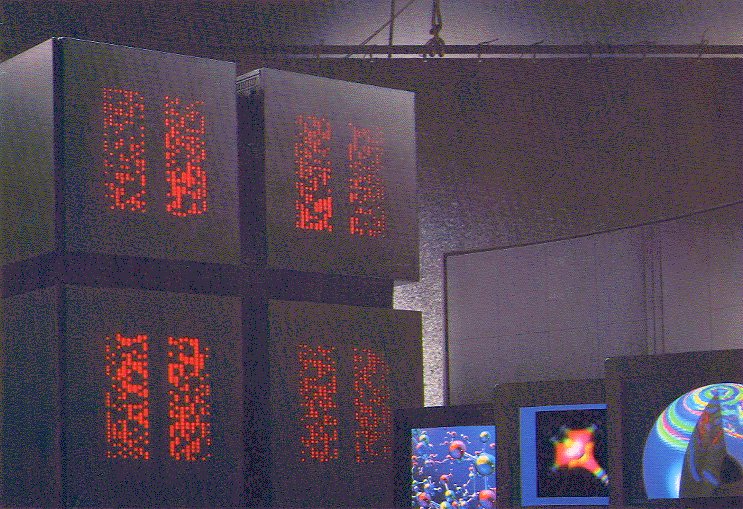
eyebrows when he choose to work on the Connection Machine, a supercomputer
made by Thinking Machines Corporation in Cambridge, Massachusetts.
He liked the Connection Machine because it uses 65,000 processors working simultaneously on calculations, as opposed to conventional supercomputers which use eight high-powered processors. Emeagwali effectively increased the number of processors to over eight million. He avoided computer downtime by linking with other Connection Machines across the United States along telephone lines. Emeagwali developed equations to simulate movement of fluid underground by modifying calculations designed and then abandoned by a Russian mathematician in 1938.
Emeagwali: "Classmates nicknamed him 'Calculus'."
The results surpassed even the theoretical peak speed of the widely used Cray Research Inc supercomputers and when Emeagwali talked to colleagues they doubted him. "When he told me about the results, I thought he had made a mistake," said William Martin, director of the University of Michigan's Laboratory for Scientific Computation. The prevailing scepticism prompted Emeagwali to enter for the Gordon Bell prize, awarded each year by the US Institute for Electrical and Electronics Engineers and known as the "supercomputer olympics." The competition is considered the annual high point of supercomputer research. "I wanted to see if the judges agreed with me," Emeagwali said. "Now all of a sudden the award gives me scientific credibility." It also got him that long-envisaged doctorate, in civil engineering and scientific computing. Emeagwali was the first solo winner of the prize, which is usually taken by teams from corporations and national laboratories. He chose to apply his work to the problem of recovering oil because "to have the most impact, you have to work on the most serious problems." Currently engineers can recover only about 30 per cent of the oil in an underground petroleum reservoir. By using simulation models to manage a group of oil wells economically, they can recover more oil.
His intention is to achieve 1 trillion calculations per second. "He has made a significant accomplishment in a computer science sense," Alvis E McDonald, a research scientist, told The Ann Arbor News in Michigan. McDonald, who simulates oil fields at Mobil Research and Development Corp in Dallas, said Emeagwali's breakthrough was important because it saved time and allowed scientists to do more engineering studies.
Although the Nigerian scientist works some 13 hours a day including weekends, this is not a domestic problem because his wife, Dale, a molecular biologist at the University of Michigan medical school, also puts in long hours.
In true African style, Emeagwali has not forgotten his family back home.
Since the mid-1980's he has brought his mother and seven of his brothers and
sisters from Nigeria; five are at the University of Maryland and
two at high school in the Washington D.C. area.

Click on emeagwali.com for more information.
|
 When
he was a boy in Onitsha, Nigeria, Philip Emeagwali told his father he intended to
become a doctor of philosophy.
When
he was a boy in Onitsha, Nigeria, Philip Emeagwali told his father he intended to
become a doctor of philosophy.
![[Philip Emeagwali's Reservoir Equations]](../../gifs/Emeagwali_Reservoir_Equations.jpg)
![[Only 30 percent of oil can be recovered]](../../gifs/www_cmgroup_com_why_sim_htm.jpg)
![[Oil Well]](../../gifs/oil_well.gif)