SCIENTIST PUTS SHINE ON NIGERIA'S IMAGE
![[Philip Emeagwali]](../../gifs/African_June_1996.gif)
+
 p h i l i p   e m e a g w a l i
 +
RELATED Interviews You said it ... This Man
RELATED |
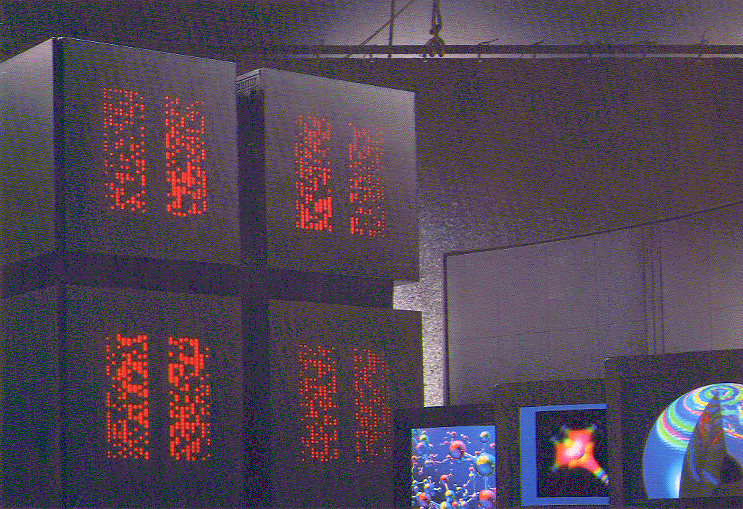
By Chike Okocha AFRICA, including, its teeming inhabitants is renowned for being a Liliputian compared to other parts of the globe in terms of its achievements in science. More importantly, computer technology, a relatively new field in the fast growing world of science, is perhaps the continent's weakest point. But a Nigerian, Dr. Philip Emeagwali, in far-away United States, has done the continent proud by developing the world's fastest computer. He attracted the attention of the American public when he won the Gordon Bell Prize in computer science by showing how he programmed a supercomputer to perform the world's fastest computation of 3.1 billion calculations per second to solve one of US's most difficult computing problems - understanding how oil flows underground so that oil companies could extract the most of it.
According to experts in the oil industry, oil has properties that make calculating its flow patterns within an oil field more difficult than modeling the flow of groundwater. To model oil-field flow in a computer requires simulation of the distribution of the oil at tens of thousands of locations throughout the oil fields. At each location, the computer must be programmed to make hundreds of simultaneous calculations at regular intervals to determine such variables as temperature, direction of oil flow, viscosity, pressure and several geological properties of the basin holding the oil.
"Even a super computer working at the rate of
millions of calculations a second is far too slow to
reach a result that can be acted on a timely fashion.
Oil companies need the results quickly
enough
to
decide
how to
recover
the
maximum
amount
of
oil,"
Emeagwali
explains.
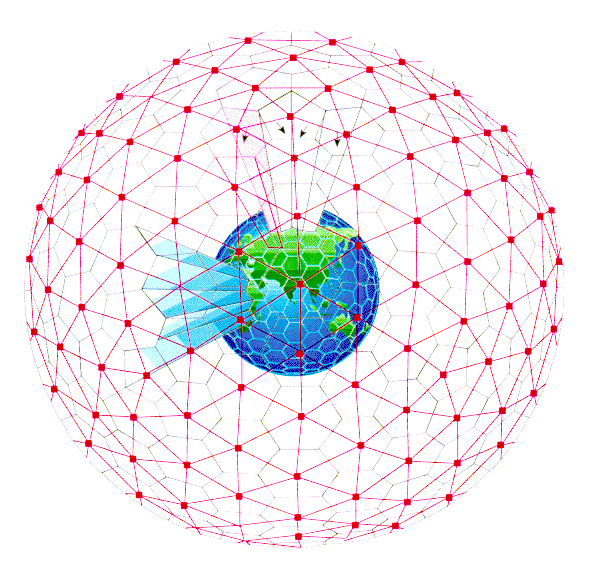
The implication is that the increased speed and accuracy may boost the available amount of oil by a few percentage points which will translate into billions of dollars in savings for oil companies, he adds. Commenting on the breakthrough, Alvis McDonald, a research scientist with Mobil Research and Development Corporation in Dallas, US says that: "He (Emeagwali) has made significant accomplishment in computer science sense. During the time saved, we could do more engineering studies on other oil fields which saves both time and money." Emeagwali, who says he was inspired by the complex designs of nature, used geometry to prove that bees use the most efficient method to construct their honeycombs. He reasoned that a computer based on the honeycomb design could improve efficiency and it did.
He expects his computations to be used in solving a number of other significant problems like calculating the movement of buried nuclear waste tracking the spread of AIDS, improving the accuracy of weather prediction and testing for automobile safety. For his research efforts Emeagwali has been honoured by so many scientific associations in the US. For instance, in 1991, he was honoured as "Scientist of the Year" by the national society of black engineers and "Computer Scientist of Year" by the national technical association in 1993. He is also one of the scientists bemg honoured in the US this year to mark the 50th anniversary of computer technology However, according to Jeff Gaines, who writes for the Journal of the National Technical Association published in the US, Emeagwali is best known for his Gordon Bell Prize --- a prize highly coveted in the computing field and awarded by the Institute of Electrical and Electronic Engineers in the US. Even more impressive Gaines adds, is the fact that Emeagwali's Gordon Bell Prize is the first ever awarded to a single individual, and not a team of scientists. The oldest of nine children, Emeagwali who hails from Onitsha Anambra State was forced to quit secondary school midway because of financial difficulties. He therefore studied at home with his father's assistance until he passed his University of London General Certificate of Education (G.C.E.). His academic career in the US began in 1973 when he won a scholarship to study mathematics at the Oregon State University. Shortly after graduating in 1977, he earned a master's degree in civil engmeermg at George Wahington University. There, he studied how to design dams because water supply problems abound in Third World countries where he was thinking of working. "I like to work on problems that are important to society because you get satisfaction. Research is hard work, so you might as well work on important research" he says. Emeagwali also earned two other master's degrees: one in ocean, coastal and marine engineering and l another in applied mathematics. His doctoral degree was in scientific computing which he received from the University of Michigan in l990. In the past years, Dr. Emeagwali has submitted 41 inventions to the US Patent and Trademark Office. These activities, and their market potentials have kept him very busy. His office is full of funding proposals to build prototypes of his ideas. Emeagwali says his goal as an independent consultant is to start his own company which will market products of his own design.
Currently, his
research
interests include
fluid dynamics,
flood forecasting
and nature
inspired
networks, among
others.
Original article was distributed on May 2, 1996 by the News Agency of Nigeria. Philip Emeagwali's Honors
1. Nigeria Prize, (Africa's
largest scholarly prize)
Click on emeagwali.com for more information.
|

![[Philip Emeagwali's Reservoir Equations]](../../gifs/Emeagwali_Reservoir_Equations.jpg)