RELATED You said it ... Hotseat
RELATED |
 As
a young school boy many, many years ago back home in Onitsha,
Anambra State, Philip Emeagwali
35, was regarded as something of a
prodigy. As
a young school boy many, many years ago back home in Onitsha,
Anambra State, Philip Emeagwali
35, was regarded as something of a
prodigy.
Whenever the teacher ran into crisis in the mathematics or physics lesson, the precocious little lad would be trusted to help figure out the problem.
Emeagwali and the mathematical equations that won him the Gordon Bell Prize
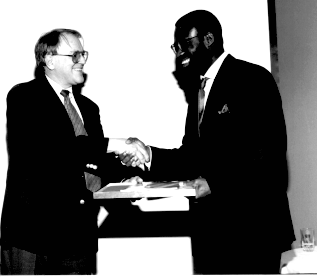
The yearly award honours outstanding achievement in the use of supercomputers to thrash out knotty scientific and engineering problems. What makes Emeagwali's breakthrough even more astonishing is the fact that all past winning entries in the Institute of Electrical and Electronics Engineers-organised competition have been a result of collaborative efforts among researchers from universities, industries and research laboratories. This is the first time the prize has been given to a lone investigator. Emeagwali's research has brought about a solution to the problem of understanding how oil flows underground, a problem rated as one of America's 20 grand challenges in science and engineering. Typically, oil is trapped within rocks underground which makes its removal difficult for oil companies. Engineers, able to recover only some 30 per cent of the oil in a reservoir, use computers to simulate oil fields so they can back oil's flow.
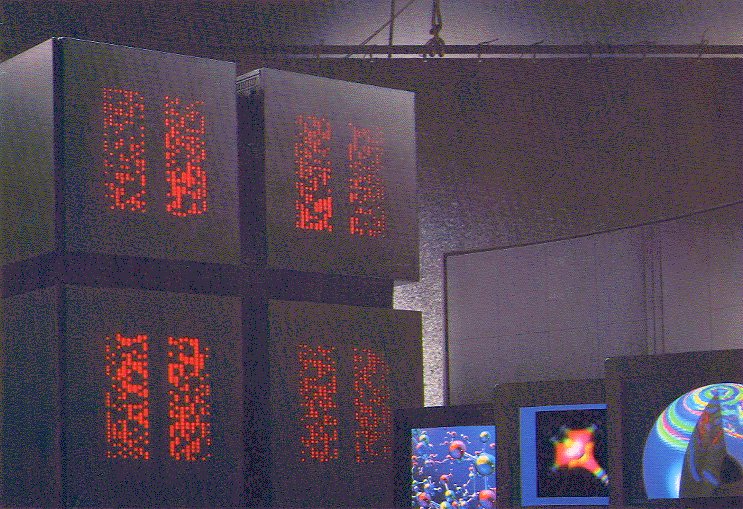
Speed is the key to solving the equations. Desk top personal computers would tackle in years, problems that a supercomputer can solve in a minute. Emeagwali's equations drastically speed up super computers designed like the connection machine. Using this new approach while putting in a 13-hour work day, Emeagwali's model rate at the speed of 3.1 billion calculations per second. With his extremely fast approach, petroleum reservoir simulation problems which formerly took may hours on conventional supercomputers, can now be solved in only a few seconds.
Emeagwali told the Detroit Free Press that his choice of problem arose out of a desire to do something meaningful. "I chose this problem to tackle because in this field, in order to have the most impact, you have to work on the most serious problems. I wanted to work on something useful." There's not a lot of room for leisure but he doesn't seem to mind. "My work is challenging, rewarding and engrossing," he told an American reporter. "I exercise to keep my sanity otherwise I can't sleep or work well. I like to get outside, so I took up tennis. If the weather is bad, I swim or jog." Right now, Emeagwali is the focus of attention in the scientific community; requests for his works would trickle in very soon. "Since I worked alone on this project, I am the sole source of it," he explains. And he doesn't mind the attention. "Recognition is what every scientist wants. I would like to stay in research and contribute to the solving of important problems.
The eldest of nine children, Philip Emeagwali was born in Akure, Ondo state, dropped out of school because his father could not carry the burden of his education anymore. He continued studying on his own, however, and soon landed a scholarship to Oregon State University where he took a degree in mathematics. PHOTO UNAVAILABLE: Artist's sketch of Emeagwali on a computer terminal
He then earned a master's degree at George Washington University. He majored
in design of dams.
 Click on this
icon to
Click on this
icon to

Click on emeagwali.com for more information.
|
![[Philip Emeagwali's Reservoir Equations]](../../../gifs/Emeagwali_Reservoir_Equations.jpg)
![[Only 30 percent of oil can be recovered]](../../../gifs/www_cmgroup_com_why_sim_htm.jpg)