|
RELATED
ARTICLES:
Interviews
Please join
our online
discussions
You said it ...
Real letters
from
Real folks
This Man
Is Hot
By Baffour Ankomah
+ + +
RELATED
WEBSITES:
Philip Emeagwali
His wife
His son
|
Against the background, in recent
times, of unprecendented
negative campaign directed at this country by sections
of the international media, the development by a
Nigerian scientist, Dr. Philip Emeagwali, of the world's
fastest computer is refreshing and cheering news.
Experts say that the computer, which can compute 3.1 billion
calculations per second, will greatly facilitate
the ability of oil firms to understand and calculate the
flow patterns of oil within an oil field as well
as maximise the extraction of the mineral resource.
Dr. Emeagwali's achievement will therefore help the
oil industry to save valuable time and money.

The
Connection Machine programmed by Emeagwali to perform
3.1 billion calculations per second.
Although intense attention has been focussed on those those
unpatriotic Nigerians, a microscopic proportion of our
population, who perpetrate various crimes abroad, here
is an example of a worthy Nigerian contributing significantly
to the development of his host country. Ever since he
arrived in the United States in 1974 to pursue his academic
career, Dr. Emeagwali has won several awards including
the prestigious Gordon Bell Prize for work done in the
computer field. It is noteworthy that he is the first
ever single recipient of the respected award which, in
previous years, had been won by different teams of scientists.
That the U.S. Patent and Trademark Office has received
41 inventions submitted to it over the years by Dr. Emeagwali
is further testimony to the scientist's genius.
![[Only 30 percent of oil can be recovered]](../../../gifs/www_cmgroup_com_why_sim_htm.gif)
Only 30 percent of oil can be recovered from the average oil field.
Petroleum reservoir simulators, running on massively parallel computers,
are X-ray machines that
help the oil industry recover more oil.
There are, of course, thousands of other Nigerians in the
U.S. and other parts of the world contributing positively to their
various host societies in several fields including medicine, engineering,
academics, the arts and so on. Unfortunately, these do not receive
as much publicity as the few who carry out negative activities
to the detriment of the country's image. Dr. Emeagwali's
achievement only helps to further illustrate the fact
that this is a country immensely endowed with high quality
human resource. The big question is, why do we continue to
stagnate in the vicious cycle of political instability,
economic recession and social decay inspite of being so richly
blessed?
![[Philip Emeagwali in front of the
partial differential equations that won him the Gordon Bell Prize]](../../../gifs/Emeagwali_Reservoir_Equations.jpg)
Philip Emeagwali in front of the
partial differential equations that won him the Gordon
Bell Prize.
It is certainly frustrating to see scores of Nigerians
contributing to the further advancement of already
developed societies even as our country strives to cast
off the shackles of underdevelopment. We must acknowledge,
however, that the so-called "brain drain" phenomenon,
which has seen the exodus of talented Nigerians to all
parts of the globe largely for brighter material prospects,
can be a blessing in disguise. This is because the skills
and experience garnered by such persons can be usefully
utilized to enrich the development process here when they
eventually return home.
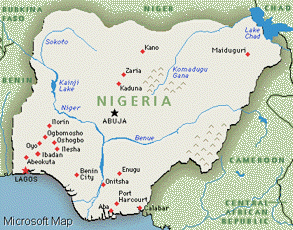
Map of
Nigeria.
For us, the lesson of Emeagwali's success story in the
U.S. is the urgent need to create the conducive environment
and atmosphere necessary to properly motivate and mobilise
the country's human resources for positive social transformation.
In particular, the country's leaders, across contending
divides, must spare no effort to heal past wounds and
achieve reconciliation in a spirit of compromise so that
the requisite political and economic conditions can be
created for the developmental project to be frontally
tackled. We must also be prepared to invest heavily in
research, especially in critical areas such as science and
technology, and make available necessary facilities for
experts in such fields to work fruitfully. That way, the
scores of Emeagwali's in foreign lands will be encouraged
to come back home and contribute their quota to national
development.
Editorial in the May 13, 1996 issue of
Daily Times (Nigeria's largest daily sale).

Click on emeagwali.com for more information.

|

![[Daily Times]](../../../gifs/editorial.gif)