After God is Dibia
Igbo Lectures
& Poems
By Friends of Emeagwali
Ichoputaghari Ihe Banyere Umu Igbo Furu Efu
Ozi Nkwado Ndi Igbo nke Ma'zi Chukwurah Filip Emeagwali degara Igbo Cultural
Association of Calgary,
Ndi b'anyi ndeewo nu O!
Obi bu m so an~uli oge Ma'zi Kene Ufondu kpokurum ka m bia
buru onye obia puru iche na emume ncheta Ndi Igbo 2003 na
Iji kwado emume unu, ana m akpoku nwa Igbo obula ka ochee
echichi ma lotakwa ihe iriba ama puru iche Umu Igbo gara mba imilikiti afo gara
aga megasiri ikwado oganiru madu.
Ewerem ubochi Icheta Igbo were lota Ma'zi Jubo Jubogha nke
ana etu "Ja Ja," onye nke atoro na oru nafo iri na abua ma gbagide
mbo we buru Eze Igbo n'Opobo. Ndi ulo ikpe
Iji kwanyere ya ugwu ruru ya, ndi mba
Ozo, ewerem ubochi Icheta Igbo were kene Ma'zi Olaudah
Equiano, nwata ozo dikwa afo iri na abua erepulu n'oru onye nke jiri aka ya
dere si: "Abu m Igbo". Ewerem ukpa ekene bunye Ma'zi Equiano onye nke
mere ka anyi nwee akuko edere
Abu na esota bu abu nke ejiri were kwaa obere nwa anyi
Olaudah furu efu:
"Obu Onye ka anyi na acho? Obu
Onye ka anyi na acho?
Ikwuano ka anyi na acho.
Obu iyi ka ochulu? Biko nya nata.
Obu ugbo ka ojelu? Biko nya nata.
Ikwuano ka anyi na acho."
Ma'zi Ikwuano bu ichie, burukwa
nna-mmuo. Ndi ogu akwukwo dum, iji bobe ya ndu anwu anwu, nyere ya aha otutu:
"Nna akuko banyere ndi ojii."
Ewerem ubochi Ncheta Igbo were kponite mmuo Umu Igbo
nwoke, nwanyi na umuaka ndi Georgia's Sea Islands ndi nke miri rigbadoo oge ha
siri na ugbo oru manye na miri iji gbanari agbam oru. Akuko ndi anakpo n'oyibo
ndi
"Oshimiri butel'anyi, Oshimiri g'ebu anyi laa"
Omume dike nke Umu Igbo, makwa inupu isi ha nupuru banyere
agbam oru madu ewerela onodu anwu-anwu na akuko makwa abu ndi bi na ikpere miri
Ka mmuo Umu Igbo furu Efu soro unu n'akuku n'ije unu,
gbanyere unu izu okwu, makwa dube unu na ochucho amam ihe na ako n'uche unu.
Ma'zi Ikwuano kowara onwe ya sin a ya bu "obia na
obodo oghotaghi" Dika ndi obia na obodo
Ndi ba anyi si na njiko ka, mmadu ka e ji aba.
Igbo Kwenu!
[Chukwurah nwa Emeagwali bu onye onicha. Ma'zi Emmanuel Chinyeaka Okoli
de re nka na asusu Igbo. Udo di ri gi, nwannem.]
IGBO
By OBU
UDEOZO[MSOffice2],
the earth
vanished into a pin-hole;
I am soaked with songs...
My ancestry’s
sharp beauty baptized me
at the forest’s nipple
-
a pilgrim of delicious peace.
Igbo
space-shuttle
and speech
your
civilisation flowers
in
every face of earth
yet your offspring
hide in the toilets
of foreign tongues
your offspring
bury your sharp beauty
with the inferiority of mad English.
mystic damsel
I shiver
in your tabernacle’s splendour
beyond Bill Gates and microchips,
you fathered supercomputer’s Emeagwali
- a vapour in the ocean
of your maltreated genius.
mystery’s powdered face
succumbs to insight
we must rescue
our lone baby from oblivion’s fire
we must re-plant
our fingerprint
against the monologue of English,
resurrection
awaits those
who drink from our roots
not our suicidal love of foreign
gods.
-
by Obu Udeozo.[MSOffice3]
THE 2001 AHỊAJỌKỤ LECTURE
IGBO OR IGBOID:
ASỤSỤ N’AGBỤRỤ NDỊ IGBO
LANGUAGE IN IGBO CIVILIZATION
by
Prof. Emmanuel Nwanolue Emenanjo
B.A. (Hons.) English, Ibadan; Post-graduate Diploma Linguistics: (Ibadan)
M.A. (Linguistics) Ibadan; Ph.D (Linguistics)
Ibadan
EKELE
Igbo mma mma nụ
Ekelee m
Abịa mma mma nụ
Ekelee m
Anambara
Mmma mma nụ
Ekelee m
Delta mma mma nụ
Ekelee m
Ebonyi mma mma nụ
Ekelee m
Enuugwu mma mma nụ
Ekelee m
Imo mma mma nụ
Ekelee m
Rivas mma mma nụ
Ekelee m
Naịjirịa mma mma nụ
Ekelee m
Igbo bụ Igbo mma mma nụ
Ekelee m unụ
Kwezuonụ
OKWU MMALITE
I meela, Chineke, I meela
I meela, Chineke, I meela o
Imeela, Chineke, Imeela
Onyeaweanyi nara (ekele) I meela
(otito)
(onyinye)
CHAKPII wọọọ
CHAKPII wọọọ
CHAKPII wọọọ
Nkịta nyara àkpà
Nsị àgwụ n'ọhịa
Ọhịa ogwū mara ọkụkọ A naghị epio yà epiọ
Òke bàa na mkpọ Àzụ gwụ na mkpọ
Dinta buru egbé Anụ àgwụ n'ọhịa
Isi akwu daa n’àlà Nwaànyị arịa ya elu
Agụ bàa n'ọhịa Mgbada achịri ume n'aka
Mmiri riri nwa awọ À naghị egwū ya ègwù
Ahịajọkụ agbaala afo iri abụo na abụo. Ọ mụtala umu iri na isii, na
ederede iri na isii. Ozugbo ha, n'asụsụ Bekee. Na ndị ochie dike ndị a, na ndị diji ndị a, na ndị ọkà okwu na otụ ilolo ndị a, ọ dịbeghị nke ọ bula n'ime ha nwere ụdi nsogbu mụ onwe m nwere n'asụsụ m ga-eji akpụpụta echemeche m ma ọ bụ kwupụta mbunoobi m Ihe kpatara
nke a bụ na na 'Citation on The Ahịajọkụ Lectures' ekwuru ya n'akpughị mmiri n'onụ na:
Each lecturer is to choose his or her Language of
delivery bearing in mind that the audience understands both Igbo and English.
Ụmụnne m na ụmụnna m, unu anụla ya nụ. Ọ bu ihe a ka Igolo. Gius
Nkemjika Anọka, Ode Nguru, na ndị komiti ya chepụtara ma kwuo n'afo 1o7o mgbe ha naewube Ahịajọkụ. Ndi niile maara ihe e jiri mara m na ihe mere m jiri bụrụ ihe m bụ, maara na anọ m na nsogbu. Ezigbo nsogbu
o. N'ezie, adi m ka onye chi ya na ogo ya rịorọ olụ, n'ọnọdụ a m hụrụ onwe m n'asụsụ m ga-eji. Chi m n'ebe a bụ asụsụ Igbo; Ọgo m abụrụ asụsụ Bekee. N'ezie, ọ na-adị m ka na ụfọdụ - ikekwe - otụtụ ndị bịara Ahịajọkụ n'afo a, bịara ihụ etu nwoke ga-esi anabata
aka mgba asụsụ cheere ya. Ma a kpọrọ ya Ahịajọkụ ma ọ bụ Ufiejọku o, ma ọ bụ Njọkụ ma ọ bụ Njọkụji, ma ọ bụ Ajamaaja, - ha niile bụ otu ihe ma bụrụkwa okwu ọkpụ Igbo. Ahịajọkụ bụ mmemme. Ọ bụkwa evueme ndị Igbo. Otụtụ ndị bịara mmemme a, n'ebe a, n'afo a, bụ ndị Igbo. Nga a anyi guzọrọ ugbuaaka a bụ ala Owere Nchi Ise, n'ala Igbo. Ebe ihe ndị a niile dizi etu a, ọ bụ gini gbochiri anyi iji asụsụ Igbo gawa n'ihu? Nga olee ka mba ọ bụla si akpata nkụ ha ji esi ihe? Kedụ ebe mba ọ bula si enweta mmiri ha na-anụ? Ọ bụ na mba ndị ọzọ? Olee ebe e si agbata mmiri e ji esi ụgụ? Eche m na ọ bụ mmiri ụgụ gba(pụ)
CHAKPII wọọọ
CHAKPII wọọọ
CHAKPII wọọọ
Ladies and Gentlemen, the point I have tried to make is that no Ahịajọkụ lecturer before me has had
my dilemma in the choice of the language for preparing and delivering his
lecture. All before me who have trodden this road had
no problem with their language of delivery. Not necessarily because of what
they had to talk about but necessariiy because of their training. Luckily, in
the extant and pristine citation crafted by those who thought of and through Ahịajọku, it was explicitly stated
that each lecturer is free to choose his or her 'language of delivery' because
the audience understands both ‘Igbo and English.’ Simple, children like
statements are rarely childish. Are choices really ever free? Aren't they hemmed in by the imperatives of context-time, space,
dramatis personae? Again, who says the typical Ahịajọku audience 'understands' both Igbo and English? And when we
talk of both Igbo and English, are we talking about conjunction, disjunction or co-ordination? Are we talking of a monolingual
presentation through and through in either Igbo or English or of the bilingual
presentation in both Igbo and English, in one text, or of the same text
presented simultaneously in Igbo, and in English all bound together as a book
in the Aboyedean sense? We know that bilingualism has as many types as it has
varieties. Ladies and Gentlemen, I will stoutly resist the temptation of being
drawn from ikpọta ụtaba to iba n 'ime ahịa.
Ndị nwe m, we all
have our own different proverbs and
anecdotes for why it is the mad man uses so many words. That is really
stream-of-consciousness at work. I have mentioned the Igbo, Ode Nguru,
Ambassador Gaius Nkemjika Anọka, master bureaucrat 'and administrator, International diplomat, Poet, Scholar, Linguist, Thinker, Traditionalist and a
Knight in the Anglican Communion, Master Facilitator and Strategist in Igbo
Lore. Have you ever heard of The Readings on the Igbo Verb, The Dictionary of
Igbo Place Names and the still-born Standard Igbo Dictionary (Project) scuttled
by the ndorondoro between persons, offices and location? Division of Culture in
the Ministry of Information and Culture and The
CHAKPII wọọọ
CHAKPII wọọọ
CHAKPII wọọọ
Gwa m gwa m gwa m, ...
Gwanụ m.(ihe) ...
Ị mara, Ị marala, Ị marala ...
O befọrọ be onye?
Nri ọ na-adighị,
Onye nà ọ gaghị eri?
Ụgwọ onye ọ bụ la aghaghị ikwụ
Ihe nyirị dike?
Ihe a gụrụ aha,
O di ka aha a gụrụ ya?
Ozuru ụwa nille?
E zuru ezu gaa
E zughị ezu laa?
Maazị Chiifu, Dọkịta Frederick Chiedozie Ọgbalụ has paid his own debt.
Whatever anyone likes, let him say about Ọgbalụ. Nobody can take away from him the fact that between 1944 - 1992, he literally facilitated the empowerment of the Igbo
language for functional literacy, numeracy, creative literature and in the
collection, transcription and description of Igbo orature. F.C. Ọgbalụ, he is also now dead. So,
too, another Frederick, Professor Doctor Nnabuenyi Ogonna,
the authority on Mmanwụ, in particular, and Igbo dramatic arts in general. The diegwu
of the Lagos School of Igbo Studies. Maazi Tony Uchenna Ubesie proved to the
international world of literary creativity that the Igbo language, can contribute its own to all genres of fiction,
faction and radio-television productions. Mr Chairman, I am not aware that any
or all of this ouartet-facilitators, masters, practitioners and analysts of
Igbo language, literature and culture have ever had any mention at an Ahịajọkụ. With your revered
permission Mr. Chairman, I pray that this highly esteemed and respected
audience rise on their legs, and remove their hats, caps and headgears - in
their names and in their honour, n'ugwu unu niile. May their great and large Igbo souls rest, nwa jụụụ,
in the bossom of Chineke, Olisaburuuwà, Ọpụtaobie! May they become ndịichie n’ala Igbo niile. And saints of the Most High.
Ise
Ise
Ise ọ ise
Amaala, mma mma nụ Ekeleenụ
Mma mma nụ Ekeleenụ
Okwu m chighaa! Back to my language of discourse. It will be Igbo and English
in complementary distribution and in line with the principle of complementary
dualism which pervades Igbo thinking, Igbo mode of thought and the grammar of
structures in the Igbo language. Igbo and English. Not Engligbo, for that would
be Igbo oxide, Igbo carbon monoxide! Nor Igbo and English with code-mixing. Or
with code-switching. Those are not allowed or tolerated in 'native like' or
symmetrical micro-bilingualism. That will be our language of discourse. I would
really have preferred it through and through in Igbo as I did in the first in
the series of the Odenigbo Lectures: Olumefula. But do all of us here; really,
understand Modem Spoken Igbo with all its complex internal dynamics and the
evolving protean language for talking about Igbo IN Igbo; otherwise called Igbo
metalanguage? We all are familiar with the ụkabụilu of the sick mart who went to the traditional doctor for
treatment. After he had reeled off his mind, the doctor asked him to put himself at ease, comfortably. While trying
to do so, a huge fart was heard. And the doctor asked him what the matter was.
The patient replied, well, 'you can hear and see things for yourself. That is
one of my ailments.' You all can now see with me, why it has taken Ahịajọku so long to recognize the
other side of the Igbo identity and reality - the Igbo Language! Is it because
we were waiting for the young to grow, in s milieu where age is something? Or
is it because what concerns us most, must
be treated last?
MBÈ àgaba Ajambène
MBÈ àgaba Ajambène
MBÈ gaa gaa Ajambène
Inu m, na akụkọ m na okwu m enupụụnọọ faa faa gidigwom wee nukwasị ofu nnukwute ala, otu obosara ala. Ọ bụghị ala Ịgala, ala Ọnọja Oboni.
Agadaaga ala a di, site n'ala ndị Nsụka n'Ugwu ruo na nke ndị Ikwere na Ahoada, na Ndida;
ma sitewe n'Ehugbo n'Ọwụwa Anyanwụ ruo n'ala Ndịosimili, Ụkụani na Ịka, n’Odida Anyanwụ. Ala Igbo di mbụ dịrị tupu ndị Potokori eruo Ose Naịjirịa n'afo 1472. Ọ tọrọ
E mee elu mee ala, mbo tọrọ eze. Ma ọ masịrị ndị di ka Bala Usman na ndị ọdịka ya. Ndi a bụ ndị ka nọ n'afọ 2001 na-eso onye di ka Hugh Trever Roper na-ako ka ọ siri masị ha, ka Naịjirịa siri malite ma ọ bụ ka Naịjirịa kwesịrị ịdị. Iji tupịa okwu m ọnụ. E kwesịrị ikwusị ya ike na ala Igbo kwupụrụ iche n'ala mba ndị ọzọ soro mepụta Naịjirịa ka anyị siri mara ya ugbuluaka a!
N'ugwu ala Igbo, Ndị Nsụka ka ma oke ala ha na ndị Igala, na ndị Idoma. Etu ahụ ka ọ di ndị Abankeleke (Izii) na ndị Idoma na ndị Tiv na ndị Mbembe. Wee ruo echi, ndị Ehugbo na ndị Arọchukwu maara oke ala ha na
ndị agbataobi ha
ndị a - ndị Mbembe, ndị Yako, na ndị Ibibi. Ndị Ngwa na ndị Ụkwa maara nke oma oke ala ha
na ndị Mmom. Ndị a niile bicha n'Ọwụwa Anyanwụ. Na Ndịda (Naịjirịa) ndị Ikwere na ndị ụmụnne ha, ma oke ala ha na ndị Ịjo na ndị Ogoni na ndị Andoni. Ndị Ekpeye na ndị Ahoada masịrị oke ha na ndị Ịzon na ndị Ogbịa. N'Odida Anyanwụ, Ndịosimili na Ndi Ụkwani na ndị Ịka, ka mara oke ha na ndị. Urhobo na ndị Isoko na ndị Okpe. Ala Igbo, ọ teela ya. Ọ teela ya na ndị egede nwere ya. Ala Igbo bụ ọkpụtụrụọkpụ ala. N'Ugwuele, n'Ehugbo, na Nsụka na n'Igboukwu e gwụputala ọtụtụ ihe okpu kabon - 14 na-egosi na ọ peka mpe, ndị mmadu ebiwela n'ala Igbo site n'afo 100,000 tupu a mụo Jesu wee ruo afo 5,000 tupu a mụo Jesu. Ọ bu ezi okwu na ndị ọkaa na mmụta ka kaa-asụ ngongo n'ikwekorịta ma ndị (mmadụ) ahụ bi n'ala Igbo, n'oge ahụ, nke ka nke, n'Ugwuele - ma ha bụ ndị Igbo ma ọ bụ ee. Ma otu ihe di n'enweghị mgbagha bụ ebe Ugwele di taa. Ọ bụ n'ala Igbo. Mana ka m jụkwaa o, mmadụ ole na ndị nọ ugbu a, na-ege m nti ma ihe ndị a m na-arụtụ aka maka Ugwele n'akụkoala ndị Igbo? Ihe a abụghị akuko mbe na ajambene. Ihe a bụ ọkpụtọrọọkpụ okwu nwere njirimara ya.
N'ezie ọ bụrụ na ọ bụ ndị mba ndị ọzọ nwere Ugwuele n'akụkoala ha, ha ga-egi ikòrò na ògele na ngwa ndị di ugbu a, e ji ezisa ozi
na redio n televishọn, na opike na ederede dịgasị iche na-ekwu maka ya, na-ako maka ya, na-ama njakịrị, na na-agba oke ogbondu na
egbe onụ maka ya. Ma na-agwa ndị mmadụ, ndị mba ọzọ n'ụwa niile: bịa lerenụ, bịa hụrụnụ, bịanụ kilibenu. A ga-ewu oke ụlọ ọkpụ e ji ọla edo chọọ mma, ka ọ ga-abụ oge onye - na ndị - chọrọ, na ka onye ahụ-na ndị ahụ siri chọọ, ha bịa, a sị ha:
Kilibenu
Kilibenụ
Kilibenụ o
Kilibenụ
Ihe kara mere n'ekobe
Kilibenụ
Kilibenụ
Kilibenụ o
Kilibenụ
Ihe ndị ọkpụ mere n'akụkọ
CHAKPII wọọọ
CHAKPII wọọọ
CHAKPII wọọọ
Kà Ị mà nke à
Ị mà nke ọzọ ụ
Kà Ị sị na Ị ma nke a
Ị mà ñke ọzọ
Ị nụbela maka Thurstan S na Maịk Angulu Ọnwụejeọgwụ na Frank Anọzie na Lawal. Ọ kweghị Lawal na ndị ogbo ya na di ọdịka ya ghọta ma ọ bụ chemie na oze di n'ọkpụtorọọkpụ ngwongwo na ngwoloko ndị ahụ e gwupụtara na Nri tọrọ nke oma, oze nke ahụ e gwupụtara n’Ife na n'ala Idụu - n'usoro e jiri meputa
ya. Azi gbakwaa, otoro gbakwaa ndị kwuru na ndị dere na ndị hụrụ ihe a! Tufiakwa! Kabon-14 aruola ala! Gini ka nsị na-achọ n'agba? Nwata (ya bụ ndị Igbo) ọ na-ebu nna ya ụzọ amụta ọkpara? Nwata ọ na-egosi nna ya oke ala! Ma
ọ masịrị Lawal, ma ọ masịghị ya, ndị maara maka ola dịgasị iche iche, na-ekwu ma na-akowa na oze nke e'gwupụtara na Nri bụ ezigbote oze e jiri kọpa, tiin na leedi gwọọ. Mana oze nke
e gwupụtara n'Ife na
Ka Maịk Angulu Ọnwụejeọgwụ na Lawal nọsịrị na-eme ndọrọndọrọ a, na-agba egbe onụ na egbe ederede a mmadụ ole n’ogbakọ a, mara maka ya, gụrụ maka ya nụrụ maka ya? Ọ bụghị atụmatụ ọzọ n'Igbo oxide! Ezechitaoke,
Olisabuluụwa na Chi Okike kenyere anyi
Ugwuele, na Nri na Nsụka na Ehugbo n'ala Igbo na ọkpụtụrụọkpụ ihe ọkpụ, n'akụko anyi. Ozọkwa, ihe gbasara anyi agbasaghị anyi. Olee uru Ugwuele baara anyi n'oge ugbu a, n’ụwa taa? Ka ọ bu Ehugbo ma ọ bụ Nri Oreri, Aguleri na
Nsuka? Ugbu a, uwa niile na-ekwu maka w.w.w. ma ọ bụ: sayensi @niile.yahoo.com.
Mana ndị Igbo, ha bụ yahoo! Lee ihe J.C. Obienyem dere maka 'Akwa Ala Igbo Na-Ebe'
A zụrụ unù n'isụ ọhịa
Ma unù nọrọ na-èlè m anya ọcha
Ụmụ m, oleè ihe m mere unu?
Amamihe unù na-anyụ osụ
Unù jiri ha ètere ni ọzọ ofè
Mgbè unu hapụrù m n'ida ajo ọhịa
Ndị m, oleè ihe
mere unu?
J.C. Obienyem Akpa Uche 1975:66-7
CHAKPII wọọọ
CHAKPII wọọọ
CHAKPII wọọọ
Ihe niile anyị nwere n'ụwa à
Ònye nyèrè ànyị ha
Chi nyere anyị o
Chi nyere anyị o
Mba niile Igbo nwere n'ụwa à
Asụsụ niile e nwere n'ụwa a
Olu niile e nwere n'Igbo
ASỤSỤ IGBO: OLUMBA NA IGBO IZUGBE
O wee bụlụ ma okwu. Ogbu a, inu m, na okwu m na akụko m enukwasala asụsụ Igbo. Asụsụ Igbo na olumba ndị dịgasi na ya adịrịla adịrị asụrụla asụrụ, n'oge ọkpụ, tupu Bekee na Ụka abịa n'Ala Igbo. Site n'Ugwu wee ruo na Ndịda n'Ala Igbo, site n'Ọwụwa Anyanwụ wee ruo n'Odida Anyanwụ n'Ala Igbo, mba ọ bụla nwere olu ha na-asụ e jiri mara ha. Anyi
ekwuola ya na Ala Igbo bụ obosara ala gbanyere ụkwụ na steeti isii, dị ka Naịjirịa sịri dịrị ugbu a.
Ndị a bụ: Anịọma (na
Mkpụrụụda asụsụ, na mkpọpụta nke ọ bụla
Mkpọpụta ụdaasụsụ - ngowire, ndebeolu, ọdịdị olu, olu nka, n'abụ na n'ukwe
Mkpụrụasụsụ na mkpụrụkwu
Mkpọkpụta mkpụrụsasụsụ na mkpụrụokwu
Mkpọnuume, mkpọnaakpo, mkpọna egbagbere
Nkebiokwu, nkebiahịrị, ahịrịokwu na ndịnaya
Nnyemaka ngwaa, mmejupụta ha na mpụtara ha
Ndị Igbo niile
maara nke a, ofụma ofụma, kpatara ha ji ebee otu akpata onụ na:
Mba na-achi n'olu, n'olu
Ma ha kwaa ụkwara
Ya adaa kwa kwa kwa
Ilu a bụ mmanwụ tiri onwe ya. N'ihi na achọghị m ka ego e jiri lụo nne m laa ọkpọrọ, agaghị m agbali ikowa ya. Mana n'ihi na nne m azụchaala ahịa nke ya soro igwurube laa
mmụo, ka m gbalịa zipụta ụmi ilu a. Ihe ọ na-ekwu bụ na e gemizie nti na rịịị
na tịịị dị n’olumba gasị anyị were anya ahụ e ji ahụ nsị osa, na ntị ahụ e ji anụ ikiri ụkwụ esu, anyị ga-ahụ ma nụ otụtụ ndịiche, site n’otu ebe gaa
n’ebe ọzọ n’olumba ndị Igbo. Mana anyị bịa n’ihe ndị ahụ asụsụ jiri bụrụ otu njirimara ndị, na omenaala ha, olu na ibe ya bụ otu, site na nghọta na mpụtara dị n’iminiimi ha, na n’ọkpụ ndịrị ha – na mpụtara na nghọta ha.
Asụsụ Igbo nwere otụtụ olumba. E nwebeghị ike imatacha olumba ole di
n'asụsụ Igbo. Otu ihe anyị maara bụ na ọ karịrị steeti ole a na-asụ Igbo ka asụsụ mbụ, maka ụfọdụ ma ọ bụ niile, na ha. Otu ihe ọzọ anyị maara bụ na olumba ndị a erughị ka komuniti ndị nweere onwe ha, na goomenti ndị di ugbu a n'Ala Igbo, na-ekewapụta aghara aghara. Otu ihe ọzọ anyị maara bụ na e nwere otu olumba, oge, ndị mmadụ na adimkpa nyeela ndị Igbo. Ọ bụ nke a ka a na-akpọ Igbo Izugbe. Asụsụ di ka Igbo, a na-asụ n'obosora ala di dika Ala
Igbo, asụsụ nwerela abidii ya oke mgbe, asụsụ nwerela otụtụ ederede na ya, asụsụ so asụsụ abụo ndị ọzọ bụrụ asụsụ Ala Naịjirịa, a na-akụzi site n'otaakara wee ruo yunivasiti dị ka A1 na A2, asụsụ a na-asụ na redio na televishon, were ya na-eme otụtụ ihe ndị digasị iche iche, asụsụ bụ na ndị na-asụ ya ruru 20m ma ọ peka mpe. Asusu di etu a kwesiri inwe Izugbe abuo - nke osusu
na nke odide. Izugbe Osụsụ na Izugbe Odide abụghị ebiri. Nke osụsụ tọrọ nke odide. Izugbe asụsụ Igbo malitere kemgbe ndị Igbo si na mba digasị iche bidoro nwewe mmekorịta n'ọgbako, n'azụmahịa, n'ụlo ụka, n'ama egwuregwu, n'ụlo akwụkwọ, n'egemnti na mkpịrịta ụka na ejije na ihe ndị ọzọ a na-eme na redio na televishon. Izugbe Odide malitere kemgbe ndị ụka Siemesi tinyere anya n 'asụsụ Igbo imepụta na ikpụpụta otu olu Igbo ga-abụ ozuruigbo niile onụ. Na mbụ na mbụ ndị Siemesi wubere Isuama site na mgbali. Schon, na Saro.' Mana ka
Schon garuru Abo sụo Isuama n'enwegbhi onye ghọtara ya ka ọ kpụpụta na akamere anaghị adi n'asụsụ. Achịdikịn Denis ewee gbalịa chopụta Yunion Igbo ka ọ bụrụ Igbo Izugbe. Nke ahụ kụkwara afo n'ala. Ida Ward
ewee haziwe Central Igbo, etu Welmers na Welmers siri hazie Compromise Igbo. Na
ndị a niile ọ dighị nke a nabatara ka ọ bụrụ Igbo Izugbe. Ma ka agha Bịafra biri, n'afo 1970, Otu
Iwelite Asụsụ na Omenaala Igbo bidoziri haziwe Igbo Izugbe nke e jizi ede
ederede Igbo ugbu a. Na mkpọkọta okwu m, ọ kwesịrị ka anyị mata na Isuama, Yunion, Central na Compromise Igbo jikọrọ aka mee ka mpupụta na nhazi Igbo Izugbe na-aga were were. Ọ bụ naani Igbo Izugbe a nwere ọkaasụsụ Igbo. Ọ bụ nke a bụ otu oke ndịiche di n'etiti olumba ndị ọzọ e nwere n'asụsụ Igbo na Igbo Izugbe.
Sọọ
nwata ụ nọ n'ikpele mmili
Kwe m eke Ekene Oma
O ma Oma na udo
Údo Ùdo obele
O bele Obele nza
Nza Nza atụle
Atụle Atụle òbò
O bo Obo n'ụgbo
Ụ gbo Ụgbo n'amì
Amì Amị gololịo
Osikapa Joloof O nà-àsonashị kombiìfu
Osụwayịwayị Ìyaà
Ladies and Gentlemen,
THE IGBO OF INNOCENCE
THE ESSENCES IN IGBO CIVILIZATION
In the age of innocence the indịgenous, native and original Igbo were simple child-like,
hardworking, imbibing from their elders who were steeped in essence, in the
lores and mores of Igbo culture and civilization. As the young Igbo grew up they were exposed to and imbibed four crucial 'cults' (but without
the pejorative senses of today).
Ikengà – ‘the cult of the right hand which symbolizes indịvidual achievement through
hard work (with one's hand);
Iru-cult – ‘the cult of the face which sytnbolise
one's commandịng personality and influence;
Ùhu-cult - 'the cult of the body and tongue which symbolise personal charm and
persuasive eloquence;
Ụkwụ nà ije - 'the culture of
the limbs which symbolise success in adventures.
Essential in his inculturation programme, the Igbo
amika and ntoroobia, were taught to recognize the Alusi or supernatural being
forces for what they were. Even though they could have the features of men, the
Alusi were neither living human beings (mmadu) nor dead human beings (mmuo). In
the age of innocence, the Igbo, whatever was their location in Igboland, shared
an identical conception of the Cosmos. To them the universe was divided into
four complementary departments:
Ùwà, Mmuo, Alusi and Okike. Uwa (-wa break open; split open, be cracked) in the
world of the senses is seen in Igwe (the heavens or firmament) and Ala (the
earth) Uwa is inhabited by Mmadu (living human beings), Mmuo (dead ancestors
who, as ndịichie, the canonized ones, can re-incarnate, or as Akalaogoli can't re-incarnate, or Ekwensu, mischievious spirits, and
Agwu, the maverick ambivalent trickster spirit which through divination, Afa,
reveals to human beings the complex nature of the cosmic relationships in the
Igbo world. Very close to but distant from Uwa ndị Igbo, is Chi Ukwu (Chukwu), the Great Chi (God), Chi Okike =
Chinaeke (the Creator), Olisabuuwa (the God that carries the world). In the
pristine world of their bucolic innocence, the Igbo revered Chukwu (God), the
Great Enigma, Amaamaamasịghịamasị (The-known-and-not-so-known). Ọnọnsomateeaka (One-that-is-near-but-still-far). The innocent Igbo
venerated Chiokike because:
Ikeechukwuebuka Chukwunọnso
Chukwuebuka Chukwuenweghịiwe
Chukwunweikeniile Chukwunwendu
Chukwukadibịa Chukwujindu
Chukwumụanya Chukwumaobimmadụniine
Chukwubụike
In the philosophy of Igbo knowledge
Chukwu kere
Ma
In the age of innocence the rural Igbo had very great respect for Ndu (life)
because it comes from God. It is greater than money
or wealth. It cannot be foundered by blacksmith. All things are only useful if
they have life.
Osondụagwgụike Ndụbụeze
Chukwụbụndo Ndụbụisi
Chukwunwendụ Ndụkaego
Chukwujindụ Ndụkaakụ
Ekejindụ Ụzụakpụndụ
Ifebụnandụ Mdịkaanwụifemgaemedị
Ifesinandụ Obụlụnamdịndụifemgaemedị
Ifeakandụ
In the age of pre-innocence, God allowed Death to be in order to checkmate
Onye lote ọnwụ
O mea nwayọọ
N'ihi na
Ọnwụatụegwu Ọnwụenweiro
Ọnwụatụaka Ọnwụamaoke
Ọnwụasoanya Ọnwụakpaoke
Ọnamaoke Ọnwụnọnso
Ọnwụeliego Ọnwweteaka
Ọnwụelingo Ọnwụejeọgwụ
Ọnwụenweoyị Ọnwụamaife
In the age of innocence the Igbo respected age and the elders almost to the
point of reverence because:
Ife okènye dànà àni fụ
Nwatà kwụlụ ọtọ ọ má-afụ yá
A hụ, e kwughị nà-ègbu okènyè
E kwuo, a nụghị nà-ègbu nwatà
In their ranking of professions or attributes, the igbo of innocence ranked
brain over brawn:
Kalịa aya gà-èli ọtụ ilòlò
Ya lia dike
Thus the strategic thinker, the philosopher, a bundle of brains is preferred to
the warrior, the military strategist, the man of strength.
For, whereas the latter is replaceable and dispensable, the former is not
replaceable, and is indịspensable. Tied to the virture of thinking and geometric
reasoning is the indgenous Igbo ranking of amamihe
(absolute wisdom) amamizu (absolute wisdom) over:
Àkọ 'smartness,
‘wit’ as in Nwa Ebule Ako
Uchè ‘commonsense’ (without real wisdom)
Àkọ nà uchè ‘wisdom’
Ñtụbịrịkọ ‘diplomacy’
If the above analysis is correct, what then do these mean?
Àkọ bụ ndụ
Uchè bụ ndụ
Uchè bụ afa
Uchè bụ àkpà
The autochthonous Igbo of innocence prized material possessions but would not
make a fetish of them because material possessions come from God.
Chukwunweụba
Chukwujiụba
Ekèjiụba
Ụbàsìnàchi
But if:
Ndụbụàkụ
Nwabụàkụ
Mmadụbụàkụ
Madụwụụba
And then:
Nwakàụba
Mmadụkaụba
In the light of the above what is?
Àkụ ụba àkụ nà ụbà
Possessions possessions of assets wealth
· Eluluù (animal resources)
· Akụmakụ (forest resources)
·
· Ndịinyom (wives)
· Ụmụ (children)
· Ohù (slaves)
In terms of wealth, the Igbo of innocence were concerned more with the creation
and acquisition of wealth - than with the spinning of money. The image of the
King in Every man which the Ikenga and the Ụkwu na Ije cults seem to
portray, is only partially correct. Adventure and success are not only carried
out and achieved in society, they are measured against other people in and the
virtues society. Persuasive eloquence, rhetoric and oratory associated with the Uhu-cult are society-determined. So, too, is
commandịng personality and influence of the Iru-cult, society-driven.
The Igbo of innocence was a community dweller and a team worker.
For while he knew that:
1. Onye ya na chi ya kwụ
O dighị ihe ga-eme ya
Or
2. Onye kwe, chi ya ekwe
He also knew and believed that:
1. Mmadụ bụ chi ibe ya
2. Ịhà mè ịha me ịhà
3. Ọgọ bụ chi ogbenye
4. Ofu onye adị-abụ ebò
5. Ofu aka adị-eke ngwugwu
6. Ofu onye adị-ebu ozu enyì
7. Ofu onye adịghị mma n'ije
8. Otu mkpịsị aka rụta mmanụ
Ya eruo ndị ọzọ
9. Ihe kwụrụ
Ihe akwụdebe ya
10. Onye maani ya kwụ
Odudu atagbuo ya
11. Ọkọ kọba mmadụ
O gaa kwụde mmadụ ibe ya
Ka ọ kọọ ya;
kọba anụ ọhịa
O gaa n'ahụ osisi
12. Otu onye lie onwe ya
AKA ya ga-apụtarịrị
13. Nwata nwe ọkpà
Mana n'ezi okenye
Ka ọ na-akwa
14. Onye fee ezè,
Ezè eruo ya
15. Ọhà nwè tutuu
Tutuu nwè ọhà
16. Aka nri kwọọ aka ekpe
AKA ekpe akwọọ aka nri
All the above proverbs emphaize the complementry roles of indịviduals with indịviduals - inhuman society. So, too, does the aetiological
anecdote about why 'Fowls go in twos - because the thing that kills fowls
(hawks) come from above. If one fowl sees the enemy first, it alerts the
others. So too do personal names like:
Adimabua Nwaìgbò
Adaọha Igboanụgo
Nwaọha Igbonaekwu
Obiọha Igboakalụzịa
emphasize complementation, reciprocity and group plidarity.
What I have been saying so far suggests complementation rather than polarity,
inclusivism rather than exclusivism, and holism rather than
indvidualism. Too much: exists in the political, sociological and cultural
literature about the Igbo being an extreme indịvidualist, a lone ranger (= I-go-before-others). I would not,
however, like my audience to go away with the
impression that the Igbo society of innocence and the Igbo people of innocence
did not have their fair share of mavericks, madmen and deviants. They had. But
they believed these were the exceptions that give vibrancy and relevance to the
rules.
O dighị ala na-enweghị ngwere
Some people among the Igoo of innocence did do what they were not expected to
do. The ten, universal commandments were broken. There was incest. There was
adultery, fornication and abortion. For the Igbo language has words for these. People ate animals, fishes and fruits they were
forbidden to eat. People went to other people's farms and removed yams and
cocoyams from their farms and barns. But there were sanctions for those caught
in the act. There were public confessions, executions, and suicides for those
who offended grieviously against ala. For:
Ògbu mma nà-àla na mmà
Ogbùru onye nà onye ọ gbù yị àla
Ajụghị àjụ eri kpàtàrà
A rịàghị àrịà ànwụ
For those who confessed their transgressions, there was forgiveness. For:
Mmehie dịka-àdị
Mgbayàlị adị-àdị
The Igbo of innocence lived in and operate within his umunna, at the three
levels of partilinage: minimal, major and maximal. He also lived and operated
within the Ikwunne or Nnamochie - the matrilinage. At the widest level, he operated within a village. Beyound that, he
went into an mba - another or foreign land adjacent to his and with which it
had all sorts of alliances and relationships. Even in some of the known (Igbo)
kingdoms the king, even where there was a primogeniture, was treated as a
President-for- as long as he proved himself people-centred, democratic and
republican - and his people were satisfied with his reign not rule. For:
Ọhà nwè ezè
Èzè nwe Ọhà
In conclusion, the Igbo of innocence loved and
coveted wisdom and applied it to all he thought, said and did. For him Chukwu
himself created wisdom and so all true wisdom came from Chukwu. This true
wisdom is not just one of intellect, derivable from facts but a passion for
truth. The young garnered it from counsel, instruction and observation from the
elders and the wise, through informal traditional education whose unwritten
texts were the folktales and other narratives the proverbs, anecdotes, tongue
twisters, riddles, songs and poems of all descriptions and genres, feasts and
festivals. Whether as technical knowledge, or hypostratic knowledge, true
knowledge as against spurious wisdom is what kept the Igbo going in their
arcadian innocence.
THE BACKGROUND TO EXPERIENCE
Mutual trans umunna, trans ogo, trans mbam, trans mba contacts, with other
sub-cultural Igbo groups within Ala Igbo. This was one factor. Mutual trans
Igbo culture contacts with their non-Igbo neighbours (
THE IGBO OF EXPERIENCE
According to Onwuejeogwu (1987) exprience intergrated the theatre of Igbo
civilization into what is today called
Ezè Ìgbò di mfe
nweghị omà:
Aju e ji èbu ezè dọ nà ngwùrù niile
Di n'ime Olu nà Igbo
Ebe m nwèrè òkpu mmèe mmèe
Jide ija nà ñkù akpukpọ
Ezè, ọ fọrọ ihe ọzọ
N'Olu nà Ìgbò ezè na adà n'obi ọ masịrị ya;
Àjàdu nà-akpọ isi àlà, ọ na-akpọrọ onwe ya
Ebe ọ bu ego bu
igidigi oju eze
Àjadu chi ya mụ any a, ọ majite ego
Ego tụa ahụ, eze adawaa!
Ma eze naịrà, ọ bụ eze gini?
Eze ụra atụ na eze nkwōro
E gbue ebi naabo, e zoo otu
Okwu sie ike, ndị uwe ojii na ndị dibia
Bikonụ, eze naịrà, ọ bụ eze gini?
Nolue Emenanjo (ed.) Ụtara Nti pp. 63-4.
Put in the most simplistic language the combination of all the agencies and
forces of the post-innocence era resulted in the emergence of men without
shape, women without ears, shapes without forms, hollow men without backs; for
whom all things are not where they are supposed to be, the spirtus mundị was ambivalence, the
zeitgeist; snakes swallowing snakes. Ebe niile abụrụ mmadụ mmadụ, mana mmadụ akoo. Ụkwụ eju ala, mana ije adighị. N'ezie, ọkụkọ agbasaala okpesi. Ndị nọ n'ala bidoziri dagbuwe ndị nọ n'elu. Akwụ wee chaa n’ọdụ igù. Ịkwighịikwighị efebezie n'ehihie. Eỳi n'ehihie. Ndị eze akarịa ndị ha na-achi. Ya abụrụ mpụ n'elu, mpụ n'ala. Enyi mbekwu na Uze
ejuzịa n'ebe niile
Nke bụzi na n'Abụja na n'Ajegunle, e nwezi
eze ndị Igbo? Nke a, abụghị eze akhje! Ka ndị eze siri hie nne ka aha
(otutu) ha siri na-eyi egwu ma dikwa egwu!
Mmirinaezònaọkọchi I
Otuonyeanaetuụnuabịala I
Oshìmìrìrieonyeorieọgwụya I
Odịụkonamba
I
Gwugwuga I
Odụmnaegbuagụ I
Anụanaagbaegbeọnaatahwịọhwịọ I
Mmirinaarịugwu I
Ndị bụ na karịa ha ga-echepụta ma rụpụta ngwa ọhụrụ, ha alaa defence, rụo ngwa ahụ akpụrụka ma mepụta ajasa ya, adịgboroja ya, ijebu ya! Nke a
emezie ka n'Ala Igbo niile mana ọ karịrị n'Aba na Ụlụ diwazịa ka Lo Wu, oke obodo ahịa di na Shenzhen na
I will now end my observations and impressions about the Igbo experience with
this poem, (a little adapted) from an anonymous hand. It's title:
(THE) NOTHING PEOPLE
They do not lie.
They just neglect to tell the truth.
They do not take,
They simply cannot bring themselves to give.
They do not steal,
They scavenge.
They will not rock the boat,
But did you ever see them pull an oar?
They will not pull you .down,
They'll simply let you pull them up,
And let you pull them down.
They will not hurt you,
They merely will not help you.
They do not hate you,
They merely cannot love you.
They will not burn you,
They'll only fiddle while you burn.
They are the nothing people,
The sins-of-omission folk,
The neither-good-nor-bad,
And, therefore, worse.
The good, at least, keep busy, trying,
And the bad try jut as hard.
Both have that character,
That comes from caring, action and conviction.
The honest sinner with God and Satan.
They know the price of everything,
But do not know the value of anything
They scream about national character.
But, given the chance,
They live and practise family character.
Or sell out their own quota and the character
Or scatter everything, like the fowl
Who says:
Scatter and scatter lest another eat!
CHIAKPII wọọọ
CHIAKPII wọọọ
CHIAKPII wọọọ
Enye m i ọkwụlụ inyom inyom inyo! ọkwụlụ Inyom
Enye m i ọkwụlụ inyom inyom inyo! ọkwụlụ Inyom
Enye m i ọkwụlụ inyom inyom inyo! ọkwụlụ Inyom
Okwụlụ àkpàjili inyom inyom inyo! ọkwụlụ Inyom
Asụsụ neafụ o inyom inyom inyo! ọkwụlụ Inyom
THE IGBO LANGUAGE OF EXPERIENCE
...n'okwu Igbo
Ndị gboo kpara ụka n'asụsụ a
Ha kọrọ akịkọ ọchị, daa kwàkwàkwà;
Iwe hà pụtàrà n'okwu zuru òke;
Ha gbàrà ìzù, ghọta ònwe hà n'Ìgbò
Ha bụrụ Mbe n'echìche okwu Ìgbò
Ha bụrụ Ndùrì bụkwa nwa Ọkịrị
Ha zara ọkwà nka, zaakwa ọchị agha
A kpọrọ ha mà ọkà okwù mà ọkà alò
N'ọnụ na nghọta, ha nọrọ bụrụ Ìgbò
J. C. Obienyem, 'Mbo m Na-Agba' Akpa Uche p. 69.
The Igbo language of innocence was, as should be expected, a closed circuit phenomenon. Each person spoke his dialect
(D1) in his umunna, his ogo, his onumara, his mbam - essentially and
unrepentantly, undịluted. The smiths who produced the Igbo-Ukwu bronzes must have
spoken an undịluted Aguukwu-oeri D1. So too the
axe makers at the foundries at Ugwuele, an Okigwe D1. And the salt makers of
Uburu, and undịluted Ehugbo D1. What did the Nri aka nshi speak when they went
on their religious njem across those parts of Igboland within the Nri hegemony?
At the axe foundries of Ugwuele what language
did the master axe makers, their patrons and their clients speak? When the Aro
went on their exploits beyond Ibiniukpabi, and, for Ibiniukpabi, how did they communicate
along their routes? What language was used by the Ekumeeku Warriors who were
drawn from all parts of Aniomaland? At the salt markets in Uburu and the horse
markets at Nsukka, how did the buyers and sellers communicate? My haunch (given
today's experience) is that Igbo-speaking people who left for other
Igbo-speaking mba modified their D1 - or learnt and used the more prestigious
D1, for purposes of intra-group communication. Let it be emphazised that
inspite of the political independence of the mba, there were many forms of
formal and informal contacts and for inter-dependence between various
Igbo-speakingpeople before the dawn of experience: trade, marriages, fairs,
festivals, feasts, and even wars. These were veritable avenues for mutual exposure
to different lects, varieties, jargons, sound systems, syntactic structures,
lexical elements and semantic systems in the Igbolanguage.
With experience came greater mobility within ahd beyond Igboland, as the Igbo
and their land now had greater contacts with other peoples, other cultures and
other languages. The nascent Spoken Standard Igbo began to grow and grow in its
lexical inventory, especially, in the names of plants, animals, geographical
features and phenomena alien to Igbo culture. Words like osikapa, otanjele, jakị, dawa, akamu, alakwuba,
agidi akpoto, elele, munchi from Ugwu Awusa, ụrooshi, ichafo, abada,
panya, from European Languages via the Coast; oloma, agboro, wayo, ashawo,
jedijedi from yorubaland; Iduu, iyase, Agwuele, from Edoland; banga, bonga,
ogogoro, agogo from the Niger Delta, mmom, abasị afaniko, Ibibi from Ibibio-Efikland.
Just as new words were coming in and being domesticated to the realities and
imperatives of the Igbo sound and lexical systems, so too, new tales, proverbs,
and anecdotes were being welcomed and added to the repertoire of Igbo folkore,
poems and songs. Collectors of unwritten Ibo literature are used to choruses,
non-ideophonic words, phrases and sentences which they often treat as either
'archaisms', 'nonsense words or 'obscurities'. These so-called archaisms and
nonsense words may well be from languages which are either siblings of the igbo
language or 'live' languages spoken by non-Igbo neighbours of the igbo or
others who have come in contact with the Igbo. As for the 'obscurities', those
references which may now look opaque may well be references to phenomena in
cultures and literatures which are neighbours to th igbo. Among the Anioma, for
example, references to Ala Iduu are copuous. And characters like Giant
Alakwukwu, an Agwuala (i.e. Giant), Gbanwula Asigie, Ogiso and Ezechime,
feature robustly in their folklore and oral histories. These and many more
features of the language contacts between Igbo and the languages of their
neighbours are begging for urgent studies.
IGU AKWUKWO NA IGU EGO
Onye ọ bụla chọrọ iga n'ihu, ndị ọ bụla chọrọ iga n'ihu, ezi na ụlọ ọ bụla, ụmụnna ọ bụla, ebe ọ bụla, ogo ọ bụla, uhe ọ bụla, mba ọ bụla, obdo ọ bụla, n'ezie, agbụrụ ọ bụla chọrọ iga n'ihu ga-ebu ụzọ gwọọ ọgwụ mmadụ tupu ya agwọọ ọgwụ ego. Maka na mmadụ bụ mma di na ndụ na n'elu ụwa a. Leekwa aha ndị a ndị Igbo na-aza:
Mmadụbụakụ Mmadụbụuko
Mmadụwụụba Mmadụnaecheibeya
Mmadụkaego Madụmereụwajiasoụso
Mmadụbụchiibeya Ihekanammadụ
Mmadụbụike Mmadụkaife
Ị gwọ ọgwụ mmadụ apụtaghị iga na dibịa. Ọ bụ iga akwụkwọ gaa nweta mmụta na mmụba si n'akwụkwọ. Ọ bụ ima akwụkwọ wetara ka mmadụ ghara iko mmadụ ibe ya ma ọ bụ mba ya. Ọ bụ ụko mmadụ kpatara mmadụ ga-eji eju, a ka na-achọ mmadụ. Iga akwụkwọ bụ isi dọkpụ nti n'etiti ndị na na mmepe obodo na agbụrụ. Ọ bụ ezie na:
Akwụkwọ nà-àtọ ụtọ
Ọ nà-àra ahụ na mmụta
Mà onye nwere ntasi obì
O ga-amuta akwukwo
Ịga ezi akwụkwọ na-eweta mmụta na mmata. Ndị a na-eweta amanihe na
amamizu. Ịga akwụkwọ na-enye mmadụ orụ aka na aka orụ. Ịga akwụkwọ na-achụ ma na-egbochi
Amaghị nka asụsụ
Amaghị ege ntị
Amaghị echebara ihe
echiche dị omimi
Amaghị agụ ederede na akwụkwọ ndị dịgasị iche iche
Amaghị aghọta ma ọ bụ akota eserese na diagram,
na tebulu, na fịgo ndị dị iche iche
Amaghị atụ ihe na isì ihe
Ịga akwụkwọ na-akụzi nka ndị dị ịche iche
Nka ọgụgụ na odide ihe
Nka e ji aghọta ma ọ bụ. akota eserese na diagram, tebulu, na fịgo gasị
Nka otụtụ na osịsị ihe
Nka nzụlite amamonwe
Nka maka opịpịa ihe gasị
Nka mpiako na nhazi
Nka nzulite aka orụ na orụ aka
Nka maka mkpata na ndokọ àkụ
Nka maka mmata aka ọrụ na ọrụ aka
Nka maka àmụmihe
Ịga akwụkwọ na-enye mmadụ ike na ikike karịrị akarị n'ih ndị a:
(a) mmata na mmụta maka
Ịchọpụta na idokọ esinaaka
Nyocha esinaakonauche
Ozụzụ ọgụgụ isi
Iji aka na ako onye chọwa ihe ndị ọzọ dịịrị mmadụ mkpa
(b) nka dịgasị iche iche maka:
Ọgụgụ isi na ntụrịch….e
Nchepụta na nhazi ir
Mkpebi esinaọgụgụisi
Iji ako na nka tinye n'echemeche
Ikwu na ibe imeko ihe na ibiko onụ
(gb) Mmaraonwe y.b. mmadụ imara onwe ya site n’ijụ ma ichọpụtasị oziza ajụjụ ndị a:
Onye/gịnị ka m bụ?
Olee ihe ndịm nwere ike imeli?
Aga m ejiko aka m nọrọ duu n'agbaghị mbo ọ bụla n'ihi na onye kwe, chi onye ahụ ekwetakwala?
(c) ngwa ndị na-ezipụta na mmadụ adịrịla ezigbo niikere maka ibi nke oma
n’ụwa nke ubu a:
Orụ aka na aka orụ pụtara ìhe e jiri mara onye
Mkpata akụ na-abawanye ma na-amụwanye, kwa daa, kwa izu, kwa onwa, kwa afo
Nkwere n’onwe onye n’ime ihe ọ bụla
(d) mmadụ ihụ onwe ya n’ụzo zịri ezi na n’emume kwụrụ oto. Nke a ga-enyere mmadụ aka ikwusị ike na:
O bụ m di ihe a. Ọ bụghị onye ọzọ. Eji m anya m ahụ ụzo ma werekwa ntị nke m na-anụ ihe
Aga m emeli ihe a n’eleghị onye ọzọ anya, n’ajụghị onye ọzọ nke a na-eme
Ọgbọ dị iche, ibe dị iche
Otu nne na-amụ man ọ bụghị otu chi na-eke
Onye kwe, chi ya ekwe
Mmadụ ibu onwe ya
n’eleghị anya n’azụ
Mmadụ itinye onwe
ya niile, ndu ya niile, ike ya niile, echichle ye niile, n’ịhe ọ bụla ọ na-eme n’ajụghị ihe (ojoo) ga-esi na ya pụta
Ịga akwụkwọ bụ oke ihe. Ọ na akụziri mmadụ nka ndị a bụ ọkachasị ibe ha:
(i) nka ntoala,
Maka ọgụgụ na odide
Ọnụọgụgụ na nọmba
Iji akara, ma eserese na fịgo dịgasị iche mee ihe
Otụtụ na osisi gbasara aka na uhịe: volum, aro, ago, njem
(ii) nka maka obibi ndu gbasara nzụlite onwe
Opịpịa ihe
Mkpezi na nhazi
Mwughari ihe - iji nke a rie/mee nke a
(iii) nka enwemakaolụ maka
Mmụta akaolụ na olu aka
Nzulite aka olụ na olu aka
Nzụlite akpamakụ
Mmụwanye na
ntowanye
Nka omụmụ ihe
(iv) nka maka amụmihe ebighị ebi, agwụ agwụ
N'ezie, igụ akwụkwọ abụghị nnanị maka inweta asambodo e ji achọ ọlụ oyibo ma ọ bụ e ji agụwanye akwụkwọ. Ọ bụ maka izụ mmadụ, ahụ mmadụ dum, obodo niile na agbụrụ niile ka mmepe na ọganiihu wee jupụta n'echiche na n'echemeche ndị mmadụ na mba ha.
O bụ maka ịzụ anu ahụ mmadụ na nke ime mmụo ya. Ọ bụ maka ịzụ anya onye ka ọ na-aru ma ọ bụ rụkarịa olụ dịịrị ya. Ka mmadụ wee nwee ike leruo ihe anya
iji hụ nsi osa na
iji mara anya nke e lere ele na nke a rọrọ arọ. Ọ bụ maka ịzụ echiche ndị mmadu ka ha wee mata na tutuu nwe
ọhà, mana ọhà nwekwa tutuu; na ofe
na-atọ ka ọkwụrụ ma n'agbaghị mkpụrụ ka ọkwụrụ abụghị ofe ọkwụrụ. Ịga akwukwọ na-azụ imi mmadụ ka ọ nwee ike iminyere imi na
mmiri ịchọpụta ebe ndị mmụo si abata n'elu ụwa. Ịgụ akwụkwọ na-azụ ire mmad ka ọ dị ire, nti mmadụ ka ọ wee nwe ike mata myiri na
ndịiche dị n'etiti egbe na egbe. Ọ bụrụ na iga akwụkwọ bụchasịrị ihe ndị a niile anyị kwuputarala, ọ bụ gini bụ mbunuuche ndị a na asị na:
Unù na-àgu akwụkwọ,
Anyi àna-àgu egō,
Fa ncha bụ
Onye na-asị na igụ akwụkwọ na igụ ego bu otu ihe na-agwa ụwa niile na ọ maghị asụsụ Igbo ma ncha. Isi ngwaa a bụ – gụ dị n’ịgụ akwụkwọ na igụ onụ (ego) abụghị otu n'ụtoasụsụ Igbo, na na nghọta ha. Akwụkwọ enweghị onụ ma ọ nọmba: A naghị agụ ya ka e si agu ego nwere onụ na nọmba. Ka ị sị na ị ma nke a, I mazigo nke ọzọ ahụ? Ya bụ, onye sị na ịgụ akwụkwọ na ịgụ ego bụ otu, ihe ọ na-agwa uwa niile bụ na ọ bụ iti, iti bolibo, okpe,
mumu, ewu Nupe! Ọ na-agwa uwa niile na ọ maghị na amaghị akwụkwọ, amaghị agụ na amaghị
Ebe ndị ọzọ na-ekwu maka yunion – European
Union, Africa Union – ọ ka na-ekwe maka Ọtọnọmọs komuniti. N’ebe ndị ọzọ n’ụwa ugbu a nnukwute kompịnị ole na ole na-ejikozị aka abụrụ otu agadaga kompịnị, ọ ka na-ekwu maka kompịnị nke ya na ụmụ ya nwoke naanị. Ịhe ụwa ugbuluaka a, abụkwaghị nwa Arọ iche, mkpọọla iche, nwa ọhụhụ/isoma ichie; amaala iche, nwaofo iche. Ọ bụ aka weta, aka weta, onụ eju. Ọ bụ a gbakọọ nwa mmiri ọnụ, ọ gbaa ụfụfụ. Ọ bụ ihe kwụrụ, otụtụ ihe ndị ọzọ akwụnyere ya. Ọ bụ ony aghala nwanne ya. Ịgwebụike. Onye naanị ya kwụzi ugbu a, odudu emee ya otụtụ ihe! Onye na-agaghị akwụkwọ agaghị aghọta izụ a, ugbu a. Onye na-amaghị akwụkwọ ọ nwere ike nwee otu agadaga ụlo, ma ọ dịghị ụzo e sị aga ya. N’ime onụ olụ ọ bụla dị n’ụlo ya, e nwere televịshọn (na Akwụkwọ Nsọ) Mana ọ dịghị nkọwaọkwu ọ bụla n’ụlo ahụ niile. N’oge ugbu a, olee eve onye, na ndị dị etu a, ji azụ aga? Ọkpaakụerieri. Mmirịnaezonaọkọchị. Ibe ya jiri ugbo elu
na-aga njem, ọ were moto abalị ebe ọ ga-anọ n’obere oche! Ọ were bụrụ ụka bụrụ ilulu.
IGBO OR IGBOID
Mba na-achị n’olu n'olu
Ma na-asụ n’olu n’olu
Mana ha kwaa ụkwara
O daa kwa kwa kwa
O daa n'olu olu
Time was when it was fashionable to be Igbo. It was then a mark of achievement to
know and speak Igbo, with pride and gusto especially among the neighbours of the Igbo. Northcote Thomas recorded in 1914 that
during those times it was nothing strange beyond the Nsukka frontier to find ‘a
knowledge of Igbo extendịng fully one day’s match into Igara country but no correspondịng knowledge of Igara on the Ibo side of the frontier.’ The Ovie of Abraka paid tribute
and received recognition from the Obi of Abo. Igbo ritualists, smiths and
traders from the Igbo heartland were not strangers in Isokoland, Ogoniland and
Ijoland. Just as Igala, Nupe and Idoma traders were common sights in Ohambele
in Ndokiland. On the southern flank at least in the Niger Delta, at that time,
and up to fairly recently, it was fashionable and a mark of achievement to be
born of an Igbo mother. For the belief was that:
Onye nne ya na-abughị onye Igbo
O naghị aba n'ihe
CHIAKPII CHIAKPII wọọọ
CHIAKPII CHIAKPII wọọọ
Once upon a time Timer
Once upon a time and it was a very long time ago, the Igbo, the Yoruba the Edo
among many others of their present day neighbours,
spoke one very big language. Then some 6000 years ago, so say some historians
of language, the Igbo, the Yoruba and the
And all these came to pass. Then came the Europeans as traders, missionaries
and colonial administrators. And Igboland was conouered by force. And sacred
Igbo institutions, icons and their language got into a terrible bind. And the
English Language was subtlely introduced and imposed through the Education
Codes and Ordinances, grants-in-aid to Schools, and the missionary activities
of the Catholics, especially during the Sanahan and post-Sanahan eras. The
massive bombardment of all these on the Igbo psyche led some of them to the
point of believing that 'the native' was a bushman who continued to use his
language. The new elite - the Igbo kotuma otue ntu, the interpretes, the
cashiers and the non-Igbo colonial administl.ators carried out all their
transactions in English, not Igbo. Then came the 'great' Igbo Orthography Question
- that big ferocious storm in a tea Cl.lP perpetrated, fuelled and confounded
by the CMS and the RCM over the writing of just a few letters of the Igbo
Alphabet. So, from 1929 - 1961, no serious creative literahlre was produced in
the Igbo Language. Afigbo (1981), and Emenanjo (1974: 1993) among others, have
said most of all there is to say about how the Igbo were used by the Igbo to
underdevelop their language.
Then came the Nigeria-Biafra War. And the Igbo were again conouered by force.
And this came with a new type of linguistic dilemma - the displacement of
glossotomy or languag unity, with glossogamy or language splitting. On the eve
of the Biafran adventure, the Igbo had a high profile in
One of our weak points as a people is that we do not know how to manage crises,
adversity failure or misfortune. As an either... or people not a both...and people
we cannot understand, let alone reconcile why, in Chinese, the symbol for
crises and adversity is the same for challenge, prosperity, success, growth and
development. As something likeu, a NothIng People when we charter a society
association or group in the interest or service of our people we seem to make
it our own, not allowing for new or other synergies and conglomerate action.
Why is it that we have so many societies today' fighting' for Ndị Igbo'? Where is Otu Iwelite
Asusu na Omenaala Igbo - The Society For
Promoting Igbo Language and Culture? Why was Igbo Language Association never
allowed to stand?
Okwu m chighaa. With the Fallen House of Biafra, many Igbo-speaking peoples and
groups started to say that they are no longer Igbo. This has resulted in new
myths of origin in certain communities. If it is not
Ihe Ọkwa Ekwe
Nà-Ekwu
Unu gbaa akwa mmìri gafere anyịm
gbasaghị m
Ma ọ bụ kwọrọ ụgbọ gaa onwa
Ma ọ bụ wuo ụlọ elù
Nke ọla edò gbùru
egò
Mgbe unù eleghìghàrị Asụsụ na Òmenààlà unù anya
Ihe unù nà-eme agbasaghị m
Unu gaa Roshịà mà ọ bù gaa Amerikà
Unù mara sụọ Frenchị ma ọ bụ dee Jaman
Ma ọ bụ gaa ụka na London ma ọ bụ na Rome
Unù mara sọm mà ọ bụ mara anya ahịa
Mgbe asụsụ unù nà-àdachigha àzụ
Ihe unù nà-eme agbàsaghị m
J.C. Obienyem in Akpa Uche pp. 64-5.
Add that in the spelling practices, the Onwu Orthography and the conventions in
use for Igbo since 1961 had to be re-written in all sorts of ways to de-Igbonize them. An agu can discredit its agutude. But it
cannot disown it. Or wish it away. It cannot. Never ever!
THE IGBO LANGUAGE AND HUMAN COMMUNICATION
There is nothing new in the observation that there is a one-to-one relationship
between language and culture, especially, among a people for who there has not
been any language shift and language death. Nor is there any originality in the
view that not everything in the Sapir-Whorf Hypothesis was headed in the wrong
direction. In spite of all that have happened to the Igbo people and their
culture, their language has shown a great deal of resilience and vitality,
moreso in the spoken medium. The ire-cult survives in the njakili phenomenon
which has become a veritable source for word-smithery in the Igbo language.
This is found especially among the agbero, mechanics, petty traders, members of
the underworld, popular musicians, itinerant magicians, acrobats and vendors of
all sorts of mechandịse including Christianity, pimps and prostitutes, and their fellow travellers. There now exist hundreds if not
thousands of words, structures, proverbs, anecdotes, wellerisms, as well as
slang, argots, and colloquialisms in the Igbo lexicon. It will not be
out-of-place to hypothesize that all these may constitute a subculture language
of its own, completely closed to outsiders. This language is full of Igbo words
with new 'underground' meanings, Engligbo and X-Igbo, where X is any language
in contact with Igbo.
If a new 'underground' language for which Igbo is the substratum currently
co-exists with Igbo, this is simply because languag is essentially a medium for
intra-group human communication in response to the many variables of its
dynamic environments and needs. The Igbo language has always been a link and
bridge between and among the people rather than a gulf or a gully. Over the
6000 years of its existence, the dialects of Igbo were always media for mutual
understandịng through mutual intelligibility. How?
(i) Human communication, in the same language, but,
in different dialects, is only possible among those who share genetically the
same linguistic community and so 'feel they belong to the same language and
believe they speak alike in all respects' (Martinet: 1967).
(ii) Igboland constitutes one culure area and, by the same token, one
linguistic community: The Igbo linguistic communiiy is a very large one in
terms of territory, terrains and population. A large culture area, of
necessity, has sub-culture areas. In many respects, dialects are the linguistic
equivalents of subcultures.
(iii) When people belong to the same culture area, speak the same language but
use different dialects, they are more concerned with understandịng what is said rather than
the way it is said. At their relaxed moments, they
make fun of and laugh at the idiosyncracies of the different ways they all say
the same thing. With time, these idiosyncratic ways begin to disappear and we
have the emergence of a spoken standard. 'What disappears when the speakers of
different dialects of the same language meet and speak, each speaking his own
dialect are for th'e mot part those peculiarities which people first - or
always notice - in others and are inclined to make fun of (Jespersen: 1946).'
(iv) Human language is essentially a cultural construct. It is a sociofact, a
mentifact and a artifact fashioned by man for intra-group communication. It is
a behaviour that is learned and used by all who believe they belong together in
the same culture area.
(v) In spite of present-day differences in the surface structures of different
Igbo dialects, they share lots of common things in their underlying structures,
from sounds to meanings. Emenanjo' s (1981) comparative study of auxiliaries in
the grammar of Igbo reveals that there are correspondences between the various
dialectal elements used to express negation, tense and aspect across Igbo
dialects. These elements include auxiliaries, tones and tonal patterns which
are extraordinarily stable and systematic. Anagbogu's (1991) study of
nominalization, Uwalaka's (1983) study of verbal-nominal combinations,
Nwachukwu's (1975) study of noun phrase sentential complementation or Igwe's
(1974) study of afiixes in the grammar of Igbo, all these reveal unity in basic
structures but diversity in dialectal forms for which regular correspondences
are available across the dialects. Armstrong's (1967) Comparative Word Lists of
Five Igbo Dialects reveals 'one striking unifying factor which is obvious from
these lists. There is an extraordinary stability of tone through the whole
range of dialects studied. Igbos who speak or understand other dialects than
their own are relying to a very great extent on tone. Tones are one of the
principal means to mutual intelligibility of dialects.' Tones are also basic if
not precondịtions for the mutual 'modification' or 'accommodation' of
dialectal forms, when 'unsophisticated, rural', 'traveled' and 'intelligent'
Igbo people meet and have to communicate in Igbo. These were the first-hand
field experiences and findịngs of foreigners like Westermann
(1929), Ward (1935; 1941) and Green (1936) concerning how and why the Igbo
handle the issue of one language, many dialects. But the significant thing
about their findịng for us now is this - they all predate the application of lexicostalistics to the study of the Igbo language. They all
predate the introduction of glossogamy into Igbo studies. They all were carried
out at a time when the Igbo had not become a problem to
(vi) Human language is essential to human communication. But human
communication involves much more than speech sounds arranged in a structured
systems of words, phrases and meanings. It is a complex and intangible
phenomenon that is linked to and associated with many variables which unclude
physical well being, one's definition and identification of self and group,
socia1 needs, the nature of direct and indịret experiences within and beyond self and group. It involves
dialogue and is thus bidirectional, context-sensitive, culture-driven,
simultancous, relatively unstructured, with an
interdependence of participants requiring explicit and immediate feedback.
Human communications only meaningful in communication contexts in which all the
interlocutors who may be two, many or a mass, may be in private or in public.
It may be intra-cultural or extra-cultural. So crucial and critical is human
communication to the definition of man-in-society that the normal literate
person is believed to spend some 70% of his working hours daily communicating.
And so central is human: communication to human understandịng and intra-, and extra
group cohesion that words alone are not and cannot be the only carriers of
meaning, in a speech act. This is what is called 'The Container Fallacy'
(Haney: 1986). Human communication through speech is conveyed by verbal and none-verbal cues. Non-verbal cues include spatial,
temporal, visual and body movements. It is estimated that well over 700,000
possible signs can be transmitted via body movements in the form of eye movements,
facial expressions, body mannerisms that accompany speech acts, dresses and
costumes, hand gestures, voice cues: volume, loudness, timbre, pitch - among
other features of paralanguage. Verbal and non-verbal communication are
mutually complementary and mutually reinforce, replace or even contradict each
other and one another. Whereas non-verbal cues are known to convey messages
that are prmarily relational or emotional, the verbal ones convey messages that
are lexical - and lingual. For relational., emotional and lexical communication
to effectively take place, the participants must belong to the same speech
community, speak the same language, dialects notwithstandịng, enjoy robust and warm
relationships which filter all the interference and noise which are associated
with mistrust, anger or confusion; the impenetrable
barriers to mutual understandịng, desired feedback, misconception, distortion, improved
relationships and action. When all these condịtions are met, the input will produce the desired output, and
the receiver's meaning will be equal to the
sender's meaning. When all these condịtions are met it is then, and only then, that real communication
takes place. In terms of verbal communication per se, of the four crucial
language skills that make up the total communication time, 53% is expended on Listening, 16% on Speaking, 17% on
(i) They have become serious victims of the virus of
glossogamy, a post-Biafran epidemic in parts of Igboland; or
(ii) They have refused to use and exploit the potentials inherent and genetic
in intra-Igbo communication;
(iii) They are completely devoid of, and lacking the LAD - devices and the
audio-oral skills in Igbo; or
(iv) They have forgotten that as a component of ethnicity and group awareness,
human language can be used to give or hide information as well as to
communicate and exclude; or
(v) They are being plainly and fashionably dishonest playing to the gallery of
those who are slavishly interested in the phenomenon of Igbomosaic; or
(vi) They have refused to heed the findịngs in the Container Theory or the warnings of honest historians
or archeologist of language, and of
psychologists and sociologists of human communication, that words alone without
empathic listening are meaningless in intra-group communication within the same
speech community. Some more words about glottochronology and its handmaid,
lexicostatistics, for creating so many 'new' languages out of the Igbo language
Hicks and Gwynne (1996) and Renfrew (1987), among very many others, have drawn
attention to the many flaws in glottochronology - and lexicostatistics as
techniques for historical linguistics and dialectology. In the words of Renfrew
(1987: 117) 'Glottochronology in its single assumption is just too good to be
true. Onwuejeogwu (1975) has drawn attention to some fundamental problems in
the application of lexicostatistics in the study of Igbo. And this critique not
only forced Williamson to look again at the technique but also to change the
nomenclature and classification of Igbo from the Izi Ekpey Group of Related
languages or language cluster to the Lower Niger Languages which are
essentially all dialects of Igbo. The title of Paul and Inge Meier and John
Bendor-Samuel's 1973 book Grammar of Izi: An Igbo Language is mischievious,
patronizing and misleading for imposing Euro-American post-Biafran prejudices
on Igbo, and mixing politics with academics in general, and linguistics, in
particlar. How about a title like this for a book on English linguistics: A
Grammar of Cockney: An English Language?
IGBO LANGUAGE AND LITERATURE
Language is primarily spoken. It's survival in the spoken medium is the mark of
a people robustly loyal to their language. But its survival in robust creative
literature and other literary classics is the mark of a true civilization. For,
it is the texts in all the genres of literature, and other ancillary and
cognate areas, like phiosophy, literary critisism and stylistics that valorize
and perpetuate a language and its civilization. Even if the language eventually
dies! Not the linguistic studies or grammars in or about the language. In the
use of the Igbo language for creative literary purposes, orature appears to
have done better than written literature. With Igbo orature, the genres have
been largely identified and established, their structures or forms have also
been identified. Hefty collections of some ọ these have been made and studied. While the minor genres have
been reduced to writing (even if amateurishly) - the folktales, proverbs,
songs, poems, anecdotes, tongue twister, conundrums; the more mature genrs, -
the epics, the sagas and the extended prose
narratives are only now beginning to have serious mention in the collections
and critiques of the Azuonyes, the Okpehwos, the Ugonnas and the Uzochukwus,
among others. It is unfortunate that the rich corpora of tales, epics and sagas
which where being collected from the Aguleri areas of Anambra State and studied
by the Nsukka School of Igbo Studies under the assiduous professional
leadership of the Azuonyes and the Udechukwus, have suffered some serious
setbacks with the 'brain drain' that has taken away the duo. For example, from
some of the corpora collected and studied under their guidance, it has been
established that there are tales which take one long (big) Igbo week i.e. eight
days, to tell. I have in my corpora an egwu une, partly narrative and partly
sung to the accompainment of the une, a string instrument, a folktale collected
from Ibusa. I have transcribed this in some fifty pages of A.4 paper, typed.
There is not much problem collecting orature by the professionals. But there is
with its transcription. Two problems, among others, stand out. What is the
nature of the 'line' in Igbo poesy? For the scholars in the Lagos School of
Igbo Studies, 'something' appears to have been extablished. But this
'something' was not quite acceptable to the late Prof. Donatus Nwoga who was
battling with this problem at the time that he left. The second problem - the
dialect into which the text should be rendered. I believe it should be in the
dialects of the performers. Attempts to reduce texts to the sound system and
orthography of a Central or Standard variety of Igbo does irreparable damage to
the spontaneity vibrancy, unioueness, and authenticity of these texts. Texts
collected in any lect or variety of Igbo should be faithfully reproduced in
writing, in the lect or variety of the performers with their entire local
colour, phonological and structural idiosyncrasies, in full and intact. To do
anything different, as the scholars of the
But why has creativity in written Igbo not fared so well? The Orthography
controversy? The Dialect issue? The linguistic and literary 'immaturity' of the
practitioners? The neglect of publishers and the formal school system: The
absence of receptive and willing audience? The abandonment of literature in
Igbo by the 'mature' Igbo creative writers for Literature in English? The
genres of Igbo written literature? The shape or structure of the serious,
well-crafted prose narrative: cylindrical, curvilinear or linear? Then, the
language of creative Igbo literature? Emenyonu's Rise of the Igbo Novel is good
schlarship in mellifulous prose for which Emenyonu is known. That book is now a
classic. But is it conceived, executed, titled and headed in the right
direction? Some scholars brought up in the Euro-American and Anglo-Saxon
traditions of literature see everything right and exellent about the contents
and argumentation in the book, and tend to trivialize the reactions of scholars
of African literature in African languages, to the praxis and crisis of
identity thrown up by the text.
Ladies, and Gentlemen, what really is creative literature? It is, simply put,
the use of language to create domes of pleasure. It is the use of language
through displacement and the exploitation of deviation in its multifarious
forms, to provide entertainment, provide food for thought and thought for food
for the readers wherever they might find themselves - Ala Bingo Otu Ebe, Ala
Iduu, Erewhon, Utopia, Umuofia, Wonderland, Treasure Island etc. Essential to
the definition of literature is human language. If written literature is meant
to grow from and expand the horizons of the orature of a culture and its people
in THE language autochthonous to the culture and its people, shouldn't the
written literature of a culture and its people be in THE language indịgenous to the culture and
its people? If one of the definitions of poetry is the best words in the best
order, or whatever was thought but never so
well expressed In a named language should the best words in English crafted'to
the best order in English be used to express a poem in Igbo? The essential
difference between English Literature and Literature in English lies somewhere
between endogamy and autochthony - right there in the bowels of identity.
Now, lastly, - another impression and another problem for Igbo written
literatur. Shouldn't great literature flow from the barrels of spontaneity in
tranquility? Omenụkọ, Akpa Uche, Udo Ka Mma are the firsts in their respective
genres. And all of them were thrown up by literary competitions. Competitions
have time frames. They are prize-driven. They are context-sensitive. They are
mechanical. Great written literature takes time
to be. It consumes celebral energy. It is not written for a prize or to raise
money, like Rasselas. It is not even written by those with formal training in
creative writing and literary criticism. Tony Ubesie's works were all written
before he went to the university. His Isi Akwu Dara N'Ala and Jụọ Obinna are
great prose narratives. Tony Ubesie confided in me that his biro went dry after
his exposure to literary aesthetic in the university. The posthumous
festschrift we have put together in his honour is
seeing its debut at Ahiajọku 2001. The Igbo language can do with many more Ubesies in the
different genres of creative literature - short stories, novels, plays, poems,
faction, etc, etc. Let people write in their dialects if they are not comfortable in or conversant with Standard Igbo. (But why shouldn't they
be?) And here I agree with Chinua Achebe. If the works are good and with great
potentials they can be re-done in Standard Igbo or translated into English and
other Languages by competent hands who should not distort the flavour, the
internal logic and dynamics of the works. But will we be ready to read the
prose narratives and go to the theatres to watch the plays, and buy the printed
texts?
LITERACY AMONG THE IGBO
Literacy in Igbo is very low and I doubt that our people are a theatre-going
people. Our people are very selective in expendịng their money on written texts. Hence church bulletins and
denominational newspapers are rarely bought by the faithful. Given my very
close association with publishing houses as an editor,
a literary agent and assessor, I am aware of hundreds of texts in genres of all
sorts IN Igbo.
Some of them are of excellent quality. All these are begging to be published.
Publishers, we all know, are into hard-nosed business: not into vanity
publishing and philanthropy! Can the Igbo governments of today in all the Igbo
states not follow the example of the Literature Bureau of the early colonial
governments? And can these governments not help out with Igbo newspapers like
the Ogene of old? Abiola is no longer there to give us Udoka. Neither is Ogbalu
there to give us Anyanwu. We hope Nzisa, which the Catholic Archdiocese of
Owerri has established, will succeed and survive like the Odenigbo Lecture
Series. What as become of the Imo State Anu - A Journal of Igbo Arts and
Culture; the defunct Anambra State Ugo, and the extant Abia State Onwa? All
these are veritable outlets for creativity and analyses in Igbo. They all
should be revived. For me, these count much more than the Mmanwu Festival of
NCHIKOTA, NA MKPOKOTA
What we have tried to present you in this year's festival is an okwu, an uka,
an ilu, an ụkàbụilu - all these rolled into one. Where is the cohesion? Where
are the links? Our interpretation of civilization is not one about large empires and monarchies, military campaign and conquests, big
feats and the subjugation of othcrs. No. Civilization for us, is a mental
construct populated by ideals, fired by ideas which are the undersoil of Igbo
life and cosmos: the four cults that motivate and moderate the Igbo, respect
for traditional authority in age and in other institutions including
constituted authority; the inscrutability and fear of God, reverence for life
and the awe and usefulness of death; wisdom to appreciate that man, nations and
civilizations are not great by the virtue of their wealth but by the wealth of
their virtues; wisdom to distinguish between appearance and reality, and the
ephemeral (Ezemfu the wastrel; ụzọ nkụ, enyi) from the permanent (Ezeji: the achiever; ụzọ mmiri; ụzọ). We have argued against group illiteracy and the dropout
syndrome. We have emphasized that illiteracy is a sin, a mortal sin; a crime, a
capital crime. Illiterate people are liabilities. They have no dreams, no
theoretical thinking, no strategic planning.
They have no focus and lack long term durable ideals. They lack all the skills
of language and cannot use language to articulate ideas. They cannot engage in
geometric reasoning and can neither be proactive nor synergize. They lack Stevn
Cowen's seven attributes of the Effectiveness, and the seven desirable virtues
in the Vision 2010 Report needed to steer
The Igbo of the 21st century must see education for what it is - the summation
of all the processes for developing abilities, attitudes and all other forms of
positive attributes needed for self and group socialization, realization and
the total empowerment; the acquisition of skills of all sorts including the
skill of being civilized. Ability to live with problems and paradoxes and find
solutions to them. We need language transmission in Igboland. We abhor the
issue of lack of inter-generational transmission leading to language shift, and
the absence of language loyalty among the Igbo. There are, among the Igbo,
population movements, urbanization, mixed marriages, pressures to learn the
official language. These should not be seen as liabilities but as challenges to
the Igbo language - and the Igbo people.
CHAKPII wọọọ
CHAKPII wọọọ
CHAKPII wọọọ
Igbo and Igboid have been used in this work as metaphors. Igbo is unity with
diversity; Igboid, diversity without unity. Word compoundịng, derivational processes
and holistic dualism in the language of the civilization point
in the direction of one rather than of the other? Kedụ nke anyị chọ?
THANKS AND APPRECIATION
Permit me now, Mr. Chairman, Distinguished Ladies and Gentleman, to do the
first thing last. Thanks and appreciation. I feel
highly elated. My family, friends and associates feel very happy. My discipline
feels fully recognized, for all the honour done to all of us for being the
first Ahiajọku lecturer in the new millenium. We thank, most profusely, all
those who have made this possible.
Igbo bụ Igbo mma mma nụ
Alawala m, nụ
Amaala, mma mma nụ
Alawala m, nụ
Igbo bụ Igbo mma mma nụ
Alawala m, nụ
Naịjirịa kwezuonụ
Alaala m
Naịjirịa alaala m nụ
Kwezuonụ
E. Nolue Emenanjo
National Institute for Nigerian Languages, Aba
OPERATION
KPOCHAPU
By OBU UDEOZO[MSOffice4],
with swords
longer than one year
and
sharper than acid
horse whips and python clubs
they combed the
teeth of every rock
armpits of mountains
bowels of forests
and
surveilled ant-holes across the land
for Igbos to
roast across the land
waves, upon
waves, upon waves
trainloads,
trailers, and trucks,
in wheelbarrows
and body bags;
football fields
and market squares
their massacre was
aflame...
Igbos blossomed
in graveyards
saturating streets
with blood and bones
from
Kafanchan to
Fadan Karshi,
from
Igbos were cleansed
from rooftops and market squares
until the ocean vanished
and the sea surrendered
her last plea of moisture...
-and they are not
appeased
their revenge is aflame...
the universe
froze
at the ferocity
of mankind
darkness ruled
the hearts of men
and daylight
vomited blood
and reconstructed
graveyards
groaned from
saturations afresh
in streetsful of
dead Igbos
the climate was:
blood and bones
but these they
labelled flies
void census and statistics
for their revenge
is aflame...
with the pogrom’s
switch
in automatic mode
and the 3-year
war on song
Nweke Udeozo
my father said:
witness history’s
first
colour blind
marriage across the compass;
Communism and the
West
in a strange and
sudden tango
to pepper Igbos
with
one annihilating
blow...
Agrippa and Pilate’s
romance
over the blood of Christ
and our brothers
arrived in fractions
our brothers
arrived as spare
parts
Gabriel Okoh, Theo Okeke, ...
Chief George Mbonu; and
Mrs. Adekunle whose knife
is sacred but her teeth
craves forbidden meat:
punctiliously signalled Nwandu to the
assassins...
from
rooftops to
market squares
until the ocean
vanished
and the dark
census awakes:
ỤZỌ NDỤ NA EZIOKWU
Towards an Understanding of Igbo Traditional Religious Life and Philosophy
by
Rev. Professor Emmanuel Nlenanya Onwu
1. INTRODUCTION
Ndi Igbo have suffered the double misfortune of being misunderstood and having
a bad press. In spite of their stupendous achievements in every area of human
endeavour, particularly in science and technology, religion and education, the
Igbo nation has been deliberately and systematically marginalized. At the risk
of sounding patriotic and accommodating, Ndi Igbo have suffered the loss of
their human rights and dignity but have also shown great courage and
determination to survive as a people.
The questions arise. What is it that keeps Ndi Igbo going despite all odds?
What is it that makes them behave, act, and move the way they do? What is the
power behind the Igbo? Why was Igbo religion in conflict with Christianity? Why
do the Igbo love the Christian way of life? The answers to these questions are
the main focus of this paper.
These answers definitely are rooted in the traditional religious life and
philosophy of Ndi Igbo. It has been rightly observed that the Igbo are a highly
religious people. Writing about the Igbo in the early 1900, Major A.G. Leonard
in his book The Lower Niger and Its Peoples remarked that:
They are in the strict and natural sense of the word a truly and a deeply
religious people, of whom it can be said that they eat religiously, drink
religiously, bathe religiously, dress religiously and sin religiously. In a few
words, the religion of these as I have all along endeavored to point out is
their existence and their existence is their religion.
This observation is not only true of the Igbo but also of other Africans.
Professor J.S. Mbiti (1969:1) more than fifty years later in the opening
sentence of the very first chapter of his book, African Religions and
Philosophy has re-echoed similar statement which summarized the traditional
religious attitude of Africans when he said:
Africans are notoriously religious, and each people has its own religious
system with a set of beliefs and practices. Religion permeates into all the
departments of life so fully that it is not easy or possible always to isolate
it. A study of these religious systems is therefore, ultimately a study of the
people themselves in all complexities of both traditional and modem life.
Religion is the strongest element in traditional background, and exerts
probably the greatest influence upon the thinking and living of the people
concerned.
Similarly, after observing how religion thoroughly permeated the life of every
Igbo, Bishop Shanahan was cited by John P. Jordan (1971:115) as having come to
the conclusion that:
The average native (Igbo), was admirably suited by environment and training,
for an explanation of life in terms of the spirit; rather than of the flesh. He
was no materialist. Indeed nothing was farther from his mind than a materialist
philosophy of existence. It made no appeal to him.
In the context of this paper, Igbo religion and philosophy are perceived as two
sides of the same coin which Leonard, Shanaham and Mbiti acknowledged. In order
to understand and arrive at the meaning of Igbo religion and philosophy, it is
not necessary to engage in a definition or analysis of concepts. On this I
agree with Kunirum Osia that this is because in Igbo, religious categories are
not bound together in a purely ideal order. The categories do not form a
system, a bundle of abstractions, as it were. Rather, they define a style of
life, and a guide to practical living. Unlike the major world religions, Igbo
religion is not codified or formulated into systematic dogmas. It is culturally
learned and adopted. It is a tradition. Religion is an intrinsic part of
culture. Culture is itself the totality of knowledge and behaviour, ideas and
objects that constitute the common heritage of a people in a given society. And
as a lifestyle, culture covers every aspect of the society's life in their
efforts to relate with their environment, with one another and as well as the
ideational elements within the society. Scholars agree that they are layers of
culture. Kato (1976:8) had identified the philosophical level of culture as its
core. Philosophical not in the sense of abstraction but in the sense of reality
-- what is viewed as the real thing that gives answers to life's problem. The
philosophical level is the basic thinking or idea of a community. It answers
the question as to what gives meaning to life. Close to this hard core of
culture is the mythical level, which is made up of the basic beliefs of the
people, which gives meaning to life. In a sense, people's culture constitutes
their beliefs, customs, ethos, and manners which of course enshrine morality.
Whereas, on the one hand, cultural elements can be discerned from the people's
religion, the people's religion itself is an intrinsic part of the people's
culture in a broader sense. Therefore studying one is by implication studying
some of the vital elements of the other. Philosophy is therefore the heart of
culture.
Religion and philosophy are therefore concerned with the beliefs and practices
of the people. T. U. Nwala (1985:26) in his book Igbo Philosophy argues that
the best word or concept which expresses Igbo philosophy is Omenala or Omenanị which literally means that
which obtains in the land or community and refers to what accords with the customs and traditions of the Igbo people. For
Nwala, Igbo philosophy is the philosophy of Omenala, Omenala referring to the
spirit, the underlying principal or idea behind a particular custom/act. The
inseparability of the two concepts are similarly recognized by Professor N.S.S.
lwe when he argued that the African, Traditional Religion is inseparably
interwoven with the traditional African society and culture. This is because
African traditional religion is essentially a philosophy and a spiritual way of
life, which permeates, pervades and animates the traditional social
institution, norms and celebrations. Nwala (1985:112-200) also agreed with the
inseparability of Igbo religion and philosophy. He rightly noted that generally
a people or an individual may have a philosophy but no religion, but no people
or individual may have a religion without a philosophy. Religion and philosophy
are intimately related both in the belief and practice content. We must note
here that every Igbo ritual act - sacrifice, dance, festival, has a philosophy
or idea behind it; it is such an idea that motivates such act. Both involve
basic belief, a philosophy, an underlying principle, or an idea, which generate
actions and behaviours, which influence individual or group. Therefore it is
obvious that a discussion of traditional Igbo religion must involve a
discussion of Igbo philosophy. The main justifications rest on:
1) That Igbo religion and philosophy are centered on Chukwu, the Supreme God
and
2) The fact that the sacred and the secular are held together. In other words,
the secular life of the Igbo like all other traditional communities has been
inseparable from their religious life. Their cosmology has a deep religious
root and their practical life and moral values are interwoven with their
religion. The only weakness is that their philosophy has often lacked what
Nwala rightly called “critical and analytical content"
The point being emphasized is the appropriateness of the expression Igbo
religion and philosophy. Religion and philosophy originated from native African
soil (Onyewuenyi, 1993) and therefore indigenous to the Igbo as well. Both are
about our way of life, concerned with meaning and explanation.
In other words, the burden of our argument is that one of the challenges of Ndi
Igbo in the 21st century is religious. Therefore, our intention is to engage
.in a hermeneutical exposition of some aspects of Igbo religion and philosophy
from the Igbo African point of view. It is here we find the essence of the
reality of Igbo scholarship in the traditional Igbo religion.
I am not, however, ignorant of the propaganda mounted by western writers about
the sub-humanity of Africans as a people without history, without religion,
(Green, 1964:52) denying them any conception of morality (Basden; 1966:34) and
lacking in intellectual and technological accomplishments. I am not unaware of
how African religions in general, and Igbo religion in particular suffered
neglect, misinterpretations and distortions in the hands of missionaries and
colonial government and their agents.
Without any intention to criticize any of these previous writers who had done
veritable work in the study of African religions, our position is rather to
indicate a positive contribution to the on-going quest for a meaningful and
contextual interpretation of some aspects of Igbo religion and philosophy from
the African point of view. The work will draw attention to the great potential
Igbo religion and philosophy hold out for the unity, peace and progress of the
people was well as to argue that Igbo religion and philosophy has been the key
to Igbo self-understanding, identity and achievement within the Nigerian State.
We will emphasise within that context that the religious challenge of the 21st
century is for the Igbo to take a leap of faith and be fully restored in their
relationship with 'Chukwu' first entered into by Igbo first ancestor and to
insist that Christianity and education which act as sources of empowerment
remain the only viable option that can equip the Igbo with character and
knowledge that can transform us into instruments of change in the 21st century
world which is knowledge-based, technology- driven and responsive to
environmental concerns. We will begin this study by probing into the origin of
the Igbo and their religion.
2. ORIGIN OF IGBO TRADITIONAL RELIGION
2.1. Who are the Igbo?
The puzzle about Igbo origin has been attributed to lack of interest in Igbo
studies either from our own people or from outsiders. This problem was
compounded by the fact that some Igbo people did not accept others as being
‘lgbo,’ for instance, Mbieri people did not regard the Onitsha people as ‘Igbo’
(Green, 1964:7; Isichei, 1976:19)
Similarly, some groups in Onitsha who traced their root to Benin kingdom used
the expression 'nwa onye Igbo’ (an Igbo person) in a spiteful manner to refer
to other Igbo people (Onunwa, 1990:2). Most scholars are agreed that there was
no real sense of pan-lgbo identity in the pre-colonial period, that the village
groups felt a strong sense of local patriotism (Isichei, 1976:19; Talbot,
1926:404). The Igbo studies by C. K. Meeks (1937) and M.M. Green (1964) only
helped to perpetuate the bad press the Igbo already had as a lawless and
ungovernable people.
We do not intend to go into the old speculative arguments about the theories of
Igbo origin and expansion. The people we intend to focus on in this work are
found in the South-eastern part of Nigeria and are presently comprised of the
people of Abia, Anambra, Ebonyi, Enugu, Imo and parts of Delta, Rivers, Cross
River and Akwa-Ibom States. The Igbo have common boundaries with the Igala and
Idoma on the north, the Ijaw and the Ogoni on the South, the Yako and the
Ibibio on the Eastern boundary and the Bini and Warri on the West. The Igbo
geographical area are what scholars call a culture area, rural or urban,
manifesting distinctive characteristics or traits. Ọnwụejeọgwụ (1975) in his Article
"the Igbo Culture Area" identified six basic traits which include: the linguistic, social, political, economic, ritual, and
cultural traits.
There are five identifiable sub- culture areas within the Igbo culture area
made up of:
(1) Eastern or Cross River Igbo (2) Southern or Owerri Igbo, (3) northern or
Onitsha Igbo (4) Western Igbo and (5) North-Eastern Igbo (Forde and Jones,
1950:10) Inspite of the obvious sub cultural differences, the Igbo see
themselves as one people and at the same time outsiders see them as a
homogeneous entity. They are a unique people. While the Yoruba could find their
kins in Burkina Faso and the Hausa could find their kins in Chad and Niger,
historians are yet to tell us where- the Igbo could be found other than in the
South- eastern part of Nigeria.
In recent times, our scholars have engaged in an exciting and fruitful research
into Igbo origin. Their efforts are highly commendable. Professor A.E. Afigbo
has ably articulated the scholarly views on Igbo origin in his books Ropes of
Sand (1981) and more recent monograph - Igbo Genesis (2000). The weight of
scholarly opinion rests mightily on situating Igbo origin within the Negro race
generally but particularly in
In fact conventional wisdom ostensibly based on earlier discoveries had placed
the origin of man around the
Speculations about Igbo ancestry whether it was Eri as in Nri myth Digbo as
contained in Nwosu’s Ndi Ichie Akwa Mytholody and Folklore Origins of the Igbo
(1983) cannot be historically confirmed. However, both Igbo myth of origin and
archeological discoveries show that Igbo history and culture go far back into
human history.
2.2. ORIGIN OF IGBO TRADITIONAL RELIGION
2.2.1. VIEWS ON THEORIES OF ORIGINS OF RELIGIONS
As far as we know, all human societies have possessed beliefs and practices
which have come to be grouped and known under the name ‘religion.’ Religion is
thus a universal phenomenon. Speculation about which religion would be superior
has never been of scholarly interest but rather why religion is found at all in
all societies.
The quest for the origins of religion has centered on four main views. The
first refers to the psychological theories, which cover a variety of postulations,
which 1ocate the origin, of religion in primitive people’s concept of ghosts,
the soul and even in the deification of natural phenomena. One of the most
enduring strands was that the origin of religions is in fetishism – worship of
the animate and inanimate things, which the early Portuguese observed in
In sum, all psychological theories agreed that whatever the origin or purpose,
whatever the belief or rituals, religion served to reduce anxiety, and
uncertainly which are common to all people. Second Sociological theories
suggest that religion stems from society's needs. Emile Durkhein recognized
that it is the society not the individual which is the society; not the individual
which distinguishes between sacred and profane things. He suggested that a
sacred object symbolizes the social fact that society considered something
sacred. In other words the sociological theories concentrate on religion as
significant to social solidarity and the integration of the relevant society
within which the feelings, belief and practices are common.
It was argued that societies from ancient times modeled their cosmology after
their own experiences. Aristotle in Politics (1.1.7} tersely stated as follows:
As men imagine gods in human form, so also they suppose their manner of life to
be like their own.
Aristotle's view was extended by later scholars who saw a relationship between
political sophistication and the nature of a people's cosmology (Nwanunobi,
1992:168). Thus Fuste1 de Coulanges argued that ancestor worship as the origin
of religion since in ancient societies before the larger forms of political
organizations: the family was the basis of co-operation and survival.
The third suggestion is the combination of the psychological and sociological
approaches. This position argued that religion is a response to strain or
deprivation which is caused by events in society. Thus, when the society is
stable, its efforts and its energy are employed to maintain its equilibrium.
But when the stability is threatened either by internal dissension or by
outside force, the society many ‘revitalize’ itself by various means. Perhaps
this revita1ization is achieved by a new cult, sect, denomination or religion.
Aberle (1971: 528-531) has argued that relative deprivation, whether economic
or social, is the cause of the stress which generates new religious movements.
Wallace {1966:30) suggested that the threat of societal breakdown forces people
to examine new ways to survive. It is the hope they gain from the new ways -
not deprivation for people can live for centuries in deprivation-which leads
them to revitalize their society.
The last view for the origin of religion which anthropologists and psychologists
do not like to mention is that of revelation. Revelation is God’s disclosure of
himself to man. The Bible tells us in Hebrews 1:1-2, God has in the last days
finally and fully revealed himself to humanity. Christ is the full expression
of God's revelation, better than anything in the Old Testament, and so the
author warns his readers to depend on Christ alone. Igbos believe in God’s
revelation to their ancient ancestors, including revealing his name as Chukwu.
It is with this conviction we now discuss the origin of Igbo traditional
religion.
2.2.2. IGBO TRADITIONL RELIGION: IT'S GENESIS
Our Igbo ancestors were philosophers who were inspired by Chiukwu/Chukwu, the
Supreme Being. In other words, our Igbo ancestors like other ethnic groups received
the revelation of God. Igbo religion is as old as humanity. It is a
well-established fact that religion in
It is for this reason that one comes to the conviction that the Igbo people are
born religious. In Igbo world, time and space, objects and persons are made
sacred. People born into the Igbo world approximate to the spiritual. Thus
people are born with their personal ‘Chi’ or personal god or protective spirit.
The question here is what is the origin of this religious sentiment in the
Igbo? In other words what is the origin of Igbo traditional religion? This
question has not been a scholarly focus. Many renowned Igbo scholars have
written on many aspects of Igbo traditional religion but that question has
never attracted their conscious attention.
Professor A. E. Afigbo (1981:9) in his Ropes of Sand first muted the idea of
the origin Igbo Traditional religion, and I share his insight on the subject.
The history of the origin of Igbo traditional religion must be sought within
Igbo history of origin. Igbo lived a hazardous wandering life of the hunter and
gatherer of wild edible plants. The tradition of Nri disclosed how the Igbo
entered a settled 1ife which brought him further development of skills.
The Nri Myth has it that the father of all Nri was Eri. When Eri was sent by
Chukwu from the Sky to the earth, he sat on an anti-hill because he saw watery
marshy earth. When Eri complained to God Chukwu, sent an Awka blacksmith with
his fiery bellow and charcoal to dry the earth. After the assignment, the Awka
blacksmith was given ọfọ as a mark of authority for his smithing profession. While Eri
lived, Chukwu fed him and his people with azu-igwe! But this special food ceased after the death of Eri. Nri his first
son complained to Chukwu for food. Chukwu ordered Nri to sacrifice his first
son and daughter and bury them in separate graves. Nri complied with it. Later
after three-Igbo-weeks (Izu atọ = 12 days) yam grew from the grave of the
son and cocoyam from that of the daughter. When Nri and his people ate these,
they slept for the first time; later still Nri killed a male and female slaves
burying them separately. Again, after Izu Ato, an oil palm grew from the grave
of the male slave, and a bread fruit tree (ukwa) from that of the female-slave
(Afigbo, 1981:41-42). With this new food supply, Nri and his people ate and
prospered. Chukwu asked him to distribute the new food items to all people but
Nri refused because he bought them at the cost of sacrificing his own children
and slave. Nri and; Chukwu made an agreement. According to M. D. W. Jeffreys
(1956:123) a tradition has it that:
As a reward for distributing food to the other towns Nri would have the right
of cleansing every town of an abomination (nso) or breach, of crowning the eze
at Aguleri, and of tying the Ngulu (ankle cords) when a man takes the title of
ozo. Also he and his successor’s would have the privilege of making the Oguji,
or yam medicine, each year for ensuring a plentiful supply of yams in all
surrounding towns, or in all towns that subjected themselves to the Eze Nri.
For this medicine all the surrounding towns would come in and pay tribute and
Umunmdri people then could travel unarmed through the world and no one would
attack or harm them.
Another tradition claims that because Nri would not sell yam to his neighbours,
he then demanded seven fowls, chalk, a pot and goats, with these he made
medicine Ifejiọkụ, the yam spirit, which he
gave to the applicants. They took this home with the new crops and sacrificed
to it. This tradition has some variation but basic facts still remains
(Isichei, 1977:22-23; Thomas, 1913:50).
The discovery of yam cultivation formed not only the economic base of Igbo
civilization but it also carried tremendous religious import. It was of such
great importance that it was given ritual and symbolic expressions in many
areas of Igbo life -- (Sacrifice at Nfijoku/ Ifejiọkụ during Yam festival/Iriji).
The Nri myth suggested how agriculture and iron technology
brought tremendous changes in the life of the Igbo. These changes Afigbo
rightly indicated includes (1) the more effective mastery of the land, (2) the
growth of population, (3) the elaboration of the archetypal Igbo social
institutions (4) the evolution of a cosmological system in which the Earth
(Ala, Ani, Ali) then became deified and occupied the central place as the
ordainer and guardian of morality, the source of law and customs.
It is significant to note here the emergence of Igbo cosmology from the Nri
myth in which
This development accords with the otiose character of Chukwu - the Supreme
Being - in Igbo cosmology and the domination of the lgbo world by the Earth
goddess. This is not only peculiar to the Igbo; it is a common perception of
the Supreme Being as Deus Otiosus in primal religions.
The Nri myth which contains Igbo cosmology also has in it an important
dimension of historical truth not yet hitherto recognized, namely, the origin
or evolution of Igbo traditional religion (Afigbo, 1981:9). We wish to suggest
and maintain based on Nri myth that Igbo traditional religion is going through
a three-stage development. The first stage is what we may call the Eri period.
This period agrees with Professor Afigbo's periodization in 1983 which he
labeled the a-horizon. This first stage is the earliest period of human
existence, the probable dynamic age of Chukwu, when God created and dominated
the earth, including the Igbo world. The age of pure intuition marked by the
over powering awareness of the presence and nearness of Chukwu the creator. The
God fed Eri and his people and Eri had intimate contact with Chukwu and
worshipped him alone. This was the age of innocence and what existed at period
was pure religion. This was because man had not come to need intermediaries
between him and his creator. Igbo myths and folklores lend validity to this
claim (New; 1985:15-32 Iwuagwu).
'The second stage is the hunting and gathering stage of existence when the Igbo
had not fully come to a full appreciation of the value of the land. This I call
the Nri period, when with the coming of agriculture and iron technology the
Igbo attention shifted from the sky above to the earth below, with Ala, Ani,
Ali displacing 'Chukwu' into a supposedly remote inactivity. This is the
supposed period in primal societies including Igbo when 'Chukwu' came to be
perceived as the Deus Otiosus the withdrawn God, the absentee landlord. This
period marked the dominance of the Earth goddess in Igbo traditional life and
the origin of Igbo traditional religion. Based on Nri myth, it became the chief
function of Eze Nri to preside over the worship, veneration and purification of
the Earth through rituals and sacrifices. Professor Afigbo calls this period the
b-horizon marked by recession of pure intuition, the fall of man, the
withdrawal of the creator and the domination of man's daily existence by a hose
of gods and spirits. At this time the Igbo adopted divinities which appear to
work in controlling their world.
The dominance of the Earth goddess in Igbo land at this period is well
acknowledged. On this Professor Anene (1966:12-13) stated:
Among the Igbo law and custom were believed to have been handed down from the
spirit world from time immemorial from ancestor to ancestor. The spirit world
comprised a hierarchy of gods: the most important perhaps was the god of the
land-the unseen president of the small localized community. No community is
complete without the shrine of the god of the land.
The god of the land in context refers to the Earth goddess whose influence is
very great in a society whose economy is primarily agricultural. It is at this
stage that the Igbo abandoned the worship of Chineke God to the worship of the
created things. The acknowledgement of the High God, the Creator, at the same
time as he is dealt with as remote or withdrawn forms the major basis of the
concept of deus otiosus or deus remotus or deus absconditus which many writers
have given attention to at various times (Pettazzoni, 1954:Horton, 1971 85-108)
Apart from the worship of Ala, other divinities arose in several other
communities. Some of the prominent ones included Ibinukpabi of Arọchukwu, Amadiọha (or Kamalụ) also known as the
"god of: thunder" whose shrine was at OZUZU (now in Rivers State); the Ogbunworie of Ezumọha, Mbano; Igwekaala of Umunọha (South-Igbo sub-culture area); Agbala of Awka and Ọha Mmiri of Oguta to name a
few.
The organizers of these cults were diviners, priest, medicine men, traders and
other ritual experts as well as men of note in
the community who considered their life, political and economic interests
threatened. Quite often people go to these divinities to take oath. Their
origin in most of those communities is unknown, they do not have documentary
history but they were believed to have been brought by their respective
ancestors many of whom were unknown to them. Some of them are said to have
taken their origin from outside Igbo territory and especially from Igbo
neighbours such as Efik, Ibibio Yako and Ekoi. (Onunwa, 1990:11, 21, 31).
Two of the prominent Oracular divinities - Ibinukpabi of Arọchukwu and Ogbunworie of
Ezumuọha were
destroyed by the British in 1901/02 and 1910 respectively, but their influence
still linger. At the moment there are severa1 millions
of deities and divinities in Igbo land.
In this second stage, however, it is obvious that something definitely went
wrong. It is the stage that Igbo ancestors abandoned the worship of God the
Creator to the worship of the created things -
Thus there came a great gap, a lacuna in Igbo spirituality. As the Nri myth
would tend to suggest there arose a broken link between chukwu and Igbo
ancestors, a broken link that has to be restored.
The development gained impetus in the third stage of development of Igbo
traditional religious life. This period Prof.. Afigbo called the c-horizon but
which we now refer to as the Arọ Era. The Arọ Era is what Professor Afig designated in his Ropes of Sand as
the era of Arọchukwu Ascendancy with its
Ibinukpabi Oracle - their famous Long Juju. The era, which we regard as
"the most tragic" for the Igbo race because of the evils of slave
trade and slavery. A lot has been written about it. It is obvious that Eze Arọ one of the highly recognized kingship stools in Igbo land pre-date the existence of
Ibinukpabi Oracle. It is an Oracle, which no Arọ person would like to discuss. However, it is generally believed
to have been imported from a small Ibibio shrine (Isichei, 1976:59). The
influence of the oracle in Igbo land was like a
harmattan fire. It is believed to have conferred so much prestige and authority
on the Arọ to such an extent that in 1896 an Arọ person proudly announced to
a white man at Aba in "broken English" that he was an 'Arọ man' and a 'God boy' (Isichei, 1976:59). Scholars agreed that the
oracle rested on a deliberate deception. The Arọ civilization of the period was extremely idolatrous,
materialistic and dehumanizing. The Arọ civilization generated trade in which the Igbo were commodities of trade. The slave trade bred a disregard for human
life. It is reported that in Nsukka ten human slaves sold for a horse and in
Uburu in the 1880's a horse was exchanged for four to six adult human slaves
(Isichei, 1978:47). Professor Ọnwụejeọgwụ indicated that Ibinukpabi supported slave trade, which brought
into Igboland depopulation due to instigated wars, family disorganization,
ritual cannibalism and human sacrifices
(1987:56). Thus Arọ at this period combined slave trade and manipulation of the oracle by a highly intelligent group or kinsmen for their
religious and economic interests. Thus fear of insecurity, constant wars,
headhunting at this period led many Igbo resort to seeking the protection of
divinities and deities most of which were imported.
Similarly there emerged highly developed secret societies as a new (p.12)
instrument of social control. This is not to say that secret society was absent
in Igbo land but it became prominent. The Arọ brought secret societies from Efik-Ibibio areas into Igbo land, such as Ekpe, Okonko, Obong, Akang. The
Arọ made great
use of them and because of their influence cult houses were erected for them at
the village centers of several Igbo communities, for effective control of
communities. They also made use of nsibidi sign for
communication which made the need for initiation quite attractive. Thus it was
common to hear that the need to belong to a secret cult would enable one pass
through the road (ka ewere ya ga n'uzo). In effect, this period brought about
the multiplication of deities or divinities for security.
In sum, according to Igbo myth Igbo religion in its purest form originated as a
direct revelation of 'Chukwu, 'Chineke' to the Igbo earliest ancestor. In
course of time, the subsequent earliest Igbo ancestors lost touch with the
original revelation, and turned their back on 'Chukwu' but focused on the
worship of created things -- Ala/Anị (the Earth goddess) not as creator but as their sustainer and
protector. This leads to the theory of the origin of
Igbo traditional religion as a combination of psychological and sociological
needs for their protection and survival.
Thus in their various studies Basden, (1938), Meek, (1943), Forde and Jones,
(1962), Ilogu (1973), and other numerous researches conducted on Igbo
traditional religion in the department of religion, all agree that the idea of
'Chukwu,' Chineke,' is central to Igbo traditional belief and life. We agree
with Nwanunobi (1992) that the overwhelming situation is such that even though
there is a belief in the Supreme God in Igbo traditional religion, the brand of
belief is characterized as polytheistic. It is a type of polytheism in which
the High God, 'Chukwu' presides over the lesser gods often perceived as
intermediaries in the cosmic hierarchy. The Earth goddess was the arch-divinity
with omenala as its governing moral code which regulates human relationship
with the land according to what obtains in the land or community.
Having therefore examined rather briefly the origin of Igbo man and his
traditional religion let us then inquire into how the Igbo man perceived his
world, his person, his vision and his mission.
3. IGBO PERCEPTION OF THEIR WORLD
Igbo world-view is significant in understanding the Igbo man and his identity,
his vision and his mission in the world.
The Igbo traditional understanding of the world and reality as a whole is
religious and holistic. The universe is conceived of a cyclical order as the
seasons of the year, the sun, the moon, the stars and natural events in general
repeat themselves in an interminable way. Mircea Elide calls this repetitive
order in nature as the "myth of eternal return" (1959). This ordered
succession symbolized harmony, persistence and dynamism. This order must not be
disrupted in the Universe in which the different levels of space as perceived
are inhabited.
A critical look at the Igbo world -- view would throw light on the rationale
for man's insistence on maintaining the delicate balance or cordial
relationship between him and the spirit beings in the spirit world as well as
ensure the maximum success of his life on earth.
3.1. GOD AND gods IN IGBO
As a matter of fact, Igbo religious philosophy (religion and philosophy) begins
with his conception of the Supreme God variously called Chiukwu, Chukwu,
Chineke (Obasi di n'elu). The Supreme Being is the primal being.
Though the Igbo traditional religious thought cannot lay any special claim as
to a clearer and more comprehensive perception of the nature of the Supreme God
than any other group of mankind, yet there are numerous references and
attributes which the Igbo use to express their keen awareness of the supreme
reality and ultimate explanation of all the things. Philosophically in this
regard, the Supreme Being is conceived under two major principles - (1) the
principle of creation (Chi-Okike) (Chineke) (2) the principle of Absoluteness
(Chi-Ukwu) (Chiukwu).
Both principles are implied in the principles of (i) divinity and (ii) absolute
dependence, which are expressed in the conception of "Chi" or
personal god (Nwala, 1985:115-116). In creation, Chukwu or Chineke is the
creator of all things including man whom he endows with his nature and his
destiny. This nature and destiny are referred to as 'uwa' and 'chi' which every
person possess. The principle of creation (Okike) (Chineke) shows man's divine
origin.
The second principle - the principle of absoluteness means absolute/perfect in
power and might in everything. Here he is Chi-Ukwu (the Great God Chukwu), his
other names such as Chukwuka (God is supreme), Onyekachukwu (who is greater
than God), Ifeanyịchukwu (Nothing is beyond God's power) Chukwunweike (In God
rests all strength) also express this principle of abso1uteness. On the basis
of this principle, the Igbo invoke the ultimate power and
protection of the Supreme Being especially when all else has failed them.
Generally Chukwu's power is constantly sought in oral prayers. The principle of
absolute dependence earlier referred to shows the source of man's nonexistence
and welfare.
This keen awareness of God is also expressed in the Igbo traditional ritual of
Igbo Ọfọ by the elders. Ọfọ symbol itself is a clear
expression of the concept of the Supreme Being's authority, justice and-truth.
The belief in the Supreme Being among the Igbo has
been strongly attested to by many other foreign writers like O'Connell, Schon and
Crowther, Talbot, Basden, Meek and others.
Thus the concept of the Supreme God as a 'loan god' introduced by the
missionaries as a "stranger" in Igbo religious thought (Nwoga, 1984)
is definitely unfounded and irrelevant. The Supreme God is seen as the chief
guest of honour at every Igbo traditional religious festival or ritual, the
ultimate recipient of sacrifices even though there is no elaborate cult for him
in Igbo land.
As a matter of fact Archival records showed that early Christian missionaries
to Igbo land drew abundantly from Igbo terminologies including the idea and
name for the Supreme God, in their preachings and translations (CMS, 1862).
Moreover, research works by some Igbo scholars like R.A. Arazu, S.N Ezeanya,
E,C. Ilogu , E. Ikenga-Metuh and E.I. Ejizu have also proved that the
generalization that 'Chukwu' was not acknowledged in public cults among the
Igbo, is also an over-simplification. Public altars and rituals in honour of
Chukwu, though not elaborate, did exist in certain traditional Igbo
sub-cultural units as Ihembosi, Okija, Ihiala, Aji, Nsukka and Ututu (Akum,
1983), (Ezeanya 1969:39-40).
3.2. DIVINITIES AND DEITIES
However, the stronger belief in and pre-occupation with the divinities and
deities, and patron spirits, are manifestly the most striking feature of Igbo
traditional religion.
No matter what other writers say, polytheism (which means belief in or worship
of many gods) is practised among the traditional Igbo. But it does no imply
that all the local deities are of equal importance and power to the people.
Although a lot of local variation exist in names, categories and details of
belief in and worship of these divinities, a number of them are believed to be
major divinities and are widely acknowledged. These include: Anyanwu (the
sungod), Igwekaala (the sky god),
Of all the divinities
The Igbo belief in the ancestors is a clear expression of the people's faith in
"after-life" even though perceived in the context of external return
to the earth again in reincarnation. And it is believed that one's status in
the after-life depends entirely on one's status here on earth since the spirit-
world is a mirror of the human world with same topography and similar
organization. The motion of judgment which everyone is afraid of is clearly
spelt out by the Igbo belief in reincarnation.
Seen from the anthropological perspective, Igbo traditional religion, as
evident from the pantheon of spirits and deities acknowledged in worship in
various localities, is a religion of structure, inextricably bound up with the
total structure of Igbo traditional life. For the Igbo, man's existence, his
welfare and destiny are totally caught up the general behaviour of the forces
above, under and around him, Igbo believe that the more man can control nature
and the force, the more he is able to enjoy protection, longevity, progress,
success and peace with God, the divinities and the ancestors. This perception
of his world-view and control methods is borne out of the conviction about the
constant interaction between the world of the spirit d the world of men. Igbo
religion relies heavily on divination in this regard.
3.2.1. Divination: Igbo religion relies on a diviner or divination to provide
answers to problems and puzzles of daily life-experiences. Divination therefore
becomes the mechanism for connecting observed effects to causes that lie beyond
the powers of common sense to comprehend.
In other words, the essence of divination in Igbo religion is the provision for
resolving one difficulty or the other that the individual or the community
encounters as he attempts to understand the world around him. The diviner
(dibiaafa/Igba aja) is thus a busy person among the adherent of the Igbo
religion. He is consulted for practically all problems, sicknesses and failure
in business or failure to have a male child, boundary disputes, sudden death,
etc. After determining the cause of the problem, the diviner then prescribes
remedies which more often than not are sacrifices to be made to the ancestors
or to the spirits believed to be angry about something. The centrality of Igbo
religion is defined by divination. It offers a lot of attraction to many
Christians who have not yet committed their lives to Christ. In other words,
Divination is therefore a common key that unlocks the door into the
interpretation of various aspects of Igbo religion. It plays an important role
in the Igbo belief in reincarnation.
3.2.2. Reincarnation: Reincarnation is one of the Igbo beliefs that have
persisted in spite of the influence of westernization or christianity. The
issue of reincarnation is a problematic one in Igbo thought and life, Damian
Opata's Essays on Igbo World View (1998) argues that it is to be understood
around two principal Igbo concepts: ilua uwa and Ogbanje. Both involve some
kind of re-embodied existence after having lived and died in the world. This is
better understood in the Igbo conceptualization of two types of existence uwa
mgbede and uwa Ututu. The ogbanje phenomenon is the repetitive coming and going
of people especially of children into one's family. It is an undesirable thing
in a family. The principle of reincarnation is seen as a positive one because
it is believed that only people who have lived well and died well are the only
person entitled to reincarnate or re-embody themselves in a beneficent manner.
Thus it is common experience through divination to identify who reincarnated a
new born baby. This is the work of a diviner. In Igbo a diviner is dibiaafa
(ogbaaja), and could be a medicine man or a priest. Some of them undergo
special training in the use of herbs, in clairvoyance, divination and reincarnation.
The concept of reincarnation makes meaningful the Igbo belief of life after
death. Since the biblical concept of resurrection is not clearly understood by
many, in traditional Igbo setting, the concept of reincarnation assures an Igbo
that his attempt to lead a good life here on earth, obey the deities and the
ancestors are not in vain. Death is not the end of life. There is another life
after death and the most practical way to make it meaningful is the belief in
reincarnation which includes physical resemblance, character traits, oracular
pronouncements all of which point to the fact that the dead are somewhere
waiting for their return to the world of time and space. The notion of judgment
which people fear is so clearly spelt out by reincarnation belief. This
implication of judgment also brings in the moral and ethnical implications of
the belief. Thus it becomes obvious that death and reincarnation explain quite
a lot about the Igbo realization of a meaningful existence. Within the concept
are woven some principles of existence, some deep and lasting motivation for
decent living among the Igbo, motivation based on everlasting and transcendent
reward. It is the idea of living well among the Igbo that constitutes for them
an authentic existence such that it could be said that to have died well is to
have lived well.
3.3. MAN IN IGBO THOUGHT
Inspite of the Igbo concept of 'Chukwu', the Igbo world remains homo-eccentric.
In other words, although 'Chukwu' is the foundation of Igbo religion and
philosophy, yet Igbo world and Igbo philosophy is focused on man.
Igbo philosophy begins with his conception of life (Ndụ). Life is the consciousness
of 'being' or existing. Man (mma ndụ) is made up of "life' (Ndụ), intellect (Uche) and body (ahu). When there is no life in a
person he is ozu (corpse). It is the sole function
of life to hold body and intellect firmly in their positions and sustains them.
As far as life is doing this, man is said to be living a human life and is
capable of showing the act of knowledge. Thus the source or origin of human
knowledge is life. This life comes from God (chinwendụ).
For the Igbo like the others life is simply a gift (Ndụ bụ onyinye). Thus according to
the Igbo, "life is a gift owned by God and is given to somebody" or
"some thing by God only." Hence the Igbo say that "Ndụ bụ Onyinye Chukwu" (Life is the gift of God).
To mention God in an epistemological treatise like this is definitely
disapproved of by some philosophers. But the Igbo people do not have any
apology to render to any of such people because their sense of God is deeply rooted in our Igbo philosophy. For the
Igbo, philosophy without God who is the first philosopher is no philosophy.
That is why it is unthinkable for the Igbo to have a religion without
philosophy. As Fr. J.J.C. Akunne (1995) rightly put it:
For us Igbo philosophy without God is like a house without a roof. To
philosophize whether there is God or not and to marshal out argument for or
against it is the most absurd thing any lgbo man is expected to do.
A basic question has been asked as to what a human being is for the Igbo in regard
to the origin of human knowledge.
Greek philosophers' positions have varied. For instance, the Rationalists
concluded that human knowledge originated from reason alone. The Empiricists
asserted that human knowledge originated from experience, while the Kantians
maintain that some human knowledge originated from reason, and some in
experience and others in their necessity. With the fact established that Greek
philosophy originated from African philosophy (Onyewuenyi, 1993) tremendous
contributions have come from other African thinkers. Using the theory of Ndụakpunyereuchenaahụ, it is rightly argued that
knowledge originated from life. Man has within him the gift of life which
carries within itself essentially the gift of knowledge. As
a man starts developing in the womb, the intellect and body become the effects
of this development, which reaches its
For the Igbo, God is life (Chi bụ ndụ) and God owns life (Chinwendụ). Since we have life we have a share in God. This lifeness of
the life in us makes our morality which has eschatological under-tone
meaningful. This is because for the Africans
to be is to live, and therefore, one continues to live even after death when he
continues to live in another form. This is where the Greek philosophers failed.
They fai1ed to recognize the inseparability of the intellect and body. They
separated intellect and body respectively and gave them independent existence.
For the Igbo, this proves the fact that not only that life continues after
death but also that it is the same person when alive in this untranscendental
world is responsible for all his/her good and bad action done in this world. In
other, words a person starts life in the transcendental world following the
occurrence of death, it is the person who is now living on this earthly world
that will continue to live the transcendental world with his full identity. His
life will be the same life because life is not affected by the action of death.
Because life is not affected, it carries the implication of one's action in our
mundane world into that of our transcendental world, acquiring a new form of
intellect and body. In other words, in Igbo thought and life, man finds
ultimate meaning in transcendence even though it is a homo-centric world.
3.4. KOLANUT AS LIFE AFFIRMING PRINCIPLE
Igbo philosophy is life-affirming because it centered on human being. Igbo
people usually say Ndụ bụ Isi (Life first). It has been observed that the overall
conceptualization of the kolanut among the Igbo is that it is a life affirming
principle. Kolanut presentation, ritual, breaking and sharing is significant in Igbo land. The ritual invocation will include Chukwu,
ancestors, the clan deities, the spirit forces especially the market days.
Finally the invocation would normally end with an affirmation of life:
Ndi ebe anyị
anyị ga adị
anyị goro ka anyị dịrị
ọ bụghị ka anyị nwụọ
(Our people
we shall live
we have prayed for life
not for death).
This final affirmation of life is significant because one of the first
statements surrounding kolanut breaking ritual in Igbo land is:
Onye wetara ọji wetara ndụ (He who brings kola brings life).
Among the Igbo, everything that is, has a life and to be alive is the
aspiration of every living thing. Ọji (kolanut) is life because he who brings it brings life in the
dual sense (1) that signifies welcome and friendship
and (2) that the prayer for good and long life which precede its breaking and
eating would be accepted by the ancestors. From the biological point of view,
the kolanut is also life affirming. Paul E. Lovejoy (1980:2) listed forty
medicinal uses of kolanut, collected at the beginning of the 20th century, and
included relief from hunger, fatigue and thirst as important properties along
with cures from headaches and sexual impotence. This list is interesting
because the medicinal uses noted is all life affirming. Of special importance
is the fact that it could be used as cure for sexual importance. For the Igbo,
nothing can be more life affirming than this very fact. In other words, kolanut
in Igbo world view touches on the principal essence of existence: being alive
and sustaining it.
This principle of life affirmation as constituting the essence of the kola is
also supported by the Igbo myth surrounding he emergence of the four Igbo
market days. It is aid that four enigmatic people once visited a place. They
would neither eat nor talk. But by mere coincidence, some one gave them a piece
of kolanut to eat. To the surprise of all assembled, the people suddenly were
given to speech in which they revealed their names as Orie (Oye), Eke, Nkwọ and Afọ. By this singular act, the kola is said to have gained significance
not only as the food of the spirits, but also something that gives life. This
is because somebody who can neither talk nor eat anything is as good as dead.
It is only something that can give life that worked the wonder of giving back
life even to the spirits. This is the basis of the Igbo saying:
Onye wetara ọjị wetara ndụ.
Apart from being an affirmation of life, it is also a symbol of continuity, of
the entire life process as a continuum. Kolanut
ritual is always a feature of the Igbo society, in social functions and
ceremonies, which has resisted westernization and Christianity.
In addition, numerous researches conducted on ritual practices that have to do
with consecration of time, space, animate and inanimate objects have also
confirmed this affirmation of the life principle in Igbo cosmology. The ritual
practice of itu aka (ritual offering of food to the spirits in general in
Agukwu Nri, or itu aka ezi (ritual throwing of food outside for the spirits) as
in Ututu, Arọchukwu, Ezza/Izzi are highly illuminating because they also show
the purpose for such a practice. For instance, the research conducted by
Anthony Ekwunife, of the department of religion,
3.5. ‘CHI’ IN IGBO WORLD VIEW
We have seen that inspite of the remarkable awareness of spiritual forces, the
Igbo like the other Africans, place man at the center of the universe, yet
there is the irony that his destiny is determined by the 'chi' variously
interpreted as his 'personal god' or guardian angel. In creation, Chineke, the
Supreme Being brings man into being, at the same time endows him his nature and
destiny. This nature and destiny are spoken of as 'uwa' and the personal 'chi'
which every human being possesses. Thus if any person does something
characteristics of him/her, the Igbo say ọ bụ etu ụwa ya dị (i.e. it is how his/her nature is}. The idea of 'chi' explains
the elements of luck, fortune, destiny or fate unique to an individual. The
Igbo say of a lucky man ọ bụ onye chi ọma.
Igbo mythology is replete with examples illustrating
the fact that the "
Supreme Being used to be very close to human beings but later withdrew to the
sky because a woman used to poke her pestle in the sky while pounding her
foofoo late in the night.
This incessant disturbance made God to withdraw. It is this that probably gave
rise to the concept of deus otiosus - the withdrawn God, a concept that at God
does not enmesh himself in human affairs. It has also been suggested that it
could be that it is this withdrawal of God that gave rise to the Igbo expressions:
Mmadụ bụ chukwu a na afụ anya n'ụwa
(A human being is the god that is seen in the world).
Madụ bụ chi ibe ya
(A human being is a god to another person).
Both expressions imply that human beings also can play vital roles it
influencing the destiny of others. This is the
point D.I. Nwoga tried to make in his very much misunderstood book, The Supreme
God as Stranger in Igbo Religious Thought.
T.U. Nwala (1985:46) tried to summarize the concept of destiny among the Igbo
by citing two Igbo Sayings to the effect that Whatever befalls a man is - ihe
ya na chi ya kpara (What he settles with his chi) but onye kwe chi ya ekwe, (If
a man wills, his peronal 'Chi' wills also) provides him an escape route from
the clutches of fatalism. Thus the element of fatalism, where man is left to
the mercy of destiny is mitigated by ascribing some will power and initiative
to man. One can influence one's 'chi' by brave or good conduct and this knocks
the horn out of fatalism in Igbo philosophy.
It is here that we find the traditional Igbo escape from this apparent fatalism
through the basic principle of onye kwe chi ya ekwe. The Igbo believe that if a
man is at peace with his god and his ancestors his harvest will be good or bad
depending on the strength of his arm. What is implied as Nwala rightly
indicated is that the efficacy of the human will depend on a sound moral life
because that is the only way he can be at peace with his god and his ancestors.
'Chi' is like a personal guide which pilots a man's prospects and determines
his fortune.
For the Igbo three principles are operative in the shaping of a person's life.
We have already pointed to the principle of onye kwe chi ya ekwe, the other two
are: (1) akara aka and (2) lfe si na chi.
Akara aka literally refers to lines inscripted on a person's palm.
Among the Igbo it is believed that what one would be in life is already
inscripted on the person's palm. What can hinder the actualization of what is
inscripted are incorrect reading and misinterpretation as well as lack of
sustained personal effort. The principle of lfe si na chi implies things that
are already predetermined from birth for somebody. However in both principles
we observe that: (I) what comes to people are predetermined and so no escape
and (2) the relationship between chi and personal effort in the total shaping
of a person's life and (3) the principle of onye kwe chi ya ekwe is a normative
paradigm in the conduct of one's affairs in life. It is a manifestation of
optimism and dynamism so evident in the Igbo attempt at self actualization and
achievement orientation.
Chinua Achebe's Things Fall Apart brought out the working of the 'chi'
principle in Igbo life. Unoka had gone to the oracle to find out why he still
had poor harvest inspite of the prescribed sacrifices he offered to the gods,
and he was also in good standing with his 'chi'. The oracles confirmed that
Unoka was in good standing with his 'chi' but insisted that he should go home
and work harder because mere offering of sacrifice would not make him reap
bounteous harvests. Thus having a good 'chi' must be accompanied by being
industrious. On the other hand, it is said of Okonkwọ that he is an example of
one who said 'yes' to his 'chi' but his 'chi' refused to give assent to his affirmation. The explanation is that no one can go beyond his
'chi.'
As a matter of fact the Igbo does not give up or get discouraged. The
principles of akara aka, lfe si na chi and onye kwe chi ya ekwe serve as
ideology of consolation, encouragement, and determination. In Achebe's Things
Fall Apart, Okonkwọ contributed to his own fate. He was consumed by his personal
ambition. He failed to understand the basic Igbo philosophy of complementary
dualities and consequent accommodationists principle inherent in that philosophy. This suggests that saying 'yes' must be
understood within the framework of the dominant world view of the people. The
Igbo hardly ever resign to fate, they hardly give up in a struggle which they
set their minds on. This is supported by their wisdom sayings:
Otụ egwu mgbagbu
adịghị eje ọgụ
(If you are afraid of death you won't go to war).
di ochi anagị akwụsị ịrị enu akwụ maka na ọ dara n'enu ya
(A palm wine tapper does not stop tapping because he fell from a palm wine
tree).
ebe ọkụ nyụrụ achịsa ọwa
(Surrender comes only after one had tried all one could).
This is also why the traditional Igbo consult diviners and move from one
sacrifice to one deity to the other in the hope that some how they would
succeed. A world-view as this makes a people rugged and does
not encourage the doctrine of fatalism. The Igbo like other Africans pays high
premium on life and would therefore go to any length to preserve it.
The Igbo world is principally a world of interacting realities the spiritual
and the physical, each impinging on the other. It is both the world of
spiritual beings and the world of man and other animate and inanimate beings.
But man's existence, his welfare, and destiny are totally caught up with the
general behaviour of forces above, around, and underneath him. And while
deploying the power of his reason, and utilizing his mental and physical skills
to better his lot, man expends as much energy and ingenuity in trying to
sustain the delicate balance between the various orders of his world view in
order to ensure the continued welfare of his life and that of his family. This
in brief outline is the Igbo cosmology whose ideas and ideals infuse meaning
and coherence into the entire gamut of Igbo religious life and philosophy. We
now focus on the dominant religious and philosophical ideas derivable from this
Igbo world view to understand how they have served as key to Igbo self
understanding and identity.
4. DOMINANT IDEAS IN IGBO RELIGIOUS PHILOSOPHY
The relevance of the foregoing Igbo perception of their world to the emotional
and psychological levels of the traditional life of the Igbo is of great
significance to the argument of this paper. This is because in the daily life
of the Igbo, their values and attitudes which they aspire to and exhibit are
the direct off-shoot of their dominant religious and philosophical ideas. These
ideas include:
4.1. RESPECT FOR LIFE (NDỤ)
Igbo world is principally anthropocentric. It is for this understanding the
Igbo say Ndụ bụ isi (life first). Because of the heavy
accent which the traditional Igbo place on human life, they go to any length in
order to preserve it. As a matter of fact the traditional Igbo attitude to the
divinities and ancestors appears on many occasions to be primarily
manipulative, as the Igboman moves from shrine to shrine for definite material
satisfaction bordering on life, off-spring and health. Igbo traditional prayers
{Igọ ọfọ) and sacrifices to the
deities are mainly petitionary for the welfare of man. Even when sacrifices are made to malevolent spirits, the only reason
for doing so is to ward them off from causing harm. Igbo constantly resort to
divination, traditional medicine, magic, the use of protective charms or
amulets and initiation into secret cults in order to cope with the
uncertainties of life, for protection and progress. Childlessness was
considered a threat to life among the Igbo as it hits the very root of that
traditional primary value, life.
Thus Igbo traditional religion provides for the people a viable system by which
they seek to explain, to predict, and to control all space and time event for
the preservation of life. In traditional Igbo society, human life was
considered sacred. That it cannot be taken away with impunity. Suicide is
considered a most abominable crime against the human society and so any person
guilty of suicide is denied formal burial. In most cases when human beings were
killed (twin killing and human sacrifice) the traditional Igbo saw such as a
fulfillment of convinced religious obligation and for the good of the land. For
them, sacrifice was different from killing a fellow human being, for which life
must go for life. Nevertheless, the Igbo respect life more than any other
ethnic group in
rural Igbo had very great respect for Ndụ because it comes from God. It is greater than money or wealth.
It cannot be foundered by a blacksmith. All things are only useful if they have
life.
Let me remind you that it was not a mere coincidence when under the Igbo war
commander Chief Odumegwu Ojukwu,
4.2. RESPECT FOR MORALITY
The traditional dominant Igbo orientation to the ultimate is their great
respect for morality and so dreaded the consequences in-built in committing any
offence against the Supreme Being, the ancestors, local divinities and deities.
We have earlier indicated that part of what the traditional Igbo were known for
is that they were a very spiritual people. That is the philosophical
understanding behind their morals, customs, traditions, beliefs, and myths. The
ultimate which a traditional Igbo person cherishes is to live a good and worthy
life here on earth, die and receive full and proper burial rites and finally
rejoin his ancestors who lived well and died a good death. This could only be
achieved within a decent moral order.
This perception of Igbo cosmology meant that the moral order must be maintained
so that they can live in peace and have abundant life. The Igbo ancestors
constructed a number of socio-cultural controls. The first was to emphasize
characters. Character refers to moral uprightness, peace with the gods and
peace with human beings. Purity among the Igbo was seen as essential in
blocking the anger of the gods or the ruin of evil spirits, this is the
implication of onye aka ya di ocha. Hence seasonal festival included
purification rites.
They devised elaborate system of moral codes known as omenala or omenani, which
regulate the behaviour of the people including their social, economic, and
political lives. Omenala is believed to have been handed down from
The implication is that among the Igbo omenala is communal rather than
individual. Every Igbo is born into a community where the person shares in the
community life, spirit and collective responsibility. Thus the concept of a man
as a person who co-exists with others gives rise to the idea of collective responsibility,
inter-dependence and humane living which is an important aspect of Igbo social
and religious life. As Chieka Ifemesia (1978:70) rightly argued that
interdependence is a fundamental principle of Igbo philosophy of life because
‘a tree does not make a forest.’ The Igbo ideology of interdependence
recognizes that unity is strength – ọha/Igwe bụ Ike, it among others promotes discipline, reduces crime, and
humanizes relations. Igbo religion recognizes personal/individual salvation,
but it exists mainly for the preservation
of the collective life (umunna/ikwunne) and of the community (ọha). Respect for religious
philosophy which inspires them to look up to future with hope and expectation
for a good reward here and hereafter.
4.3. TRUTH AS IGBO PRINCIPLE OF LIFE
Truth is a noble value in all human culture including the Igbo. Though an important
religious and philosophical idea, it has received little attention from
scholars. Nze C., (1994.4) has rightly suggested two Igbo words descriptive of
truth: eziokwu and ezigbo. Eziokwu is used to represent utterances while ezigbo
is used ontologically or materially for substance and entity to mean good, true
or genuine. Damian Opata (1998:73-80) in addition referred to the Igbo
expressions for truth: ihe mere eme meaning 'what really happened.' The Igbo
words signifying falsehood or untruth or lie are, okwu asi and asi
In Igbo community onye okwu asi or onye asi are used judgmentally for someone
who cannot be trusted, believed or relied upon. Other related Igbo words are
used, for instance asiri or onye ogba asiri refer to gossip, rumour mongering
or someone who goes about spreading rumours saying what is true or untrue. Such
a person is dangerous and that is why Mike Ejeagha's minstrel maintains that
asiri brings misunderstanding among friends and causes instability in family.
Chidi Osuagwu's study on truth in Igbo land is very illuminating. He points out
that the Igbo word for truth is ezi. Ezi means correct, order, positive, proper
rectitude, genuine, upright or valid. When ezi is used to qualify okwu which is
Igbo word for 'word' or statement then the word eziokwu becomes what is valid,
positive, genuine and truthful. Truth is paramount in Igbo life. Ezi is from
the root word zi. From this root, Igbo language generates such words like izi,
to show, imezi, to rectify, to correct; ikozi, to explain correctly, to teach;
igbazi, to strengthen, ihazi, to arrange, to organize idozi, to order, to
arrange, idazi, to fall into place, igozi, to bless, iduzi, to lead aright,
ikwazi, to mend, to arrange properly; this word-study is significant and it is
deliberately done to emphasize that in Igbo 'truth' is order.
In Igbo igha means to scatter. This word links up all chaotic processes as the
Igbo see it. Such include aghara, commotion, disorder. Agha means 'war',
ighasa, to scatter, to spread out; ghaghagha, chaotically bad and igha, to
scatter, spread, to lie; onyeaghara, troublemaker, madman. Thus igha means 'to
lie'. To lie in Igbo mind is to cause a thought scattering, a mental disorder.
From the above it can be deduced that falsehood is disorder; a disorientation.
The traditional Igbo pictured falsehood as simulated disorder, disarray or
chaos- generating expression. A liar in Igbo is basically a chaos - generator.
Just like eziokwu is okwu dabara adaba, ordered train of thought, falsehood is
okwu nadabaghi adaba -- a disordered thought. Thus the Igbo picture of ezi is
the ordered, the truth, whereas 'ugha' is falsehood. In an ugha system only
guesses can be made, while the order in an ezi system allows for prediction.
Truth is synonymous with order hence its predictability. Falsehood is disorder,
amplifying unpredictability. For the Igbo, the notion of truth is so central
and important that there are a number of ways in which it is characterized.
Among the Igbo it is said:
Eziokwu dika ehihie (efifie). Truth is like noonday
This stresses the fact that truth is self-evident and there is nothing anybody
can do to destroy it. That is why the Igbo say:
Anaghị eli eziokwu
n'ala
Truth cannot be buried in the ground
This asserts the indestructible character of truth. You cannot suppress it even
though the Igbo also say:
Eziokwu na'elu ilu
Truth is bitter.
All traditional societies have a strong
moral orientation in their conception of truth. Truth sustains relationships
with God, the deities and their fellow men. Truth is paramount in Igbo life and
they believe it is what gives life to any society.
Traditional Igbo society is built on truth and the basis of this is trust which
is primarily dependent on the ability of the individual members to tell the
truth to one another. It is the basis of our faith in God and in people. Truth
is the foundation of any Igbo community. The greater the tendency to lie in a society,
the greater will be the social disorder which no doubt increases the tendency
to lie. Thus I share Osuagwu's insight when he said that:
"A truth - telling society would be a highly ordered society."
"A better ordering of society would enhance the tendency of its members to
tell the truth."
The Igbo use the ọfọ symbol to designate truth and justice as a principle of life.
The Igbo say:
Ọfọ ka ide ji awa ala
Truth and justice are the content of life
Oji ọfọ anaghị atọ n'ije
The man of truth is never stranded in a journey
In these sayings, the Igbo are emphasizing the centrality of truth in human
relationship, organization and morality. This is further made obvious in the
Igbo saying:
Ezi okwu bụ ndụ
Truth is life
The philosophy of the Igbo founding fathers of the
The commitment to Truth is a fundamental Igbo philosophy without which there
would be neither regard nor respect for human life and dignity.
4.4. ACHIEVEMENT - ORIENTED VALUES
It is important to notice that the history of Igbo origin as legend has it,
reveals that the word 'Igbo' refers to 'forest-dwellers'. We are aware that at
this time the primitive Igbo lived a hazardous wandering life of the
hunter-gatherer of wild edible plants. The Nri myth which preserved for us how
agriculture came meant that the Igbo became 'farmers' who had to be directly
dependent on the land for their livelihood. Definitely these kinds of job
descriptions will require among other qualities - strength and intelligence.
The implications that right from the Igbo genesis, the Igbo man was born into a
tough world that demanded him to be rugged, courageous, fearless, determined
and hardworking to survive. Thus I will agree with D.I. Nwoga (1984:48) who
said:
…the .most prominent aspect of Igbo concept of man is that of a struggler for
survival, a hard and determined person in confrontation with the environment to
force out of it a means of sustenance.
Luckily enough, this Igbo nature of hard work had been acknowledged right from
the pre-colonial period. It is reported of Igbo slaves in
… excellent for work in the fields yet difficult to manage. They kept a strong
sense of their Igbo identity and gave help, care and instructions to new
arrivals from Igbo land. (Isichei, 1976:44; Herskovit, 1931:20-21; Uchendu,
1965:37).
Even in the New World Igbo slaves were outstanding for their hard work and
intelligence. Igbo slaves became much more productive than the other slaves, by
exhibiting higher degree of intelligence, honesty and craftiness. Nwosu
(1983:7) argued that the Igbo slaves showed an uncommly greater degree of
brotherly 1ove among themselves, which was lacking also in slaves of other
nationalities. This discovery made the American Masters of Igbo slaves to
become more productive, and wealthier than their counter-parts in
Admittedly, this Igbo achievement orientation as an important aspect of Igbo
life is one area in which the Igbo have been badly misunderstood and
misrepresented.
Many non-Igbo use it and argue that the Igbo are materialistic.
Interestingly enough on this kind of accusation (Jordan, 1971:115) reported
that Bishop Shanaham who had worked in Igbo land for years had come to the
conclusion that:
The average native was admirably suited by environment and training, for an
explanation of life in terms of the spirit, rather than of the flesh. He was no
materialist. Indeed nothing was farther from his mind than a materialistic
philosophy of existence. It made no appeal to him.
This was several years ago and I wish to categorically state that the Igbo do
not cherish money more than the other ethnic groups. In fact, if money has
today become an Igbo problem, it is a problem which
This achievement orientation has been found in their industry, courage,
determination and in itinerancy in search of adequate means of livelihood in
all nooks and crannies of the world, in all human endeavours. The dynamism of
the Igbo is found in their history and in the psychological structure of the
Igbo man and his society. In other words, it is a reflection of the Igbo perception
of 'self.'
First, the Igbo is afraid of failure in life. He believes that nature has
endowed him with the ability to subdue his world and succeed and therefore had
to do just that. Definitely the mandate to control the land is a mandate to be
successful. This position is well-supported and articulated by Afigbo (1974)
when he said:
It is thus quite clear that the Igbo saw failure in his world as a terrible
calamity which implied damnation and so did every thing possible to avoid it.
It is this fear of failure, this drive to succeed here, and attain the status
of Ogaranya (a rich man) which he could carry across to the next world, which
helped him to account for the economic drive of the Igbo man, as for the high
score and prestige set on hard work, resourcefulness, foresight, and rugged
individualism.
Second, the Igbo is not prepared to attribute any failure to his personal
'chi.' Thus the Igbo saying that onye kwe chi ya ekwe locates the Igbo in the
context of determination and faith to succeed. It is for this reason he has to
get all forces on his side. The achievement orientation finds the Igbo in
reverence of Ikenga, the cult of strength, a symbol for personal achievement,
heroism and success.
The Igbo people love to be rewarded and recognized after having worked hard.
Thus recognition for achievement is well entrenched in Igbo life. For instance,
far from despising manual labour, the Igbo esteem the successful farmer. Some
parts of Igbo land award them the titles of Eze ji (King of yam), Oko ji (yam
planter). There is an Igbo saying:
egbuwa ọfịa a hụ akụ
When you clear the forest you see wealth.
The Igbo people believe so much in the dignity of labour
(work) probably more than any other ethnic groups in Nigeria, and it is for
this same reason, the Igbo are also hated. Everywhere in
Creating wealth is based on hard work and intelligence. It is just recently we
started seeing people who do ‘nothing’ but we find them building ‘estates.’ It
is only recently we find people who do nothing and yet become leaders. In
traditional Igbo society, you can’t lead without your being an accomplished
person, having something doing. We have what is called the British pride, the
American pride; we also have from time immemorial what is known as the ‘Igbo
pride’ which some historians refer to as ‘Igbo identity’. Precisely, handworker
as an important philosophical Igbo idea is centered on Igbo pride. This ‘Igbo
pride’ is that Igbo spirit, that Igboness in every Igbo person, that courage,
that determination, that fearlessness, that self-confidence in every Igbo
person. He knows that he is not judged by what his father or relations have but
rather by what he is able to achieve by himself for his community.
4.5. IGBO REPUBLICANISM
The traditional Igbo had a deep sense of community. The popular sentiment among
the Igbo, as found in most other Africans is as J.S. Mbiti (1969:108) puts it:
“I am because we are and since we are, therefore I am.”
Individual existence and freedom are appreciated, but they are delicately
balanced with the underlying philosophy of life-in-community.
This life-in-community is captured by the Igbo concept of
Umunna/Umunne/Ikwunne. Part of Igbo problem is using foreign concepts to define
Igbo life and thought. Umunna is a spiritual idea embedded in Igbo origin. The
concept of democracy (ọha, umunnakwuru) which is contained in the Igbo philosophy of
republicanism is deeply rooted in Igbo life and thought as embodied in the
Ummuna concept. Before taking any decision, the Igbo
have the tradition of gathering together to discuss matters of interest in
order to arrive at a consensus and agreement. This is call in Igbo Igba izu
(consultation). This is the basis of Igbo republicanism which E.G. Ekwuru
(199:134) calls the Consensus philosophy, but referred to as Unanimity by T.U.
Nwala (1985:168). Thus modern democracy is not after all foreign to the Igbo
because it has its root in Igbo origin and thought. The Igbo life did not start
with colonization rather before the advent of the Europeans Igbo already had a
philosophy, established structure of government, education and technology.
According to Webster’s Encyclopedic Dictionary, republic is defined as an
affair, interest, a state or nation in which the supreme power is rested in the
whole voting community which elects indirectly or directly, representative to
exercise the power; a group whose number are regarded as having a certain
equality or common aims, pursuits, ect. in other words, republicanism is a
system with clear pattern of organization and a mode of behaviour.
Here we find that the republican idea recognizes individual worth and input.
People who deliberate and take decisions that arc of common interests, Ndi Igbo
live and still live in units of villages, and clans called Umunna. The
relationships among them are so close from the family to the clan level
including the age grades system. Similar close relationships are found in the
Eastern and Western Igbo. Power resided with Umunna or Ọha. People to represent each
unit are chosen on the basis of age, ability and character. There is consensus,
constant consultation covering every aspects of their lives from individual to
group levels - including marriage, education, funeral. It is common to hear such expressions like:
Ihe anyị kpara akpa
Something discussed/agreed
Igwebụike/ọha bụ ike
Umunna is strength
Umunnakwe
Umunna agreed
In Igbo republicanism, individuals and groups of individuals up to the clan
level aspired to relevance, had rights and
responsibilities, worked harder to better their lots and welfare and
contributed to policies (Nwajiuba, 2001:19-25). Igbo republicanism is hinged on
people's rights and founded on forthrightness, hard work, truth, and character.
The democratic spirit in Igbo checks any possible excesses arising from
seniority, status and achievement. This is further strengthened by the Igbo
principle of equality and equivalence which Prof. Afigbo rightly says is
fundamental in Igbo democracy.
Ndi Igbo don't worship people; they don't even have sanctions against rude
people. They respect people. In fact, there is great respect to the elders in
an Igbo society but they allow people express themselves. Ndi Igbo do not
tolerate of acts of rudeness to their elders. Osagie Jacobs's generalization
and insults against Ndi Igbo in his (This day, September 17, 2002 page 11)
where he claimed that Igbo do not respect the elders, and that they respect
money not age is unfortunate. Osagie himself knows that he is dishonest, rude
and crude, how because of one person he has the guts to insult a whole race.
Igbo people respect their elders, but they resent oppression and
authoritarianism. It is reported that during the slave trade period Igbo slaves
who were constantly starved by their European masters organized a revolt to
resent their starvation. They had to be fed by force. They refused to be
treated as sub-humans.
In modern times it could be seen that Nigerian colonial Politics had remained
passive until the arrival of the lgbo intellectuals on the scene in the person
of Hon. Dr. Nnamdi Azikiwe, Dr. K.O. Mbadiwe, Mr. Mbonu Ojike, Dr. Akanu Ibiam,
Dr. Nwafor Orizu, etc. Igbo republicanism does not mean the freedom to insult,
maltreat or abuse people because of one's position. It should be noted that the
Igbo expressions like:
Igbo-ama-onye-ukwu
I na-enye m nri
Igbo enwe-eze
were not in traditional Igbo thought. They have become Igbo expressions in the
mouth of those who harbour envy, hatred and jealousy for others, those who do
not appreciate 'excellence,' people influence by the Hebrew saying: "a
prophet has no honour in his own community." They served a colonial
interest of destabilizing Igbo unity.
I have become personally worried that even our Igbo intellectuals are accepting
the expression - Igbo enwe eze - as reflecting traditional Igbo situation. It
does not and it is arrant nonsense. It has its origin in the early colonial
European writers who spoke about the Igbo in particular as people without any
universal conception of God (CI), and without history. We must take note of the
fact that Igbo history did not start with the advent of the white man. The man
who denied that you had a history could not possibly come to believe you had a
'king’ or 'chief' which ever title you may prefer.
The truth which historians have agreed on is that all the ethnic groups in
We must not forget the fact that right from time in Igbo history there is what
we call 'Igbo pride.' The Igbo saw himself from time as a superior race. King
Jaja of Opobo treated the European traders and administrators as his inferiors.
They latter feared him and tricked him to go aboard the British warship for
friendly discussion but was carried away into exile where he died. Do we not
know the implication of the fact that he died in exile, he died with the
history of his people in his memory. The Arọchukwu people and most Igbo royal princes never removed their
hats or stood up or prostrated for the British colonialists unlike most other
subservient African tribes. Specifically in 1896 at
You will realize that this concept is introduced into our 'Culture,' the very
essence of a people. It has succeeded to work like magic in the Igbo nation
which presently is the most destabilized and disunited ethnic group in the
world. It brought the culture of disrespect and greed as well as that of
falsehood thereby destroying every evidence of a well laid down functional
leadership pattern prior to the advent of the white man. How else could we
explain that our people in government could not be united to promote Igbo
cause. We saw what happened in the period of Shagari government. It was a near
impossibility for the vice president and the governor to work together to
promote Igbo interest. It is what is happening today. Today many of our state
governors are in conflict with our people in government at the federal level.
Does it happen elsewhere?
Indirect rule is not yet over. Igbo land still remains its testing grounds.
This sys em was and is still the basic instrument being employed to destabilize
the Igbo race, incapacitate and frustrate any plan of the Igbo people to form a
common force where together they can challenge the ills done to them. There is
hope. This ray of hope comes from the Arọchukwu example. The modern Arọ understand the- Igbo enwe eze
concept as an instrument of destabilization. They are the only community in
Abia state that has up till today rejected the creation of autonomous
communities. They know that creating many autonomous communities is creating
many autonomous troubles and it will destroy their kingship institution and
traditions, which is centered on Eze Arọ as an institution, and not as a person.
Let me ask you, who is afraid of Igbo unity? The Igbo people say: Igwe bụ ike = unity/strength is
power. We know even as the Igbo Bible puts it, that
divided we fall, but united we stand. Igbo enwe eze concept is strange to Igbo
psyche and history of the origin. It should be discarded, forgotten and formal
education at reorientation of every Igbo undertaken. A family regarded as the
smallest unit in a locality has the 'father' as the head, how much more a
village, a clan and a tribe. Let the issue of Igbo enwe eze be laid to rest. We
Igbo people are not crabs; we are men and women with great propensity for
leadership and followership we do not need to invoke the expression to support
our philosophy of republicanism for self-reliance. Nor as a way of checking the
excesses of any Igbo leader.
Lastly, Igbo republicanism goes with the consensus philosophy of Igbo-kwenu.
Emeka G. Ekwuru (1999:134) has drawn attention to the importance of Igbo-kwenu
in his recent book. In Igbo 1and it represents constituting symbol of the
gathering of Umunna, which allows for the full deliberative and consultative
participation of every adult for decision-making. It not only recognizes the
freedom and right of each individual but more importantly it awakens the
Igboness in every Igbo person. I agree with Emeka Ekwuru that Igbo-kwenu in the
Igbo land underscores a social formula of action, a call to order and unity and
collective will vital in all Igbo relationships to fashion its destiny as a
people. There was a time when we hear - Igbo kwe - Enyim Mba Enyi - we see with
our eyes Igbo solidarity, the clearest expression of Umunna. W need to recover
that time and to offer to our country the best that is in us, because we have
what it takes to move
4.6. 'CHUKWU': THE ULTIMATE IN IGBO THOUGHT
Igbo scholars agreed that the Igbo world is principally a world of two
interacting realities - the material and the spiritual, each impinging on the
other. In this world, the material mirrors the spiritual in the different
degrees. The Igbo believe in a life thereafter like many other Africans and also
that the status achieved now in this life can be carried over to the next
world. Thus though homo-centric in practice, yet the Igbo find ultimate meaning
in transcendence. In other words, the Igbo see existence as future-oriented.
This is the implication of the word 'Nkiruka' - future is greater.
As we indicate, reincarnation is the central Igbo concept which captures this
Igbo sense of the future. This is related to the idea of death. Every Igbo
believes that death is a necessity. The traditional Igbo believes that when you
live well you die well in a good old age. Though Igbo myths, folklore and
rituals, they believe that at death they rejoin their ancestors. In other
works, their expectation of future is a rejoining of their ancestors whose
abode is underneath the earth, the supposedly land of the dead. The world
underneath is the abode of the ancestors and evil spirits.
I makwa na Chukwu no
Don't you know there is God?
This is a saying referring to people who think they can do anything and that
God will not see them or they believe they will go free. Their concept of God
in terms of his creative power and absoluteness, the source of man's origin
dependence and protection when all others have failed is original in Igbo
thought. The irony is why Igbo man inspite of this noble conception preferred
to worship the spirit of the earth, and to also look downwards in rejoining the
ancestors, instead of looking upwards in returning to his 'Chukwu' his maker.
It is important that Igbo myth established the fact that originally Igbo
ancestors had acknowledged that God created them and had maintained contact
with him, a contact which was broken because they now moved away from God and
focused on a created thing (the earth) as their god with elaborate sacrifices
and worship.
The coming of christianity into Igbo land in 1841 was rightly perceived as a
civilizing mission. It meant the introduction into the relatively stable Igbo
traditional religious framework of an alternative view of the world, a rival
cosmology and a different way of understand the place of Igbo man in particular
in creation. This encounter marked the beginning of the restoration of the broken
link and what has been the developmental implication of either looking
downwards to rejoining our ancestors or looking upwards to returning to Chukwu
on Igbo man and his society.
5. IGBO TRADITIONAL RELIGION AND CHRISTIANITY
Chinua Achebe (1958:123-125) gave us the first Igbo description of the impact
of that encounter between Igbo traditional religion and christianity when
Obierika said:
How do you think we can fight when our own brothers have turned against us.
White man is very clever. He came quietly and peacefully with his religion. We
were amused at his foolishness and allowed him to stay. Now he has won our
brothers and our clan can no longer act like one. He has put a knife on the
things that held us together and we have fallen apart.
The above words articulate the sentiments expressed by an Igbo elder after
realizing how the new religion (Christianity) had gone in terms of winning
converts and dividing the members of the clan. And it is true that henceforth
things were never the same for the Igbo.
The question that comes to mind is whether the Igbo did misunderstand him? If
the missionary had not posed as quiet and peaceable, could the Igbo have been
less tolerant with him? How exactly did the missionary manage to win some Igbo
over into christianity? In Achebe's Things Fall Apart, Nneka wasted no time in
joining the Christian when she became pregnant because she has been losing her
children through ogbanje. The outcasts in Mbanta flocked the church.
Christianity offered freedom from evil spirits and oppression. There was the
case of Nwoye who was shocked because twins were thrown away into the forest to
die and about Ikemefuna who was killed for sacrifice by his father Okonkwo. We
remember how Ndi Igbo gave out the shrines of their various gods to Christian
missionaries who cleared those sites, erected churches and nothing happened to
them contrary to the expectations from the people, their gods and shrines. The
Igbo are not sufficiently stupid to hang on to those failed shrines and gods, even
if they had not completely imbibed christianity. The gods were dead and the
people became convinced that the white man's God was very powerful. There were
those who failed at this time to become part of this dynamic process and they
lost out. The priestess of Agbala in Umuofia spitefully called the christians
the excrement of the clan and the 'new faith' was a mad dog that had come eat
it up (Achebe, 1958:101). Thus when the colonials and missionaries wanted the
chiefs and the chief priests to surrender their children for education, these
principal Igbo chiefs who were custodians of true Igbo history refused for fear
of being treacherously enslaved. Rather less privileged people like the 'osu'
caste, outcasts and personal servants regarded as 'worthless and empty' men as
described by Achebe were given to the Europeans for education. When this class
of people became educated they had no enthusiasm to engage in the collation and
preservation of Igbo history in view of their past shameful family background.
This negative motivation or social resentment even led many of these educated
elites to join in the colonialist propaganda that the Igbo had no common
history (Nwosu; 1983:6). Thus christianity and Igbo are weighted for what they
are worth and a choice is made accordingly.
Therefore the advent of christianity in Igbo land had meant the introduction of
a christian world view. Admittedly, christianity made tremendous achievements.
They abolished slave trade and slavery, human sacrifices and twin killing, introduced
education, built hospitals and charity homes. They destroyed some level of
superstition, increased human knowledge that brought about improved human
welfare. Igbo traditional religion was incapable of achieving this because it
was static as well as looking downwards. Through education and christian
religion it was possible for the Igbo to re-shape their faith and world view.
Nevertheless syncretistic practices among many Igbo christian show that Igbo
traditional religion is still alive. But this encounter with christianity means
it will ever be the same again.
The early missionaries saw themselves as social and religious reformers.
However, while they tried in their own way to achieve their mission goal, which
was the conversion of Africans into christianity, their approach and attitude
did not produce a wholesome result. They thought by condemning African
religious beliefs and practices, social and political means of control. That
they would produce 'a new man' born in a new faith; but this 'newman' produced
became a split personality - who could neither totally return to the old nor
firmly be rooted in the new. This was made worse by the fact that most of the
missionaries were not only ignorant of the Igbo people but also lacked adequate
knowledge of the content of the christian message. For instance, one of the
listeners in Achebe's This Fall Apart asked the missionary thus:
If we leave our gods and follow your god, who will protect us from the anger of
our neglected gods and ancestors? In response, the missionary nastily said
angrily: Your gods are not alive and cannot do you any harm. They are pieces of
wood and stone.
The impatience and unwillingness of the white missionary to educate the
traditional Igbo on WHO JESUS IS and WHAT HE CAN DO for them in relation to
their gods marked the beginning of a false start in communicating the christian
message to the Igbo. It was a brand of christianity, which did not affect all
facets of Igbo life. It was that failure which gave rise to ambivalent christianity
in Igboland whereby most Igbo christians resort to their local deities,
ancestors, medicine men, divination, sacrifices and use of charms or amulets to
seek for solution and protection in their crises moments. Nevertheless the
Christian message has continued to challenge Igbo man and his environment.
It is important that we be reminded that the various ethnic groups in the world
have their traditional religions as an answer to the reality of their
existence. The Philistines, the Babylonians, the Greeks and the Romans, all
indulged in idolatrous worship. The Arabs used to worship many spirits (Jinns).
Whatever rationalization we may try to make, the worship of God in traditional
It is important to observe that while pagan worship was a part of the religion
of the peoples of the world, they could still change to other religions of
their choice. Most Arabs accepted Islam and became Muslims. The British no
longer claimed Druidism as their religion, but Christianity. It was the white missionaries
who brought the church to Igbo land. Why should this not be the case in Igbo
land?
5.1. RESTORING THE BROKEN-LINK
The question that is being asked today is that of Igbo traditional religion in
relation to Christianity. The question has become more urgent today following
the explosion of christianity in
The great Apostle Paul categorically points to the fact that the worship of the
pagan gods is a distortion of God's revelation in nature (Rom.
The Igbo people are lucky people. Our great grand ancestor 'Eri' in Nri myth
knew God - "Chukwu". 'Chukwu' has offered the last and final
revelation in Jesus Christ, and he is the only foundation for humanity, there
is no other. (1 Corth
There is a way that seems right to a man but in the end it leads to death.
In acts 14:8-18 Paul made it clear to the people of Lystra that God had never
left himself without a witness and had also in time past let all nations go
their own way and then wed them in the words of Samuel the prophet (1 Samuel
12:21) to turn from their useless idols that can do them neither good nor
rescue them but to turn to the living God who made heaven, and earth and sea
and everything in them. It is Jehovah who alone is both God and Saviour (Isaiah
43:11-13).
The Bible makes it abundantly clear that God himself does not give his glory to
another or his praise to idols (Isaiah 42:8) Isaiah 42:17. And whenever people
pour libation to other gods, Jehovah's anger is always provoked (Jeremiah
You shall have no other gods before me. You shall not make for yourself an idol
in the form of anything in heaven, above or on the earth beneath or in the
waters below. You shall not bow down to them or worship them ---
Nri thought he was right in his worship of the Earth goddess and his
sacrifices. He saw the created beings as intermediaries. He became a captive of
Satan and lost his freedom. In Igbo traditional religion, the concept of Deus
Otiosus is explained by appeal to the lesser gods and the ancestors as
intermediaries (middlemen). On this the Bible declared in John 14:6: Jesus
answered I am the way, the truth and the life.
No one comes to the father except through me.
Similarly in reacting to the great tendency of elaborate sacrifices in Igbo
traditional life, Christ offered himself as sacrifice once for all (Heb. 10:10,
14). Salvation is found only in Jesus (Acts
For in him we live and Move and have our being.
In him alone we find satisfaction and meaning for our life in this world and
hereafter. This kind of choice, faith commitment has tremendous developmental
implication for us as a people and as a nation. No one can deny that looking
upwards to Chukwu has been more beneficial than looking downwards to our
ancestors. They were men who lived and died in their time. Where we are today
has been the fruit of Christianity and western education.
The 21st century challenges the Igbo to take a leap of faith and be properly
restored in our relationship with God first entered into by Igbo earliest
ancestor, A.O. Anya {2002) recently has rightly drawn attention to the demand
of the 21st century marked by a transition from a resource-driven economy,
society and culture to the new and emerging economy and culture which is
knowledge-based, technology driven and responsive to environmental concerns.
Igbo Christianity and spirituality must respond to this new demand. Because we
must not allow our culture to retard our development as a people, we must let
our culture be judged and transformed by the word of God as contained in the
Bible. The Bible makes it clear that people perish for lack of knowledge (Hosea
4:6) this we can avoid by engaging in aggressive education of ourselves and our
people. Igbo religion can accelerate economic development of the Igbo nation,
and the nation at large. This education can emphasize knowledge and character
formation that comes through changing our general orientation in terms of
values and attitudes, knowledge that would include acquiring skills and idea
that can change the mind. You change man and his environment when you succeed
in the mind. Ignorance is one of our destructive hindering forces in our
society. With sound knowledge of God, man and society, we will appreciate the
danger of superstition, idolatry, caste system and sacrifices to their idols
and with good character formation whereby we imbibe christian values, we become
major resource for economic and spiritual growth which will minimize
corruption, improve human relations and increase our productive capacity for
personal growth and social development. This religious demand of the 21st
century demands risk, choice and commitment. Risk because once you put your
hand on the plough there is no more looking backwards. Choice because it is a
matter of life or death. Commitment because it involves vision and mission. The
dominant Igbo religious and philosophical ideas require those three dimensions,
which constitute Igbo man's identity, vision and mission rooted in our faith in
Chukwu who not only creates but sustains and protects. Christianity and
education which act as source of empowerment will equip us with character and
knowledge that- can transform us into agents of change in our time.
5.2. CONCLUSION
We have argued that our Igbo religion and philosophy is embedded in our world
view. We observed among other things that the Igbo had a clear concept of
‘Chukwu’ from the Igbo genesis but was distorted by idolatrous and polytheistic
tendency thereby disrupting the original cordial relationship between the
earliest Igbo ancestor and ‘Chukwu.’ We indicated that the Igbo cosmology is
expressed in our respect for human life and dignity, respect for morality, our
commitment to truth, our achievement orientation centred on hard work, courage
and determination, our deep sense of republicanism with its democratic values
which also not only recognizes the uniqueness of the individual but affirms the
importance of Umunna/Ikwunne and insist on our faith in ‘Chukwu’ as the
foundation of Igbo life and thought.
We argued that these dominant religious and philosophical ideas constitute the
key to Igbo self-understanding and identity as well as providing the Igbo their
vision and mission in the world. We call for the restoration of the broken link
started with the advent of Christianity into Igbo land and urge all Igbo to be
fully united with one another and be restored back to ‘Chukwu’ their creator
through Jesus Christ the one and only Universal Intermediary of humanity which
is vital for the full realization of our capacity which is our ‘Igboness’ in
national development which the Igbo enemies would want to destroy for their own
advantage. We observed that the religious and philosophical challenge of the
21st century portrays Christianity and education as the only viable option,
which act as source of empowerment will equip the Igbo with character and knowledge,
which can transform us into instruments of change in our time.
NDI IGBO NDEWO Nu. We are not here to sing the praise of a people, but we see a
people who have the capacity to change their world.
Nke a Bụ Ụzọ Ndụ Na Eziokwu
Igbo, Chukwu Gọzie Ụnụ
Ọha na Eze mma
nụ
Igbo mma mma nụ
Naijira mma mma nu
Rev. Professor Emmanuel Nlenanya Ọnwụ
Department of Religion
University of Nigeria
Nsukka
4th November 2002
CASUALTIES
DURING THE 1966 POGROM AND 1967 TO 1970 CIVIL
WAR.*
By OBU UDEOZO[MSOffice5],
Mr. Brown
Agbogu of ATMN Bukuru
Morris Okam
Nwibe Enweani
Samuel Anudu
Mr. C.C.
Nwokoye of Akwa
Mr. Nwari of
Awka (All of these killed in Jos)
Mr. Nweke Ufele
Godwin Okeke of Nguru
fame
Clement Nwankwo of ACB
Nguru
Eric Okonkwo of Gusau
Iliemene Nweke Mene
Louis
Nwoyeocha
Reuben Nwandu
Oji Okoye
Okwubunne
Emmanuel L.
Nkwocha
Nwankwo Okika

a grim
chronicle from Enugwu—Agidi, a mere single town,
out
of the several hundreds of towns and cities in
Nwamadi Ifitezue
Uyanwune Ifitezue
Ernest Onyejeli
Anthony Ofoedu
Simon Onwuemene
Bernard Okoye Nwune
Benson Ogu
Okeke
Okwubunne
Nweke Nwine
Okonkwo Nwine (genealogy wiped)
Mgbeke Nwine
Kutanya Okoye
Igwikolo
Moses Okoye Nkili
Nwafor Okongwu
Nweke Ivenso
Okoye Nmoh
Okonkwo Ego
Ementa llodigwe
Okeke Odigili
Ama
Ofoedu Ivenso
Okoye Enweana
Okeke Ibeki
Nwokike Ibeki
Aghaegbune
Okoye Akuakor
Nwafor Anagor
Oranu Okolobu
Nwamadu Idegwu
Hyacinth Ibeki
Nweke Okonkwo Ego
Nwanne Okoye Anagbogu
Reginald Okeke
Odii Nwaku
Andrew Anikpe
Okeke Arize
Okoyenta
Onuorah
Joseph Ifitezue
Felix Ifitezue
Nwanebe Ifitezue
Okoye Ifitezue
Mgboye Ifitezue (nee Igboanugo)
Nwokeke Kameme
Mgbafor Enemmor
Nwamgboye
Nwolisekwe
Mankwocha
Nwokoye
Okekenta Okoye
Okafor Ndife
Nwankwo
Igboanusi
Nwankwo Eligwo
Okeke Anaduaka
Nweke Chilete
Okeke Akamala
Christopher Okafor
Chidebe Ogadi
Afocha Nwankwo Adunma
Eric Obunabo
Chukwuma
Okafor Akuafor
Onyeibo Ani
Modozie
Agwuncha
Nwokafor
Nwanmadi
Mgbajiaka
Anene Uluekwu
Nwanyaegbo Nwankwo
Okafor Patego
Tabansi Anaoji
Mgbekeocha Ogadi
Mgba Nwodu Anareñe
Nwije Ilozor
Mankwocha
Udeozo*
Peter Ilozor
Mgbeke Okoye
Eric Anenwe
Nweke Nwego
(and his wife)
Anaso
Igboanugo
Ojukwu Añuta
Thomas Anenye
Anakpu Okonkwo
Nwufo Mokwuo
Nwaku Nwufo
Patrick Nweke
Cordelia Ilozor
Ejiofor
Chinyelu
Ilojianya
Chinyelu
Nwaomunu
Chinyelu
Mgbeke
Chinyelu
Josiah Nwandu
 My Paternal Grandmother
died
My Paternal Grandmother
died
Sunday Josiah Nwandu
Chukwuma Okonkwo Uchendu
Mgbeke Uchendu
lwuchukwu Okonkwo
Nwandu Okonkwo
Okafor Obuah (and his wife)
Okoye Onwurah
Okoloudo
Nkeakwa
Nwafor
Ifenacho
Okafor Ejinaka
Nkwocha Nwokoye
Nwaku Nkwocha
Cecilia Nkwocha Nwokoye
Nechi Nkwocha Nwokoye
Mr. Iwotor of the
Mr. Onyali of the
Meniru Ikpeamana
Amechi Okoye
Peter Nwaneki
Peter Nogeli
Samuel Okoli
Okafor Chilete
Patrick
Onuorah
Onuorah Okeke
Nwanma
Bernard
Okeke Nwanma
Christian Nwaneki
Nweke Obiorah
Nathaniel Nmoh
Eduzor Nkwonta
Abalaora Chieme
Okoye Menu
Nwobu Egwuekwe
Christopher
Egwuekwe
Nwakuabia
Obiorah
Akueke Mbonu
Mgboye
Isidaenu
Chieme Akunkwo
Uchenu Okeke
Nwezele Igboekwe
Mgbeke Anaeme
Okoye Nwanyaka
Ekenma Dozie
Okafor Duaka
Unoaku Morah
Jeremiah
Nwankwo
Nwamgboye
Egwuekwe
Ekpe
Nwaogalanya
Caroline
Ikeanyi
Akuekwu Nwoyeocha
Albert Igboanugo (and
his wife)
Okoye Mgbeke
Nwoduijele Nwanisobi
Nwambu Ogadi
Nwude Nwokeke
Paul Okafor
Onuekwusi Enumele
Nwanna Enemmor
Okoye Enemmor
Nmonwuba Okoye Enemmor
Chigbata Okoye Enemmor
Okoye Anawana
Anyaora Uregwu
Daniel Ayeke
Okeke Ofiaeli
Chinwude Okoye Ezeudu
Simeon Ezete
Anaesolu Ezete
Jonathan
Nwankwo
Silvanus
Okonkwo
Joseph Omaefi
George Okam
Innocent
Omaefi
Nwafor Obike
Ekemezie Enunwoke
Innocent Okwubunne
Mgboye Mpuatu
Ojukwu Duaka
Nwoye’gbune Okeke
Mgbogafor
Modozie
Ebenezer
Omaefi
Okoye
Nwanyakonwu
Okeke
Nwanyakonwu
Tabugbo Duaka
Chianumba Okeke
Ibeki Obuorah
Obed Oraegbune
Nweke Nga
Onwumelu Nnangwu
Moses Okoye Nmoh
Patrick
Onyekwelu
Solomon Okeke
David Amanambu
Chidume
Okonkwo Ego
Eric Obunabo
Onuorah Okeke
Egwuekwe
Onuorah Amazigwom Enweani
Nwankwo Udozo Nebeolisa
Nwamadu Ojukwu Nweneteanya
Chinwuba Okonkwo Igweonwu
Benedict Ekesi
Ogbonnia Richard Okonkwo
Nwankwo
Ifenacho
Cecillia
Ifenacho
Ugoye Ifenacho
Nwankwo Nwegbo
Nwora Okafor Onwanuo
Anyaegbune
Anameze
Felix Anameze
Biamali Anameze
Margaret Anameze
Mankwocha Anameze (nee Nechi)
Nduba Onwudi
Nworamali Anagbo
Okoye Anaefune
Mankwo Anafune
Okoye Ogalanya
Ifeanyi
Okolobu
Benson
Akabueze (and his wife)
Ifeanyi
Akabueze
Chidebe Okeke
Nwamadu Anaduaka
Okoye Nwogo
Nwankwo Okafor Obodoaku
Jonathan Aguolu
Josiah Aguolu
Anene Chedom
Okoye Aguigwo
Okoye Ibeilo
Ibeilo
Chukwura
Okoye
Emekwisie
Ojukwu Mgbajiaka
Umeadu Ilora
Lewis Ekwealor
Nwankwo Akunkwo
Okonkwo Ilora
Nwoye Nñuli
Jonathan Duaka
Hyacinth
Mpuatu
Nwanyaerie
Chukwura
Nwonwu Ayaebu
Nwilo Aguolu
Okonkwo Nwanyako
Ibegbune Emekwisie
Mankwo Nnanyelu
Nwankwo Nmo Aghogbune
(and
his two wives)
Okolo Duaka
Victor Okoye Akuakor
Mgboyeocha
Okoye Akuakor
Theophilus
Okafor
Nwafor Obike
Nweke Chedom
Okafor Obidike
Nwankwo
Onwuakpa
Philip Ezendu
Okonkwo Uregwu
Okafor Nkilo
Nathaniel Uzoka
Nwanaebene Obuogu
Nwobu Igbo
Nwokonkwo
Nwadogbu
Nwudu Nkilo
John Aghuche
Agbonma Nweke Mkpaja
Obed Agwuncha
Okafor
Augustine Nwandu
Nwanjo Okeke
Chinwoke Ibenegbu
Chiedozie Egwuonwu
Sunday Okonkwo
Nkwo Anyaorah
Sussana
Anyaorah
Obeleokoye
Ekeokwu
Nwankwo Ubosi
Isaac Nwobu
Ozo Nwobu
Maneke
Nwanna Okafor
Duaka
Ugonwa Nwokoye Chinweaku
Akuekwu Nwokoye Chinweaku
Nwunye Joel Udeze
Adolphus Ndulue
Anakwuba Okeke Ama
Nwoye Okeke Ama
Mgbafor Udeji
Nweke
Nwanadile
Michael Okafor
Aru
Alice Okafor
Aru
Igwevi Ogadi
Nwanaigwe
Okafor
Okeke Onunkwo
Uchendu Ovulunne
Nwaku Anyaorah
Alexander Ezue
Amoge Ezue
Ogechukwu Igweonwu
Anyanechi
Nwalado
Jacob Nwabuji
Mgbeke Nwabuji
Anyankwo
Nebechi
Onuorah Obunwa
Emerenti
Obunwa
Obiageli Onuorah (nee Obunwa)
Tagbo Obunwa
Ilonwa Onyeocha
Nwoye Onyeocha
Njideka Okeke Odogwu
Anene Okonkwo Anawana
Nwafor Okonkwo Anawana
Jerome Okoye (Captain Lee)...
The Late Children of
Sampson C. Okoye
of
Chika Okoye
Ngozi Okoye
Nkemdilim Okoye
Josephine Okoye
Nwakego Okoye
Osita Okoye*

*First cousins of the poet who perished in the Biafran War.
This list however, does not include children and adolescents,
whose memories have curiously been swallowed by Time.
- dead Igbos
were
dumped in decimals:
left
femurs, three-quarter trunks, cracked clavicles,
crushed
girdles, limping ears, yanked genitals,
flying
heads,
precursors
of the Gideon Akaluka arrogant show
unscratched
cadavers
putrid
and wet
mutilated bodies, babies, foetuses
which
fanatical axes split
waves, upon waves, upon waves
of dead
Igbos
saturated a season
and
but these they labelled flies
void
census and statistics
for
their revenge is aflame...
their revenge is aflame
and foists slavery upon us
their revenge is aflame
Ironsi, their revenge is aflame
and fake lions flee
your memorials in
but garnish the anniversary of Butchers
with Harvard tinted grammar and champagne
Igbos flee
from your memorials across the land
for their revenge is aflame...
every
blade of grass
fed
the massacre
every
tributary
fuelled
the graveyard
every
face of earth
pumped
profits of Igbo blood
every
village
boasted
kilometres of martyrs
every
cycle of slaughter
amplified
their outrage
we fell
in swoops and squadrons
in
trucksful and trainloads
an
African
with
an
African Gallipoli
with
“fanning the embers...”
-
prognosis of the debacle in Hamman Gog.
Igbos
perished like locusts
some
buried alive
but at
last
spread
for
Nero’s fanciful blade to roast.
their
swords, guns, pickaxes, and python clubs
drank
the blood of kings and merchandise
but
they are not appeased
-
their anger is aflame...
so they chase us
beyond the jugular
profaning our Ikenga and Cross
uprooting our teeth alive:
pixilated, our nativity’s Ogbu Chi
battles the pityriasis of hatred
for their revenge is aflame...
they chase us
into twilight
with castration as their Coat of Arms
our regression as Constitution
subliminal slaughter punctuates our footsteps
a dirge escorts our toil in every sphere
and now that the first pilots
are dishwashers across the globe
and without one firm finger
on their switch of milk and honey
this bearded cruelty blossoms
because they are not appeased...
our oblivion is their goal
their
anger glows
their anger grows
their
anger
sharpens
at sunrise
Major General J. T. U. Aguiyi Ironsi
their revenge is aflame....
- by Obu
Udeozo.
THE 2000 AHỊAJỌKỤ LECTURE
IGBO ENWE EZE: THE IGBO HAVE NO KINGS
PROFESSOR CYRIL AGODI ONWUMECHILI
BY SIR FESTUS CHUKWUEMEKA EZE,
NOVEMBER, 2000
Ndu isi ọchịchị e kenee mụ ụnụ
Ndu Eze ekene nụ
Ndu Nze na Ndu Ọzọ ekene nụ
Ọha na Eze e kenee mụ ụnụ
1. INTRODUCTION
The legacies of the various cultures in a country tend to remain ingrained as
they are transmitted from generation to generation. In spite of this, colonial
and subsequent governments have grafted uniform governmental structures on the different
ethnic communities in
There was at least one exception. The Nri people had pre-colonial kings. Nri is
part of Northern Igbo, many of whom were believed to have immigrated from
The pre-colonial traditional government of the Igbo without kings imbued in
them the characteristic traits that prompt the saying that “Igbo Enwe Eze”. It
appears that in recent times the phrase is sometimes used in circumstances that
suggest unwholesome connotation. Perhaps this is because the traditional
governments of certain other influential ethnic communities in
Our purpose here is to examine the legacies of Igbo Enwe Eze in the light of
our times before pronouncing it a good or bad heritage of the Igbo. To provide
a contrast, we briefly outline the traditional governments of certain Nigerian
communities with kings and summarize their legacies. We then take a deeper look
at the traditional government of the Igbo without kings: its structures and
conduct, its religious and cultural setting, and its response to the external
threat of colonization before summarizing its major legacies. The role of
self-reliance in the fortunes of the Igbos is then examined because it appears
to because it appears to be salient among specific local examples are given
wherever possible. Finally, certain parallels are drawn between the legacies of
Igbo Enwe Eze and scientific culture before reaching our conclusion.
2. SOME NIGERIAN TRADITIONAL GOVERNMENTS WITH KINGS
Hausa
The Hausas had kings who were regarded as sacred. A king owed his rulership to
his aristocratic descent. Members of the royal family assisted them in the
affairs of the government. They appointed district and village heads to
administer parts of their kingdoms. Loyalty was a major factor in the promotion
of their appointees. Stride and Ifeka (1971 P. 109) stated:
"One reflection of the cultural unity of the Hausa peoples is the
similarity of their systems of government. Early rulers were both political and
religious heads of their people, their authority being enhanced by their sanctity,
their key role in local religious ceremonies and their traditional descent from
the founder of the state".
The Oba of Benin was a King very much revered by his people. But we learn from
Elizabeth Isichei (1985 p. 91) that a certain class of chiefs from noble
families known as the Uzama, represented the government of
The Oba appointed two classes of chiefs that formed the Council of State and
advised the Oba. The palace chiefs undertook various duties in the court
including responsibility for the guilds. They remained intensely subordinate to
the king. The other class comprised the town chiefs who had no palace duties.
The only chief that had right to argue with or even censure the Oba in public
was a town chief, the Iyasere. But when the Iyasere died "his jawbone was
sent to the Oba to show that the jaw which had disputed with the Oba in life
became the Oba's in death." (Isichei 1985). Thus, it was affirmed that,
the Iyasere not excepted, every Bini was the subject of the Oba.
Yoruba
The Yorubas had powerful kings. They lived in palaces in splendid ceremonials
among their many wives, slaves; palace eunuchs, court officials, drummers, and
praise singers. They were regarded as sacred and were deeply revered by their
subjects (Isichei 1985 p.70). The ancestors of the very powerful Obas were
believed to be descendants of Oduduwa, the progenitor of all Yorubas, and
indeed of all human kind according to popular Yoruba legends. Such mighty Obas
had the right to wear beaded crowns as the symbol of their authority.
A Yoruba king ruled with nobles. In all important matters, decisions rested in
the hands of the king and a minority of nobles (Basil Davidson 1981 p. 123).
This makes for quick decision and is supposed to foster unity. In this regard,
Akinjogbin (1966 p. 451) opined "all these kingdoms believed in and
practised the Ebi system of government. Under this system, a kingdom was
regarded as a larger version of a family, and a country as a collection of
kingdoms whose rulers look on one another as relations. Seniority was based on
the believed ages of the various kingdoms."
But disagreeing to some extent, Basil Davidson (1981 p.123) states:
"government by kings and nobles make it possible to unite the people of
each main town firmly together, but difficult or impossible to unite the
different towns. Each town's nobles tended to feel themselves in rivalry with
those of neighboring towns, even though the ebi family system, as mentioned
above, made all the towns part of the same big Yoruba family."
According to Davidson (1981 p.123), the Yoruba system of government mixed up
politics with religion. Governance rested not only on the political power of
the rulers appointed from the leading ruling families but also on their
religious power. To illustrate, I was once told that ancient Ile-Ife had 201
gods. The 201st of these gods was the Oni of Ife, the King of Ife himself. If
this is true, it must not be regarded as extraordinary. All the kings worldwide
reported as sacred or divine were believed to be gods by their subjects.
Outside
The following quotation from Professor Bolagi Idowu (1962) evinces the great
impact the above governance model can have on the life of the Yoruba:
"The real keynote of the life of the Yoruba is neither in their noble
ancestry nor in the past deeds of their heroes. The keynote of their life is in
their religion: In all things they are religious…As far as they are concerned,
the full responsibility of all the affairs of life belongs to the deity; their
own part in the matter is to do as they are ordered through the priests or
diviners whom they believe to be the interpreters of the will of the
Deity..."
We may summarize the major attributes of traditional governments with kings as
follows:
1. The king owes his enthronement to the accident of his birth in a royal
family.
2. The king is regarded as a god by the citizens of his kingdom who are all his
subjects. He is deeply revered by his subjects.
3. The king wields both political and religious power.
4. The king rules with an advisory council of state consisting of nobles who
owe their positions to appointment by the king and/or to their ancestry. They
remain loyal to the King in order to retain their positions.
3. IGBO TRADITIONAL GOVERNMENT WITHOUT KINGS
Most Igbo governed themselves without giving power to chiefs or kings. They
organized themselves into many independent village governments. Village
councils and assemblies met periodically, and could also be summoned as the
need arose to discuss and take decisions on both internal and external affairs
of the village. The councils might be limited to certain age grades but the
assemblies were for all and sundry. Every man could and did have his say on all
matters under discussion. Nobody had any special privilege because of ancestry.
There are however some social structures in the communities. The entire
community is divided into age grades. Each grade has its recognized rights,
duties and responsibilities for the good of all. The age grade of elders
includes those that hold the Ọfọ stick. Each holder of the Ọfọ stick is regarded as the
titular “father” of an extended family group that originally descended from the
same ancestor or what may be called lineage. His privilege ends with the right
to keep and administer the Ọfọ stick as the need arises according to tradition.
The Igbo have title societies open to all free borns of the community. There
are however certain qualifications. Depending on the community, these may
include: age, virtuous life style, contributions to development of the
community, dedication to truth, peace and service, prowess in some human
affairs, and of course sufficient wealth to pay the cost of investiture of the
title. The title holders carry respect, honour and prestige. They have
recognized rights, duties and responsibilities. Among the Southeastern Igbo in
the
Certain traditional duties and functions are reserved for elders and/or title
holders. These include: conducting funeral rites, marriage ceremonies,
libations, kola nut ceremonies; communing with ancestors, etc. The traditional
government also delegates certain powers to the age grade of elders and/or
title holders as appropriate. In such matters they function like standing committees
of the village assembly. These include: determination of general policies,
guidance and decisions on traditional issues, handling of extremely abhorrent
acts known as abominations such as iru ala (defiling the earth); adjudication
of cases involving traditional rights, sharing of inheritance, ownership of
land and economic trees thereon, etc.; as well as settlement of difficult and
prolonged disputes referred to them. Sometimes, if serious miscarriage of
justice is feared their adjudication may be appealed to the village council. It
is noted that title holders are also members of their appropriate age grades.
But even within their age grades, they enjoy their respect, honour and
prestige. In the above ways, the elders and title holders enjoyed greater
participation in Igbo traditional government than others.
Igbo traditional government often consisted of two or more tiers. The lineages
of all the people of a village are descendants of the same ancestor. There are
ancestral ahiajoku and ndu ichie shrines, and a holder of the ancestral Ọfọ stick for the village. The
village government comprises the first tier. Secondly, in most cases, the
respective progenitors of a group of villages, in what we may call a town, are
believed to be the descendants of a common ancestor, the founder of the town.
The villages take their seniority from the seniority of their progenitors.
There is an ahiajoku shrine and a holder of the Ọfọ stick for the town. In
such a case there is a larger second tier of government, the town government,
for the group of villages making up the town. There is a town council, a town
assembly and all the structures described at the village level. The only
difference is that villages send representatives to the town council except as
may be otherwise stipulated. Quite often there is a third tier of government
where the progenitors of a group of towns, in what may be called a clan, are
believed to have a common ancestor. As in the second case above, there is a
clan ahiajoku shrine, a holder of the Ọfọ stick for the clan, a clan
council and a clan assembly. The towns elect representatives to the clan
council. The seniority of the towns follows the believed seniority of their
progenitors.
The kinship stories on the basis of which the larger group of villages or
towns affiliates are often uncertain. They may appear purely legendary, lurid
and tenuous. Sometimes, they appear like mere rationalizations of names and
sayings. Because the events are supposed to have taken place at the inception
of the communities in the great past, beyond the reach of living memory, they
can hardly ever be verified. Nevertheless, they arouse strong emotions; they
are passionately believed and their appeal is sufficiently strong to bind the
affiliated communities together.
We may illustrate such kinship legends with our case at lnyi clan. Inyi is a
clan of nine towns, namely: Umuome,
Following the history of Inyi I was taught in primary my own research about
1940, my own research about 1950 and the account given by Dr. Agwuna (1981),
the first five towns listed above descended directly from the five sons of Inyi
in that order of seniority. Because the ahiajoku shrine of Inyi clan is
Indeed, some such kinship legends might have originated because the Igbo knew
the benefits of and desired large territorial governments, or at least
cherished acting together on matters of common interest of all the components.
But being essentially pacifists and lacking large armies, they rejected empire
building by conquest and looked for other bases for common action. Indeed,
there were other bases for further extensions for common action beyond the
kinship of the clan. There is the concept of iji ala (having common grounds).
On this principle, clans that may not necessarily have common boundaries
cooperated with each other as if they were in a loose confederation. Iji ala is
the concept that associates various clans that have common mores, regarded as
the laws of the land.
Even beyond the concept of iji ala, the Igbo had sometimes sought for wider
bases for association. One such basis is the invocation of natural boundaries
from geographical features. Such groupings include: Ndu Ọhaozara (peoples of scrubland), Ndu ala ike (peoples of stony
land), Igbo Ufesi Odo (Igbos around
There should be no doubt that ultimately, all Igbo must have ancestral and
sociological affinities. This is evidenced by their common language and the
strong similarity of their mores. Sociological and anthropological researches
have continued in their attempts to elucidate the origins and relationships of
the various Igbo peoples. One of the most comprehensive attempts so far is the
work of Oriji (1990). He has woven together the origins of practically all the
Igbo groups.
"The early history of the Igbo people is yet to be systematically
reconstructed. Archeology will play an important part in such a
reconstruction.” (Alagoa 1985 p. 401). Indeed, Archeology is already
illuminating the history of the Igbo and elucidating its interpretation.
Excavations discovered at Ugwuele, near Okigwe, the stone axe factory site
dated about 500,000 years ago which was described as one of the largest in the
world. Exquisite 9th century bronze and clay artifacts were discovered at
Igboukwu (Shaw 1970). They were older, distinctive in quality, style and
material from the better-known bronzes of
It is now thought that the political organization responsible for the bronzes
was born at a place near Aguleri under a founder known as Eri. Some of his
descendants spread north into Igala, and some moved south and established at
Nri. Alagoa (1985) argues that they could have got some of their materials from
trade at the Niger Delta. The interesting accounts of the influence of Nri
people over a large area of Igboland and their pacifism are relevant to our
topic.
Onwuejeogwu (1972) described how the Nri People spread their religious and
ritual power and authority over a large area of Igboland. The Nri were constant
visitors to Inyi but they did not confer political, social ritual nor religious
titles or authority to Inyi people as Onwuejeogwu (1972) suggested. They did
not invest the Ọfọ stick nor the staff of office. They could remove abomination,
but in Inyi, after the necessary propitiation this can be done by any man from
any village outside those believed to have common mores (iji ala) with
Inyi. However, Alozie and Uchendu (with fully tattooed faces signifying their
title of ichi) regularly visited Inyi from Nri during the season of iru nkpu
(which early Europeans called fattening). In addition to selling copper and
bronze anklets (nja), and whistles, they tattooed a line of design (mbubu) from
the neck, through the chest to the waist of rich and brave girls.
Meanwhile, we now turn to the influence or religion in Igbo traditional
government and life. In the first place there is no equivalent of the king
elsewhere who combined political and religious powers. "The village
society had its social norms and a strict sense of what was lawful and just.
Its members allowed their daily lives to be governed and guided by such norms
and concepts. Above all, the strong belief of the Igbos in the Supreme deity
they called Chukwu gave remarkable religious colour to the life and work of
every Igbo. All this helped to create effective government at the village or
local level which adequately met the day to day needs of Igbo people"
(Osae and Odunsi 1973 p.97). In addition to the Supreme deity, Chukwu Okuke
(God the creator), the Igbos had some spiritual forces to whom they also
prayed. In Inyi clan, for example, Aja ala (earth force) was influential. An
elderly man had a shrine for Ndu ichie (Spirits of ancestors) and a shrine for
ahiajoku (Yam force). An elderly woman had a shrine for Chukwu Okuke, who gives
children to mothers. The intercession with the minor spirits and forces is like
Christians praying to angels and saints but there is no doubt in either belief
system that these are inferior to the supreme deity. When a woman died, her
father's relations who came to bury or permit her burial destroyed her Chukwu
Okuke shrine after receiving the traditionally-codified accompaniments. When a
man died, his male children maintained his shrines. As his descendants
increased, they strove to maintain the shrines of their ancestor. Ultimately,
the shrines of a lineage progenitor were maintained by the whole lineage.
The remarkable influence of Igbo oracles that spread widely far beyond Igboland
has attracted the interest of historians from the early ones like G. Jones
(1939) to the later ones like Alagoa (1985). Oracles provided avenues for
appealing cases to a god. After offering sacrifice at the shrine, the judgment
of the god was pronounced by the priest who was the god's mouthpiece. The
oracles could also bestow the blessing of fertility to a childless woman. The
oracle could kill those disobeying its verdict and disputants who invoked it
falsely. For fear of the latter, most litigants told the truth.
The nationally famous oracles of Igboland widely believed to give impartial
verdicts were: the Ibini Ukpabi of Arọchukwu,
the Igwe-ka-Ala of Umunneọha, the Agbara of Awka, the
Amaduọha of Ọzụzụ, the Ojukwu of Diobu, and
the Onojo Oboni of Ogurugu. The influence of Ibini Ukpabi covered most of the
Igbo hinterland and stretched through the
The influence of an oracle was spread by its agents who traveled widely. This
factor made Ibini Ukpabi pre-eminent. The Arọ who acted as its agents maintained thriving trade activities and
organized settlements at all important centres in Igboland, the Niger Delta and
the
Although the Arọ had the religious power of
lbini Ukpabi and the military might of the mercenaries available to them, they
never attempted to build an empire by force. This again points to the
pacifistic nature of the Igbo. Nevertheless, the British then in the Niger
Delta feared the dominating influence of the Arọ and believed that an Arọ empire virtually existed. This was regarded as a threat to the
British empire-building strategy. As a result, a punitive British
expedition arrived at Arọchukwu on
4. CONFLICTS OF COLONIAL AND TRADITIONAL GOVERNMENTS
Historians have often drawn attention to the military weakness of segmentary
governments like those of the Igbo. On the other hand, large kingdoms can raise
strong armies. Possibly, the realization of their military limitations
contributed to the pacifist tendencies of the Igbo to which attention has
already been drawn. In the light of this, it is relevant to briefly outline the
conflicts between colonial and traditional governments in the period of the
establishment of colonial rule.
The British began the establishment of their rule over
Michael Crowder (1971) edited a book on the West African resistance to the establishment
of European colonial rule. The following is cited from page 15 of his overview:
"The nine case studies in this volume are concerned with the confrontation
of African and European armies, and as such do not cover the resistance of the
segmentary societies or peoples divided into numerous petty chiefdoms which had
no coordinated military organization beyond the level of the village.
Nevertheless, such societies in particular the
In view of his last sentence we briefly outline the encounter between the
British and Inyi community. After taking the neighbouring clan of Ufuma, the
British delayed attacking Inyi probably because an article in the National
Geographic in about 1908 cautioned special preparations before attacking the
warlike peoples of "Inyis and Ishielus". On the other hand Inyi people
were planning to attack and loot the British and sent reconnaissance groups to
study their outlines.
Eventually, benefiting from the information of their spies, the British
attacked at
The British attack swept through Inyi against unplanned and ill-equipped
resistance. Maduekesi Ekwele, the third member of his family to become the
leader of Inyi in succession, came out of his shelter in the double-face cave
at Awla to surrender to the British with a cow, although his son was killed in
the battle. The British settled on the outskirts of Amankwo and ordered the
surrender of guns. All attempts to remove them by juju power and guerilla
tactics failed. There was a second invasion and burning of houses associated
with a certain McGregor. The exact cause of the second invasion was not clear
from investigation but it was probably a reprisal for the continued harassment
of the British.
Later, the British asked Maduekesi to nominate one of his sons to replace him
as Inyi leader. Maduekesi suggested Ọhaka
to the council but had to present his other son Ezechukwu,
preferred by the clan council. Ezechukwu was made the first Warrant Chief of
Inyi. The leaders of the British were identified as a certain Ọgba aji aka (one with hairy arms) and a ruthless Major. In the
1950s, I read a book, Juju and Justice in
The above has outlined the military resistance related to the establishment of
colonial rule. The introduction of taxation engendered another series of
widespread insurrections. Indeed, the British approach to taxation was
indicative of double standards. One of the causes of the unrest that led to
King John granting the Magna Carta to the British people on
There were numerous riots in
"The last and most famous riot against such imposition (of taxation) was
the women's (Aba) riot of 1929-30 in Eastern Nigeria during which the women,
among other things, asked the British to leave the country so that the people
would run their own affair as they had done in the days of yore"
The introduction of taxation in Inyi clan has an interesting story. According
to Inyi oral historians, the British gave the directive in about 1928 that all
male adults be registered for the purpose of utu ala (contribution for the
land). Arising from a serious misinterpretation of English into Igbo, it was
believed that according to tradition the British would offer oji ala (land rent
normally paid for using another person's land) to be shared by those being
registered. Adolescent males reaching the age of puberty were enthusiastically
registered.
When it transpired that the people were to make the contributions, there was a
commotion. A delegation was sent formally requesting the British to pay land
rent for occupying the people's land. When that failed and the tax had to be
paid, the reverse argument was made that the age of puberty was no indication
that the young male had an independent livelihood. My investigations in the
1950s through oral history could not establish how the misunderstanding of the
age of liability was resolved, but the taxes were eventually paid under duress.
5. THE LEGACIES OF IGBO ENWE EZE
From the above review we note the major legacies of Igbo Enwe Eze as follows:
In general the Igbo have no kings. They respect age but respect is not
servility. Leadership comes from elders and great achievers but parentage does
not grant privilege to any person.
The strong belief of the Igbo in Chukwu Okuke (the Supreme deity) gave
remarkable religious colour to their life and work. Their daily lives are
guided and governed by special norms and strict sense of what is lawful and
just (Osae and Odunsi 1973 p. 917).
Igbo traditional government was participatory and extremely democratic. Every
grown up male could have and indeed had his say at the assemblies discussing
the taking decisions on matters of interest to the village or group of
villages.
Igbo traditional government could not raise large armies because of its
segmentary structure. On account of that the Igbo developed pacifist
tendencies. In place of empire building through military might, they sought
other subtle ways of promoting affiliations and common action by larger groups
of communities and peoples.
Being egalitarian, every Igbo man considers himself as good as everyone else.
Their traditional cultural competitions graduate into competitions in life-long
activities between individuals as well as between villages (Webster and Boahen
1992 p: 98-99). Promotion is by achievement and service to the community.
Davidson (1981) opines that "village governments of this type were very
much in line with the democratic habits of the modern world;" and the
people accustomed to these conditions are "people with a great deal of
individual self confidence: they tend to be enterprising, always ready to deal
with new problems, easily adaptable to new conditions."
Indeed, Davidson (1981 p.113) posed the very fundamental question at the core
of our topic.
"Does it mean that peoples without chiefs or kings were less successful
than the peoples who formed themselves into states with central
government?"
He answered emphatically as follows:
"Far from it. Some of these people without kings were to be among the most
go-ahead of all the peoples of
6. LEGACY OF SELF-RELIANCE
Perhaps we should say more about self-reliance, which is strongly influenced by
the legacies of Igbo Enwe Eze. It is clear from our review that the Igbo were
among the last Nigerians to come under British colonial administration. Very
soon there was no disguising their appetite for the trappings of Western
civilization. Indeed, there was a local song glamourizing Western civilization.
Their competitive spirit emerged in education as the vehicle for the
acquisition of the good things of Western civilization.
Within 10 to 15 years of the last Igbo village being subjugated by the British,
some Igbo were already working and settling in various parts of
The Igbo in the cities organized their traditional assemblies of people from
the same village, town or clan, and often one person belonged to the movements
at these levels. The assemblies at home and "abroad" (away from the
clan) rendered mutual help to their members, promoted development in their clans
of origin and often awarded scholarships to their sons and daughters. The
various clan assemblies in a city federated to become an Igbo city union
especially in cities outside Igboland. Some of the unions built Igbo schools in
the cities of their abode such as in
However, this was not unique. The lbibio National Union was already in
existence. Some other ethnic groups with segmentary traditional governments
like the Urhobo and the Tiv also experimented with national unions (Webster
1984 p.573). In 1948 the Yoruba joined the others with the formation of Egbe
Omo Oduduwa. With limited success (Webster 1984), this was followed by the Egbe
Omo Olofin.
The regionalization of
As full political independence and withdrawal of the British was becoming
imminent, fears of domination of one ethnic group by the other began to loom.
The Northern region had suspicion and deep fear of domination by the more
educationally and economically advanced South. The Southern regions talked of
the threats of the Fulani either to continue their interrupted march to dip the
Quoran in the sea or to withdraw from the Nigerian Federation (Aluko 1984 p. 639).
The Yoruba were becoming uneasy about the fast rise of the Igbo into
prominence. Indeed, there were the allegations of threatened Igbo domination of
the Yoruba (Coleman 1958 p.312; and Enahoro 1965 p.98). P.28
In the circumstance, when the British virtually offered self-government to the
people of
We may continue this sketch because it provides the background to an event that
fully tested the self-reliance of the Igbo. In 1957 the Northern region
declared its readiness to accept full internal self government by 1959 and
The split led to the breakdown of law and order in the Western region. The
Federal Government intervened with the appointment of a sole administrator for
the region. The use of soldiers to control the ugly events in the Western
Region introduced them into Nigerian politics. A military coup occurred in
1966, ostensibly to engender a Nigerian federation more peaceful than the one
ruled by the politicians. Ironically, the effect was exactly the opposite.
Before the military rulers fully settled down, unprecedented riots occurred all
over the Northern Region and parts of Western Region. Northern Nigerians
wantonly massacred thousands of men, women and children of
The Biafran war tested the self-reliance of Eastern Nigerians, especially the
Igbo, to its limit. The small
Perhaps the most difficult problem was hunger. There was campaign for growing
food crops everywhere in whatever land was left in
The Research and Production (RAP) wing of the defense effort built
mini-refineries which together with the widespread home-made boiler refineries
kept the vehicles going on Biafran roads. The RAP units manufactured salt,
soap, soft arid hot drinks, perfumes and so on. Telex links with the outside
world and Radio Biafra station, which were constantly re-located, were
effectively maintained throughout the war. Thus the self-reliant efforts of
Biafrans kept them going for about 30 months of the war against fearful odds. The
BBC (1995) Time Watch television and video documentary titled, "Biafra
Fighting a war without guns” shows only a glimpse of the heroic Biafran epic.
The self-reliant efforts of village assemblies, their improvement and
development unions that quickly projected the Igbo into the front line of
Nigerian affairs, saw them through the dreadful civil war and the
reconstruction thereafter, have continued ever since. As the improvement and
development of rural communities progressed, these village development unions
mustered greater resources for bigger projects like the establishment of
secondary schools that was earlier tackled by the entire Igbo State Union.
Again, I illustrate with examples nearer home. We spearheaded the founding of
Inyi Welfare Association (IWA) in 1952 and Enugu Community Union (ECU) in 1968.
These development unions have been responsible for expanding the main market
and building market stalls, road improvement, building a post office and a town
hall, facilitating village health clinic, promoting pottery industry, giving
scholarship, establishing a secondary school and so on. These were projects
selected by the town and the clan, as the case may be, as most important to
them at the time. The projects were achieved through the self-reliant
contributions of the communities. Most other development projects after these
have been sponsored by the Government.
Federal government policy has articulated the need to develop rural communities
at the grassroots level. So far, this has been pursued through the enhanced
funding of local governments. Unfortunately, there has been little evidence of
its impact at the village level. It should be possible to link the efforts of
these development unions with the local governments through some cost-sharing
arrangement for mutually approved projects. Hopefully, this may also promote
greater accountability.
7. SCIENTIFIC CULTURE AND IGBO ENWE EZE
We find some parallels between scientific culture and the legacies of Igbo Enwe
Eze. Scientific culture recognizes no kings and chiefs with divine knowledge.
The tests of demonstrability and conformability are applied to the views of all
scientists. The ancestry, country of origin and position in society do not
confer any privilege on the discoveries and views of a scientist. The
long-standing researchers and great achievers in a field of science may be
respected and may be invited to write or review progress in the field but there
is no servility to their views. Thus like the Igbos, science has no kings.
Scientific culture does not recognize any priest who speaks as the mouthpiece
of nature. Views of the established religions and their interests are not
allowed to influence the course of scientific enquiry. The celebrated case in
history is the discovery by Copernicus in the 16th century that the Earth
revolves round the Sun. The Church was greatly displeased and vehemently
opposed it. It would have been a monumental set back if the discovery had been
hidden or abandoned in deference to the Church.
Science thrives through open discussion in seminars, symposia and assemblies.
Everyone has a right to attend and to speak at the scientific assemblies.
Treaties on the freedom of movement of scientists are sought to ensure that the
host country admits participants from all countries including those currently
in conflict with the host. Life in Igbo traditional government, kinship among
scientific disciplines is invoked to widen the fields covered and to enrich the
intellectual and data resources available to the scientific associations and
their assemblies. The scientific associations are also structured like the Igbo
development unions. They federate from town to national and then to continental
and world scientific unions. Scientific culture encourages competition in
scientific investigation. It honours hard work and excellence. Like in Igbo
legacy, promotion is by achievement and service to the scientific and the
general community. Indeed, a systematic procedure is in place for assessing the
achievements of those to be elected for awards of fellowships and prizes.
Scientific inquiry develops self-confidence in its practitioners. Scientists
are always ready to deal with new problems and to seek their solution. They
have the propensity to question conventional wisdom and are easily adaptable to
new situations in accordance with the latest discoveries. These are very much
akin to Davison's (1981) conclusions on the legacies of Igbo Enwe Eze.
8. CONCLUSION
We have reviewed the traditional governments of the Igbo without kings. We have
briefly outlined the contrasting traditional governments of certain communities
in
Our conclusion is that the implications of Igbo Enwe Eze are democratic.
self-reliant, scientific, modern and in tune with the best traditions of human
kind. Indeed, in modern times, nations that have kings have been divesting them
of political and religious powers that used to be their royal prerogatives
Ọha na eze
Let us proclaim Igbo enwe eze
Let us say it loudly
Let us say it proudly
E Kenee mu unu
CATHARSIS: for IGBOS.
By OBU UDEOZO[MSOffice6], University of
Isaac’s obedience
to the hot sword
must awake into
freedom across our nation
we are flowing
tongue-tied into sunset...
after our submission
to automatic slaughter,
after Ironsi, Onwuatuegwu, Kalu Ezera, Nzeogwu,
Christopher Okigbo...
after decades of Igbo massacre
their
anger glows
their
anger grows
their
anger
sharpens
at sunrise
their revenge is aflame ....
STOP!!!
“For three sins of
even for four, I will not turn back my
wrath.
Because he pursued his brother with a
sword,
stifling all compassion,
because his anger raged continually
and his fury flamed unchecked ...”
-
says Jehovah, the LORD of
Igbo blood and bones
saturate the landscape,
Igbo slaughter
decorate their anger
but GOD has halted
Abraham’s hot sword over Isaac...
We must now wear
electronic shields
and hibernate our patriotism
in the anti-ballistic silos of
“Do not go gentle into
that good night...
Rage, rage against the
dying of the light.”
We have scaled
the fence of slavery;
how many holocausts
must Jews digest
before
is licensed to exist?
How many Golan Heights
must we surrender
to download a glass of water
without singing swords at our throats?
For centuries
atrocities kissed
yet over a single somersault
Igbos are out wailing labour wards
the blood of bulls and stainless sheep
capsized
the ancient tabernacle
before our salvation with Christ
after Ironsi and our kilometres of martyrs
against the logic of eternal sacrifice
oxygen is our birthright.
ignore the fallacy
of holocaust
fatigue
after Ironsi, Onwuatuegwu, Nzeogwu, Christopher
Okigbo... Gabriel Okoh, Theophilus C.
Okeke, Daniel Nwaefulu, Rowland Nwangene, James Osineme, J. Nwachukwu of St.
Andrews Primary School, Chukwu of St. Joseph’s Primary School, S. I. Ikenwe,
Richard Onyemah, M. C. Ogalue, William Nwabueze, J. Nwokolo, Jonathan
Chukwueke, Okoye Ibekwe, Matthew Amakuru, James Obinna, ‘Mallam’ Isaac of NEPA fame et al. All are the casualties of 1966 pogrom in Vom environs
alone in

*in
the fragile Diary of one witness, Nweke Udeozo - the Poet’s Dad.
Irrigation is the debt
which memory owes her martyrs.
After decades of Igbo massacre
after the 1945 Jos slaughter, the 1953 crisis in
after oceansful of the 1966 pogrom; the abyss sang
of
stomachsful of Igbo blood and bones in the civil
war;
after the Maitasine firestorms
in
in
foaming blood of Igbo kings
and merchandise in
Kafanchan in 1987; Bauchi,
Katsina and
circus of automatic slaughter - whose paradise was
the
Gideon Akaluka’s spiked and
bleeding head as an anthem of hatred….
“Phlebas the
Phoenician, a fortnight dead,
Forgot the cry of
gulls, and the deep sea swell...
A current under sea
Picked his bones in
whispers. As he rose and fell...
Gentile or Jew...
Consider Phlebas, who
was once handsome and tall as you.”
Beyond Gandhi, Mandela or Isaac;
Ebune abia:
our sacrificial ram,
has slaked the appetite
of rational altars....
And the canonical Joe Igbokwe said:
“We have accepted for 55 years,
the senseless killing of Igbo from 1945 to year
2000.
now we will fight back.”
STOP!!!
“For three sins of
even for four, I will not turn back my
wrath.
Because he pursued his brother with a
sword,
stifling all compassion,
because his anger raged continually
and his fury flamed unchecked....”
- says the Almighty GOD of all Creation.
Their masterpieces
are floods of our blood and bones
but GOD has halted
Abraham’s hot sword over Isaac...
- inhale bulletproofs for your peace.
from two sunsets
into the blood tonic of
the insanity of
yet her mother tongue
garnishes the catechism of world trade;
as the
and silent husbands of the earth.
To attain your Creator’s mandate
in your lives,
must you prostrate
for oxygen in Kontagora?
When fear is the emperor
how will the tortoise
navigate into his chamber’s serenity?
Igbos reject Amen
to madness,
do not flow
tongue-tied into sunset
to appease the Managing Director’s senseless fury.
Shall we surrender our chickens
to cool the fox’s dissonant screams?
Say NO
to professional mutilators
who brag of monopoly to slaughter
lobotomise marginalisation
from your idioms;
listen to your prophets
when did you inherit obeisance?
You who shattered slavery’s neutron bomb
with your Walking
In The Water Revolt*
and tutored democracy to
when has subservience become your ice cream?
do not submit
your manifesto
to the aluminium fingers of testicle crushers.
Say NO
to professional mutilators
who brag of monopoly to slaughter....

*Chinua Achebe disclosed in his 1999 Odenigbo
lecture that
several Igbo captives
jumped into the ocean on disembarking in
the peace of warriors
is forever earned,
and Gandhi’s eye for eye
is anarchy’s honey;
but do Igbos
owe blindness a gold medal
in their monopoly of slaughter?
Without Moshe Dayan, Golda Meir, Ben Gurion
without the infatuation of bombs, the hymns of
jet fighters, without the
Yom Kippur, the 6-day war miracle;
without the Heavenly
Father’s Mighty and outstretched Arm;
peace would never
have perched on Israeli soil!
So Igbos, drop your crutches and walk!
o bu ta ka anyi
fubalu buffalo
na uta?
retrieve your manhood
from the compassion of razor blades.
reinforce the
and quench hostility’s backhand
with genius and fire.
Udeozo Ekwughe
my messianic grandfather
snapped rascality’s spine
in the pavilion of in-laws;
our peace
must wear bulletproofs...
we have saturated
senseless slaughter’s appetite
with our blood and bones
with Major General J. T. U. Aguiyi Ironsi
and our kilometres of martyrs
whose uncertificated massacre
lubricated the vengeance of madness
our loyalty
to blind hatred
must be divorced from the guillotine.
We must patent
the orangutang’s
silver circuit to his sanctuary
since freshest psychotherapy’s Hail Mary Play
outlaws Jean Charcourt, Sigmund Freud, Carl Jung,
Alfred Adler, B. F. Skinner; with their kpakpankolo
of prognosis and retro-rocket dollars...
Psychotherapy’s eureka
is now a sweet epiphany:
“Don’t Tear Paper”
which is a marvellous window
to legitimate cure!
against oblivion’s deadline
Igbos need the primal shriek
and Gurdgieff’s warheads
against suicidal sleep...
“Who despises the day of small things?
Men will rejoice when they see
the plumb line in the hand of Zerubbabel.”
-
says the LORD.
reinforce the epicentre
of your priests with prayers
choreograph the chaos
at the North-Western sector
of Nero’s kingdom
into tingling Tequila
harvest the rainbow
of your offspring:
the Eastern Mandate
Edward Oparaoji,
the Oha na Eze Congress, Izu Umunna,
Emeka Obasi’s Hallmark,
and the God-sent Ralph Uwazurike’s
and prognosticate the aroma
of
titrate the swansong
across your compass
into the amnesia of Joe Louis’ bombs;
that is the magic consensus of ants
against a limping lunch;
and the antibiotics
over the tyranny of the fish hook.
with a ruffian’s scream at Christ
the blind beggar
received his miracle healing
Igbos
I love you beyond the gold of words…
we want to be healed...
Igbos of
and your bifurcations across the globe:
whose
profits flower
in the armpits of rocks
and canopies in village ponds;
believe me
incandescent seeds of the Most High GOD
Abraham’s hot sword
over obedient Isaac
has been lifted over your face;
receive your miracles
bewildered dwellers
in the land of the rising sun.
receive your salvation
for the bridegroom’s awaited feast:
your compassionate LORD
has now heard Ephraim’s wailing
forsake your foreign gods
of mind shattering material quests;
and intoxication with titles and chieftaincies
as the freshest apostles
of feudalism’s sugar;
prune your passion
to swallow the earth,
and gun salutes to robbery across the land;
plant your dreams
into righteousness
by reversing to your kolanut and the Cross;
which is the cryptic power
of
beyond the prison gates.
the grasscutter’s
invisible scents
laser guides him to laughter
beyond the wolf’s claws.
for our Saviour said:
“I was found by those who did not seek
me;
I revealed myself to those who did
not ask
for me.”
And wondered why
the hypocrites who dissect
the psychology of the stars
cannot diagnose the eloquent signals
of the present hour...
Incomprehensible peace
shall enkindle you
even in dungeons
when you flow
in the footsteps of Christ:
this is the hotline
from Micah;
after the Passover
at
Amen.
- by Obu
Udeozo.
The 1995 Ahiajoku Lecture
EZI NA ULO:
THE EXTENDED FAMILY IN IGBO CIVILIZATION
BY VICTOR CHIKEZIE UCHENDU
Ochi
Ndi isi ala
Oha n'eze
Ekele na udo diri unu:
Igbo bu Igbo; Igbo buru miri ga ogu kpo ya ijiriji; Kele nu:
Igbo na aru ji, aru
Igbo n'azu ahia eke ukwu, azu eke nta: Kele nu:
Igbo n'azu ahia orie ukwu, azu orie nta: Kele nu:
Igbo n'azu ahia afo ukwu, azu afo nta: Kele nu:
Igbo n'azu ahia nkwo ukwu, azu nkwo nta: Kele nu: (3)
INTRODUCTION
Thirty years ago, I faced the challenge of introducing Igbo society and culture
to the world. My response was The Igbo of Southeast Nigeria (Uchendu, 1965).
Today, I face a more formidable challenge: the task of interpreting Igbo
society to its custodians and its culture to its culture-bearers, and through
them, to the world. My task is nor, unique. Since 1979; fourteen Ahiajoku
Lecturers, drawn from various disciplines and professions, had faced this
challenge, each lecturer utilizing the most effective tools in his discipline:
And they have succeeded in providing us with differing "windows" to
Igbo culture.
As I address you, in the largest "classroom" for Igbo studies
anywhere in the world, a Persian folktale comes to mind. There lived in
”What are you looking for, Mulla?"
"My key", said the Mulla.
The villager became better focused, went down on his knees and diligently
looked for the Mulla's key. After a while, the villager became curious and
asked the Mulla:
"Where exactly did you lose the key?"
"In my house", the Mulla replied.
"Then, why are you 1boking for the key you lost in your house in the
village square?", asked the villager.
"There is more light in the village square than inside my own house",
answered the Mulla.
Mr. Chairman, this lecture could have been given anywhere: in a classroom; at a
symposium or as an "after-dinner" talk; but I assure you that I find
"more light" among you today than I could have ever found anywhere
else in the world.
The topic for my lecture is EZI NA ULO: The Extended Family in Igbo
Civilization. In selecting this topic, I was mindful of the limitations which
"generative ideas ---the wealth of formulative notions with which the mind
meets experiences" impose on human understanding. According to Susanne
Langer (1962:19-31), a Harvard philosopher, a generative idea is like
...a light that illuminates presences which simply had no form for us before
the light fell on them. Yet it is the most natural and appropriate thing in the
world for a new terminology to have a vogue that crowds out everything else for
a while. It becomes a word that everyone snaps up... the "Open
Sesame" of new positive science. The sudden vogue of such a key-idea is
due to the fact that all sensitive and active minds turn at once to exploit it,
we try it in every connection, for every purpose, experiment with possible
stretches of its strict meaning, with generalizations and derivatives.
Whether or not EZI NA ULO is, in fact, a centrally important scientific concept
for the analysis of Igbo civilization, I don't know. What I do know is that no
single concept can resolve so many fundamental problems at once and also
promise to resolve all fundamental problems, clarify all obscure issues for all
times.
We are interested in furthering our understanding of Igbo culture through
analysis and explanation. In his The Savage Mind, the French anthropologist,
Claude Levi-Strauss (1966) remarks that scientific explanation does not
consist, as we have been taught to accept, in the reduction of the complex to
the simple. Rather, what the analyst seems to confront is the substitution of a
complexity more intelligible for one which is less. With specific reference to
the study of man, Clifford Geertz (1975:33) argues that the explanation of
cultural behavior often consists of "substituting complex pictures for
simple ones, while striving somehow to retain the persuasive clarity that went
with simple ones". These contrasting positions seem to put Alfred North Whitehead's
advice to natural scientists on its head. Whitehead urged natural scientists
that in the process of understanding they should "seek simplicity and to
distrust it". On the other hand, the social scientists tend to "seek
complexity and order it" (Geertz, 1975:34).
Our approach would lie mid-way between idiographic and nomothetic, that is,
between situation-centered description and law-seeking global generalizations,
without ignoring either. Our analytical strategy is anthropological, not in
terms of techniques and received procedure6 which define the traditional
anthropological enterprise, but in what Clifford Geertz (1975:34), drawing from
the collected works of Gilbert Ryle calls "thick description". In his
essays, Thinking and reflecting" and "The thinking of thoughts",
Gilbert Ryle illustrates the method of inferring cultural behavior from
ethnography.
Ethnography is a scientific process of observing and recording field data and
also an end result. As an end result, ethnography is a historical document
created by the ethnographer to assist him in cultural comparison and analysis
and it serves others as a source-book for history. It is in "doing
ethnography" that the distinction which Ryle makes between
"thick" and "thin” descriptions can be illustrated.
Consider two boys, Okorie and Nwafo, rapidly contracting the eyelids of their
right eyes. In Okorie, this is an involuntary twitch; in Nwafor, a
conspiratorial signal to Mgbokwo hiding away from the observer. From a
phenomenalistic point of view, the two eye movements are, as movements,
identical. The observer could not distinguish which was twitch and which was
wink or indeed "whether both or either was twitch or wink". Yet, in
terms of communication and cultural analysis, the difference between a twitch
and a wink is vast. The winker is communicating precise information in a unique
medium. His message is deliberate; it is addressed to someone in particular.
The content of the message is specific; and the mode of communication is
through a socially established code; and the message is strictly inter-personal
and not public. "Contracting your eyelids on purpose when there exists a
public code in which so doing counts as a conspiratorial signal is
winking" (Geertz, 1975:6). It is a "fleck of culture".
The description "thickens" when a third boy, Okonkwo, enters the
picture. Innocently assuming that Okorie and Nwafor were engaged in a twitching
contest, and asking a poor job of it, their efforts appearing amusing, clumsy
and amateurish, Okonkwo began to parody the two boys, laboriously exaggerating
their patterns of twitching, and dramatizing his mimicking abilities. If he
does not find his efforts satisfactory, he could practise twitching .it home
before a mirror, in which case his is "not twitching, winking or
parodying, but rehearsing".
The point of all this is to re-state the fact that the object of ethnography is
to reveal a "stratified hierarchy of meaningful structures• embedded in
simple human acts and social designs. Twitches, winks, fake winks, parodies,
rehearsals of parodies are produced by what appears a single observable human
act, the twitching of eyelids. Our task is to explore the different layers of
meanings which are embedded in the concept of ezi na ulo and how these help to
shape our cultural life and civilization.
A PROFILE OF CULTURE
Ezi and ulo are two clusters of culture-traits. They are separately
identifiable units in Igbo cultural organization, embodying both material
aspects of the environment and the non-material structures of meaning which
influence the attitudes of properly enculturated Igbo 'individuals. On the
other hand, ezi n'ulo constitutes a unity, a single culture-complex, carrying
with it a hierarchy of meanings which we will make obvious later Since culture-traits
and culture-complexes do not make much sense outside their relevant contexts,
we will begin our exploration by specifying our notions and conceptions of
culture and outlining what we regard as the defining Characteristics of Igbo
culture and civilization.
Popular and technical definitions of culture abound, So also do ethnocentric
notions of the concept. In historical perspective, the Enlightenment view of
culture predated the Tylorean idea of culture which is a "trait list"
of all man-made aspects of the human environment, including man's thoughts and
worldviews. The Enlightenment view of man, nature and culture was essentially
uniformitarian except that the non-western man had no place in it. The
Enlightenment constructed a view of culture inspired by Bacon's idea of natural
science as guided by
In popular terms, a man of culture is a person who Can speak languages other
than his own, who is familiar with history, literature, philosophy, politics or
the fine arts and especially in the Western tradition of literary scholarship,
the cultured person is one who can talk about James Joyce, Scarlatti and enjoy
Picasso but it would not have mattered if he had not read Chinua Achebe or Wole
Soyinka. At a symposium on Ozo title system hosted by the Cultural Division of
the Ministry of Information, Youth, Sports and Culture, Enugu, in 1977, which I
had the privilege to chair, I was mildly surprised, when a delegate from one of
the States in northern Nigeria argued that "Religion is not a part of
culture" (Uchendu, 1988:17-18), Religion is nothing if not an essential
part of culture, What makes aspects of religion so emotionally contentious is
that they are eminently cultural, whatever other elements society and managers
of religious organizations attribute to them.
On a more technical level, I agree with Clyde Kluckhohn (1963:24) that "to
be human is to be cultured". Believing, that "anthropology holds up a
great mirror to man and lets him look at himself in his infinite variety",
Kluckhohn (1963:19, 24, 28, 29, 31-34) goes on to define culture in turn as:
that part of the environment that is the creation of man; a way of thinking,
feeling, believing; a theory that helps us to understand a mass of otherwise
chaotic (social) facts; a store-house of the pooled learning of the group found
in the memories of old men and women, in books and material objects created by
man; anti the learned experiences by individuals as the result of belonging to
some particular group. Cultures praduce needs as well as provide a means of
fulfilling them; every culture is a precipitate of history; culture throws up
to history social facts which the seive of history can hold, in changed or unchanged
form but always with altered meanings, to maintain the cultural and ideological
integrity of a living people. Culture is like a map, an abstract but
approximate representation of a particular cultural entity which enables the
young and the stranger to find their way in particular cultures; and all
culture bearers are creators and carriers of culture as well as consumers of
culture and its products.
Culture is all these and more. I share with Clifford Geertz the semiotic view
of culture. "Believing, with Max Weber, that man is an animal suspended in
webs of significance he himself has spun, I take culture to be those webs, and
the analysis of it to be therefore not an experimental science in search of law
but an interpretive one in search of meaning” (Geertz, 1975:5). Culture is
meaning-centred and a public property. It is this public character of culture
that led me to the strategic concept of culture. Permit me to quote from my
early work on the subject:
Culture is more than just a heritage, a historical product. It is more than the
expression of man’s mode of living, something that individuals in each society
must undergo as a kind of fate or rites de passage. Social engineering in
society demands a notion of culture as a strategic instrument... as an
instrumental agent, as another mode of intervention in our social and economic
life. ...the notion of culture as an interventionist agent has led man to
subsume the roles of nature within normative rules that are subject to cultural
direction (Uchendu, 1988:18-19), 1977:72).
Culture is public because meaning is shared. Cultural meaning is not, however,
uniformly or equally shared but every culture-bearer is made to receive enough
knowledge to make him or her culturally competent. This is what Ralph Linton
(1936:272-75) implied when he reminded us that every culture embodies three
separate but related spheres, cultural universals, cultural alternatives and
cultural specialties. Cultural universals refer to those elements of a culture
open to all and shared by every culture bearer. To be competent in Igbo culture
requires sharing in its cultural universals. We do this through the
socialization of the young in our ideal ways and the resocialization of the
way-ward or delinquent adults, including strangers, in Igbo ideals and values.
Cultural transmission, the process of producing Igbo citizens through their
participation in our institutions and informal life, is a never ending process.
To ask a person whether he or she is an animal is another way of questioning
whether he has lost all the benefits of his cultural transmission. As we shall
see in the discussion of Igbo social structure, Igbo society is an
ideologically open society where equal opportunities are provided for the
individual to achieve his goals.
No individual can master all the aspects of his culture. Individual
participation in his culture, therefore, tends to be highly selective. Society
therefore provides cultural alternatives to enable individuals satisfy a given
cultural end. In the domain of religion, we have a great passion to ”find
out" the wishes of the gods or ancestors who have sent us a symbolic
message. Consulting a diviner may be one alternative source of communicating
with them; going into a trance, or to one of he major oracles in Igboland may
be others. The marriage institution is an important part of our life and
culture. Until the Catholic Christian religion introduced celibacy as a virtue,
an unmarried Igbo male cuts a sad picture of hopeless poverty; and the unmarried
female was a social disaster. Our ancestors in their wisdom provided us
cultural alternatives in the form of polygamy and concubinage which give every
adult access to a spouse or consort (Uchendu, 1965:187-97).
Our society provides institutions for specialized training and knowledge needed
by our cultural specialists. Membership of these institutions may be voluntary
or ascribed. Ezes, Igwes, Dibia and other classes of medical practitioners; and
the Umu ada in our society are examples of our cultural specialties. It follows
therefore that no individual can master all the knowledge of his culture since
part of a culture must be learned by everybody; part may be selected from
alternative institutions; and part is open to only those who perform special roles
in society. Culture is not a hodgepot of traits and ideas; it is relatively
integrated and patterned. Margaret Mead (1970) sees cultural integration and
patterning as a matter of cultural transmission and commitment to a given
tradition of social heritage. She distinguishes three possible styles of life
which contribute to cultural patterning and she describes these patterns as
post-figurative, co-figurative and pre-figurative.
A post-figurative, is one in which children learn primarily from their forebears;
the past of the adult is the future of each new generation; and the blue print
of Culture is essentially complete and therefore unchallenged by foreign
models. In the absence of a written language for documenting the past, the
perception of the new is denied by the ”elders who edit the version of the
culture that is passed on to the young". Igbo society still embodies
aspects of the post-figurative culture. Post figuration requires unquestioning
commitment to the essentials of culture and is perpetuated because the elders
were needed not only to guide the group but to provide the complete model of
what life was. The post figurative Culture depends upon the actual presence of
three generations. Its defining characteristic is that the culture is taken for
granted (Mead, 1970:1-34)
On the other hand, a co-figurative culture is one in which both children and
adults learn from their peers and the prevailing cultural model is the behavior
of their contemporaries. Co-figuration has its beginning iii a breakdown of the
post-figurative system. Indiscipline in Our contemporary society is rooted in
the co figurative system of a culture which fosters shared expectation that
members of our generation can model their behavior on the indiscipline of their
contemporaries. To change this behavioral orientation is the challenge to the
youth and society (Mead, 1970:25-50).
A pre-figurative culture is one in which adults learn from their children. Igbo
society is still far away from pre-figuration, although the generational
differences in access to formal education has made unschooled parents victims
of a pre-figurative culture (Mead, 1970:51-76).
One of the insights derived from Margaret Mead's figurative thesis is that the
youth must make and occasionally reaffirm their commitment to their culture.
The question to every generation remains: to what past, present or future can
the idealistic young commit themselves? This question was not relevant to the
youth in most traditional societies. You will recall Okonkwo, the hero of
Chinua Achebe's (1958) Things Fall Apart His principal commitment to the ideals
of traditional Igbo culture arose from the fact that he could not conceive of
or be subjected to co ting styles of life and traditions. Okonkwo was who he
was. He suffered exile, lost friends and property but was never alienated from
his culture or his country. He could not change his commitment because he found
no meaningful alternative.
A PROFILE OF IGBO CULTURE
Anthropological theory makes a distinction between culture, the collective
achievements and heritage of the human race and a culture or cultures, the
achievements and heritage of an identifiable population or populations. Igbo
culture is rather complex. Its complexity is misunderstood by the foreign scholars
who forget that the Igbo utilize a limited budget of organizational principles
for their social system. This apparent paradox creates two problems. First, the
foreign scholar is fascinated and puzzled by an open, decentralized society
which exhibits cultural strengths and resilience under stress but lacks any
observable overarching institution to account for this strength. He ends up
asking the wrong question and of course gets the wrong answers. Cultural
strength does not lie in a single over-arching institution. Second, the Igbo
student is forced into a defensive position. He goes into a fruitless search
for institutions which the Igbo culture does not need, and if such an
institution were to be forced on it, Igbo culture would lose its integrity. A holistic
culture, which Igbo is, cannot just be "part society and part
culture" because it does not draw its cultural wellspring and inspiration
from outside. One of the great achievements of Igbo scholarship in the last
three or four decades is the demonstration, further reinforced by the Ahiajoku
Lecture series since 1979, that Igbo society owes no apology for any social
institutions it had or did not fully develop. To have done otherwise would have
done' violence to Igbo worldview.
Igbo Worldview
A people's worldview and their social structure are two elements of the
socio-cultural system; and they play a pervasive role in the social system. The
worldview shapes the social structure, the body of rules which governs society
and gives direction to its institutions. On the other hand, the social
institutions, including ezi na ulo, reinforce the social structure and
re-affirm the worldview. As we shall show, ezi na ulo makes a statement on the
social structure and aids our understanding of our worldview, that is, the
basic notions underlying our cultural activities, the definition of cultural
goals and social relations.
Drawing from my work, The Igbo of Southeast Nigeria (Uchendu, 1965:11-21) we
may summarize Igbo worldview in seven propositions, as follows:
First, the Igbo world is an integrated one in which all created beings, the
living and the dead, are in communion through symbolic interactions and other
communication channels. In Igbo view the world of man is not strictly divorced
from the world of the spirits Lineage continuity is a cooperative enterprise
between the world of man and the world of the spirits. Existence in this world
involves interaction between the visible and the invisible, and the living and
the dead, each honouring a contract based on mutual interest and reciprocity.
Second, the Igbo world is a dynamic world which demands that cosmological
balance be maintained at all times to sustain the social structure. When this
balance is threatened by evil men, women or evil spirits, the cause must be
ascertained through divination and the appropriate ritual remedy must be put in
place to restore the cosmological balance. Every imbalance has its appropriate
ritual remedy.
Third, the Igbo world is conceived in market terms. It is a "market
place" involving a bargaining strategy but guaranteeing only
"equality of opportunity" but not "equality of outcome".
Individuals as a party and the spirits as another, are subjected to this
bargaining process. The socially deprived individual is not denied alternative
opportunities to demonstrate his talents and abilities. He can still negotiate
a more rewarding social status for himself during the next cycle of
reincarnation through the institution of ebibi. Misfortune in this world can
only be a temporary setback since ebibi and reincarnation promise a better
chance in the next cycle of life.
Fourth, in a world of status instability, status seeking in Igbo society is
cyclical and therefore a never-ending quest. Every elder tries to live a transparent
life to guarantee for himself a place of honour among the ancestors. The elder
"confesses" his transgressions every morning as he breaks the morning
kola-nut and does not spare those who wish him and his ezi na ulo any evil. On
the other hand, the ancestors try to bring prosperity to the living lineage
because they have a vested interest in reincarnating into it. To die young in
Igbo society’ is to die unfulfilled and for the ezi na ulo an unbroken series
of such deaths is a corporate disaster.
Fifth, "in a world where life processes are delicately balanced and where
individuals enjoy a wide latitude in manipulating human relationships, it is
necessary for individuals to live a transparent life". To live a secret
life from ezi na ulo, from the kin and social groups, is to court the charge of
sorcery or other anti-social activities, personality traits that spell disorder
in Igbo communities. The Igbo say that "a country is spoilt by man, not by
gods" implying that a community is as good as its citizens.
Sixth, although the Igbo seek explanations for social disasters through the
medium of divination, they know from life experiences that their society is not
"spoiled" by the spirits but by evil doers in society. They therefore
impose a strict code of conduct with penalty for infraction that may stretch
into many generations. In Igbo worldview, accountability enjoys no time limit
or benefit of doubt. The individual is held accountable for his wrongs, moral
and otherwise, and he faces retribution in this life if he can be detected or
in any number of his cycles of reincarnations. It is not uncommon for
divination to hold a wrong doer accountable for wrongs committed in his third
or fourth reincarnation, as long as the living memories could recollect the event.
The only redeeming feature is that ritual remedies are available.
Seventh, the Igbo live in a world of constant change and are socialized to
adapt to it where possible or take a courageous exit by suicide where society
or the forces do not permit individual dignity. The ethnographic history of
Igbo slaves in the various parts of the
Igbo tendency of despondency, noted in many p arts of the New World, and a
tradition of suicide as a way out of difficulties has been remarked, as, for
example, in Haiti where the old saying "Ibos pend cor a yo" --
"the lbo hang themselves" is still current (Herskovits 1941:36).
This Igbo trait of achieving freedom, liberty and human dignity through
suicide, to escape the inhuman slavery conditions that prevailed in the
Igbo Social Structure
It is easier to make statements about social structure than to define it. Let
me take you back to village, any Igbo community, for glimpses of cultural
statements we make on our social structure. When a guest visits an Igbo
household, there is a compulsive necessity to serve him with kola nuts. The
presentation of kolanut, that ubiquitous symbol of Igbo hospitality, follows a
"path" which helps the Igbo to reinforce their "model" of
social structure. The presentation of kola may follow any one of the following
principles depending on the commensal group: it may follow the principle of
genealogical distance, the social distance, social differentiation; and of
course, status structure (Uchendu, 1964:47-50). If the guests are drawn from
different Igbo communities, an expanded "model" is invented to
accommodate the new situation. When a child is born, the umbilical cord must be
buried and this ritual may require the presentation of an economic plant or a
symbolic gift. When a young child brings home his or her first calabash or pot
of water, he or she is directed to present it to the most senior woman having a
close genealogical of affinal relationship to the child's father or mother.
This creates a new bond of reciprocity between the two. When a child dies in
the village, there are immediate, uncontrolled bursts of wailing as opposed to
the rigid discipline that fosters "business as usual" when an elder
dies. The dignity and the status of the dead elder and the prestige of his
living relatives demand that the elder's death must not be formally announced
until there is due consultation with all interested parties, and even then,
there is a compelling necessity to assemble critical items for the "first
burial rites" before any formal announcement is made. A premature wailing
would be totally irresponsible in the circumstance. These random samples of
behaviors are among many that are distinctively Igbo, although the behaviors
are neither limited to Igbo society nor universal in all Igbo villages and
communities. They have been selected to illustrate the proposition that we need
not have precise knowledge of our social structure to make cultural statements
about it. In a literal sense, social structure can be regarded as the
"building block" of society. But social structure is not a concrete
phenomenon. It is a statement of principles embodied in objective reality. One
of those realities is ezi na ulo.
Ezi na ulo: Founding a new homestead in Igbo society is always a political act,
an assertion of independence from a parental homestead. Expanding an existing
homestead is an indication of prosperity and harmony in the domestic domain;
but abandoning a homestead in a hurry is always a response to crisis of
monumental proportions - crises of death, particularly of the young, that defy
ritual prescriptions and remedies or man-provoked disasters like murder or
homicide which leave the members of the homestead no option but to seek
security in flight.
Ezi n'ulo is more than a homestead. It is a cultural phenomenon of great
complexity. A basic spacial unit in Igbo social organization, analytically ezi
precedes ulo in structural time, but ezi loses its functional integrity once
ulo disintegrates. It is the peace of ezi that brings prosperity to ezi n'ulo
and poverty that leads to its fusion. Ezi n'ulo should not be confused with ezi
na ulo. Although in structural time, ezi precedes ulo, both protect ezi n'ulo.
In cultural terms ezi na ulo constitute a unity. You cannot meaningfully think
of the one without thinking of the other. In structural analysis ezi na ulo are
polar concepts but they are also complementary. Their complementarity lies in
the fact that it is the social life in the ulo that activates the cultural life
of the ezi, the achievements of the ulo that are celebrated in ezi and
vice-versa.
Ezi is a complex word, used in a primary or literal sense and also in its
secondary, idiomatic sense. I recall a short discourse between Ogbonna, my
father's eldest brother (FB), and his wife, Ikodiya (FBW) during my
"period of innocence", to use Prof. Adiele Afigbo's (1981) term. I
was stroking a fire for my father's brother as he dried some tobacco leaves in
our ezi, preparatory to grinding it into powder. He called out in a loud voice
to Ikodiya, who was in her kitchen, and asked her to bring him a drink of
water. Ikodiya replied: Dim, a nom na ezi wo: As a child I understood the
primary meaning ezi, a courtyard but did not worry about the apparent
contradiction in Da-Ikodiya's assertion that she was in ezi when in fact she
was in her usokwu (kitchen). Like a "good child", who enjoys the
company of elders as long as he minds his own business, I asked for no
explanation and none was expected of me in the circumstance. My father's
brother understood his wife. I thought that I did; but as it turned out, I did not.
This is a communication environment in which what Paul Bohannan (1964:11)
describes as "the principle of the working misunderstanding" occurs.
Bohannan was characterizing communication in a colonial situation but the
communication between mp father's brother and his wife assumed a
"cultural", not a colonial environment. My presence introduced a
"generational gap” which made the use of an idiomatic expression
necessary. Nwa Disi and Lamoji Ugoji, in their very highly successful TV situation
comedy, called Icheku, dramatically and effectively illustrated the
"principle of working misunderstanding" in a colonial communication.
My case was one of incremental enculturation. It was much later, and under
different circumstances, that I learned what the Igbo mean when they say - na
nwanyi no na ezi. More than two hundred years ago, Olaudah Ekwuanu, a young
Igbo caught in the net of the trans-atlantic slavery and who was able to work
himself into freedom and wrote about it, recorded this experience about ino na
ezi nwanyi:
Every woman, at certain times, was forbidden to come into a dwelling house or
touch any person or anything we ate. I was so fond of my mother I could not
keep from her or avoid touching her at some of those periods, in consequence of
which I was obliged to be kept out with her in a little house made for that
purpose till offering was made and then we were purified (Olaudah Equiano
(First Published 1789):1967:12).
Ino na ezi nwanyi is a perfectly natural and indispensable process in the perpetuation
of a race. It is a symbol of womanhood; and it is in symbols that cultural
meanings are stored. In Igbo worldview, this symbol of life, which they term
ino na nso is at the same time a threat not only to social and ritual status,
but to life itself. It is pollution and a danger; and lies at the heart of the
gender patterning which paradoxically limits the opportunities open to women in
a society that claims to be equalitarian in ideology.
Ezi is not just a "purifying shrine" for the menstruating woman, it
is also a social theatre where cultural events are enacted and celebrated. The
moonlight plays, folk entertainments, marriages, births and funerals are staged
at the ezi. In many parts of Igboland, ezi serves as the "official"
burial ground" for the elder as the ulo is the "grave yard" for
the male home owner. These cultural events and activities create a deep seated
historical sensitivity which strengthens the emotional attachment and interest
of the Igbo individual in his ezi na ulo as well as in his okpulo (former
homestead).
While ezi and ulo are culturally complementary, ezi and ama are structurally
opposed but functionally interactive. Ama is the path to ezi and it does not
discriminate between the "good and the evil” which it carries to the ezi.
It is therefore compelled to limit "evil traffic" at the onu obu by
ritual fortifications. Simon Ottenberg (1968), the American ethnographer on
Afikpo, describes in his provocative essay, "Statement and Reality...”,
the role which protective shrines, egbo, located above the compound entrance,
plays in guarding against evil entering ezi. The antagonism between ezi and ama
is further demonstrated by the fact that the path used during the construction
of a compound (ezi) is usually abandoned and a new path (ama) would be
constructed, with a protective shrine in place, therefore the new compound
could be occupied by its residents. Ezi n'ulo is not just a bundle of material
cultural traits; it is a people -- people united by a bond of kin network and interlocking
functions and reciprocities. We term this network of people ezi n'ulo, an
extended family.
The Extended Family: To create order out of many competing social facts and to
understand at least part of the diverse cultural forces that shape human behavior,
social science teaches us to examine the complicated facts from a particular
point of view and to assume, implicitly or explicitly, that "other things
are equal". We can easily see that "other things" are never
equal, even in a shared cultural environment. But the alternatives are to
assume the impossible task of covering all the variables or give up the effort.
All societies, no matter the level of their technological, industrial or
socio-cultural achievements, have the same genealogical capacity to construct
and maintain an extended family. Many do; a few don't; and some of those which
developed an extended family network have reversed it because of the hostility
of their changing environment. The common element in all types of extended family
systems is marriage; and without marriage, there would be no genealogy.
Marriage creates four kinship matrices: husband-father, wife-mother,
brother-brother and 'sister-sister, which are repackaged into eight basic
kinship syndromes: husband-wife, father-son, mother son, mother-daughter,
father-daughter, sister-sister, brother-brother and brother-sister. No society
can claim more or less of these basic structures but each society decides how
much importance to attach to each of them. The basic structure that is attached
the most importance gives a focus and direction to a particular culture. For
instance, the father-son and the brother-sister emphases provide these
directions in the two contrasting Igbo kinship structures.
The Concept of the Extended Family: What is an extended family? Permit me to
answer from a previous work (Uchendu, 1971:183-85). The classic conception of
the extended family is a kinship unit with four major characteristics: a unit
marked by geographic propinquity, of occupational integration, strict authority
of the presiding elder or patriarch over the component nuclear families and
stress on extended rather than nuclear family relations. Operationally, we may
define the extended family as a social system lacking a fixed number of specifiable
positions (e.g. husband/father, wife-mother, etc.), but consisting of two or
more familiar positions of which one or more resulting dyads is not a nuclear
dyad. Implicit in our notion of the extended family as a social system is the
fact that it is marked by persistent- patterns of social relationship which
prevail from generation to generation; and that as an on-going social unit, it
commands certain resources (facilities and a territorial base) and certain
integrative mechanisms and sanctions such as norms, power, status and prestige
which facilitate the attainment of its objectives.
Theoretically, the extended family concept may concept at least four different
notions. First, it may be used as an ideal type construct, in the Weberian
sense, in formulating family theory. In this sense, the extended family
represents the polar limit of the nuclear or conjugal family system.
Characteristics which are associated with the ideal type extended family system
sharpen the contrasts which exist between it and the nuclear family. Second,
the extended family may be viewed as the ideal family culture with a varying
range of value characteristics and ideological patterns exhibited by societies
in which this institution is a cherished value. The extended family ideal is
shared world-wide by most cultures, and in the traditional prestige system, it
is the ideal that motivated the aspiring individual to accumulate wealth and
use it to build up "social 'power”. Third, we can view the extended family
as a cultural goal realized in a social system. The distinction that
anthropologists make between the "real culture" and the "ideal
culture" might be conceptually useful here. The ideal of the extended
family is not attained by every aspirant. The degree to which aspirants achieve
an extended family status which their fellow culture bearers would recognize as
"legitimate", or "proper", is a measure of the existence of
the extended family system in action. Finally, there is-the extended family
which can be viewed as a structural construct – a structure with several
central variables. Theoretically, the extension of kin boundaries is
potentially limitless. The structural aspect of the extended family is the most
flexible quality of the system. What sets the boundary is not geography but
social frame of reference. Depending on this social frame of reference, African
societies like the Nuer and the Tiv – to cite classic ethonographic examples –
have no problem claiming to be members of the same extended family. However,
the amount of resources available to the extended family, the technological
level of the total social system of which it is a part, are two important
factors which shape the organizational form of the extended family, its
corporate quality, the degree of interaction among the membership and its
general viability during the industrialising and post industrial periods of
development.
The central feature of the extended family is its structural extension. From
this, a number of attributes which characterize the ideal system, and which are
the synthesis of our four-fold view of the extended family may be deduced
(Goode, 1963:237-255):
1. The extended family includes a wide range of affinal and blood relatives.
Some of the relatives are immediate and interact in the day to day affairs of
the extended family; others are remote and are articulated by family crises.
Some are attracted by the improved fortunes of the system, and in contemporary
2. In the African situation, while the husband/wife relation is gaining in
importance, it is seldom the hub of the system. The father/son or mother’s
brother/sister's son relationships are the traditional emphases in Igbo
sub-cultures with consequences for the radical adjustment of the nuclear
families in the system which face conflicting loyalties.
3. By definition, members of the extended family have many rights with respect
to one another, and at any given time these reciprocal rights may be active or
dormant.
4. Following from the reciprocal rights are the moral sanctions and control
over one another.
5. Ideally, the interests of the extended family affect the behavior of the
nuclear components in the system. For instance, fertility and residence are
influenced by kin consideration. In an industrial system this raises questions
about labour mobility and appropriate family size.
6. In the Umunna belt of Igbo sub-culture, the value attached to lineal
continuity creates the need for androcentric culture and tends to perpetuate
widow inheritance and plural marriages.
In a summary of the relevant literature on the extended family, Gelia Castillo
et al (1968:1-40) isolates the following ten elements which in their view
characterize the extended family:
1. In an extended family, relatives other than husband, wife and unmarried
children share residence or live adjacent to the nuclear family.
2. There is a pooling or sharing or joint ownership of resources which is
usually formalized or legally recognized and these resources normally include
symbolic estates, that is, the inheritance of rights in relatives.
3. Recognition of kin relations either of a lineal or. of a collateral
character but usually of both.
4. Recognition of common responsibilities.
5. Allegiance to a common ancestor and pts worship.
6. Reciprocal assistance pattern.
7. Joint economic activities either on production or consumption or both.
8. Maintenance of expressive relations among extended family members through
visits and support at crisis periods.
9. The use of the extended family as a reference group in decision-making.
10. Authoritarian control over relationships and decision- making by the elder
who has command over the corporate resources and his house, the centre for all
formal activities, both ritual and social. This list is far from exhaustive and
I have added to it in a subsequent publication (Shimkin and Uchendu,
1978:393-94).
The Extended Family Universe: Kinship systems manifest themselves in many areas
of social life. They are involved in domestic activities such as cooking and
eating; in sexual activities like sleeping and copulating; in the transmission
of knowledge, values, status and property from one generation to another; in
the terms of address we use; and in how we perpetuate the memory of the dead
and of our heroes. Claude Levi-Strauss (1963:46-75) stresses that all kinship
systems are built up out of a single "universe", a single type of
what he calls "elementary structure". He identifies this structure as
consisting of a woman, her brother, her husband and their son. His thesis that
"exchange is the universal form of marriage" can be shared by all Igbo
elders. Because of the universally recognized prohibition of incest, a woman
cannot find a husband within her family of orientation. She and her brother
have to seek spouses outside this family group. This fact places the destinies
of women in marriage in the control of men. The consequences are many, and one
of them is the creation of a diverse extended family universe, each a corporate
group with important role in allocating and guarding the family symbolic
estate, that is, the wealth in their women, who may be daughters or sisters.
In his study of "The kinship terminology of Ezinihitte Mbaise, Edwin
Ardener (1954:85-99) provides a chart from which we recreate Igbo extended
family universe. (Figure I)
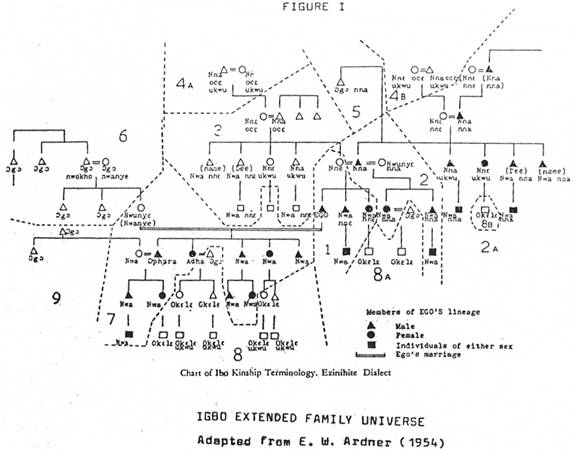
Ideally, Igbo extended family universe consists of three ascendant and three
descendant generations from EGO. Very few Igbo live long enough to be
personally acquainted with members of all these three categories, but as corporate
groups, they exist and can be activated when such important events as
title-taking, the burial of elders or other major life crises occur. In a
patrilineal system, the durability of the ties with EGO's father's lineage is
easy, EGO being a member; that of mother's and mother's patrikin is less
difficult than that of father's and father's patrikin because the functional
linkages with the former have greater emotional content than the latter. The
durability of kin ties is reversed for EGO in a double descent system.
Each generation of the extended family can be grouped into a number of clusters
or categories.
Cluster I: This consists of EGO, the parents, siblings and children.
Cluster II: It consists of EGO’s father's wife or wives, their children and
children's children.
Cluster III: This is located in the ascendant generation and consists of EGO's
mother's siblings, their children who belong to EGO’s generation and EGO's
mother‘s and father’s father.
Cluster IV: This consists of a category of relations with whom EGO might not
have much contact with. But a successful Igbo is "found" by his
remote relatives. This category of relations consists of EGO’s father's wives
mothers and fathers as well as EGO's mother’s, mother's father and mother.
Cluster V: This consists of the in-law group of relations for whom Ogo is a
reciprocal term of address, no matter the generation. EGO's daughters create
this relationship, which is further strengthened by EGO's grand children who in
the status of Okene or Okene ukwu, depending on the generation, are treated
with privileged consideration and indulgence.
In summary, we may picture the Igbo extended family as an onion with many
layers. Igbo individuals peel as many layers of the bulb as their social status
since kinship is a reciprocal relationship, individual tends to reactivate
dormant relations.
Social Structure: Concrete Reality or Body of Rules? We have presented ezi
n'ulo as a concrete reality from which structural rules can be inferred. In
social anthropology, the meaning of social structure is still debated. In the
development of social structure as a technical concept, the effort is in many
ways linked with Radcliffe-Brown (1959:190-91), who used social structure to
"denote the network of actually existing relations". As to the
content of social structure, he emphasized two elements, dyadic relations and
social differentiation as critical. The dyadic relations would refer to what
Levi-Strauss described as "elementary structures", such as father-child
or mother's brother and sister's son relationship. Social differentiation or
stratification refers to the social roles attributed to individuals and classes
or social categories.
Radcliffe-Brown did not resolve all our conceptual problems, still various
writers on social structure start off by paying him an intellectual obeisance.
Nadel's treatise on the subject is a case in point. It is based on the
assertion that "...in anthropology, the very concept of social structure
is still in a sense on trial". He found the prevailing definitions of
social structure by Radcliffe-Brown, Fortes, Eggan, Evans-Pritchard, Leach,
Levi-Strauss, and others rather unsatisfactory (Nadel, 1956:2, 5). He defines
social structure as "...the pattern or network of relationships obtaining
between actors in their capacity of playing roles relative to one another"
(Nadel, 1956:12). He takes issue with both Levi-Strauss and Leach for viewing
social structure as a "model" that has no empirical reality. His
statement on this could not be more forthright:
I am not prepared to dismiss empirical reality so completely from the
positional picture we call social structure. I consider social structure to be
still the social reality itself or an aspect of it, not the logic behind it
(Nadel, 1956:150).
Levi-Strauss's contribution to our expanding concept of social structure is
widely acclaimed. I call attention to the distinction he made between social
structure and social relations, two terms that were often fused and confused.
He sees social relations as consisting of “…the raw materials out of which the
models making up the social structure are built, while social structure can, by
no means, be reduced to the ensemble of the social relations to be described in
a given society” (Levi Strauss, 1967:271). His view that "every culture
has its own theoreticians whose models of social structure deserve the same
attention as that which the anthropologist gives to his colleague" will
command the respect of Igbo elders (Levi Strauss, 1967:274). In Levi-Strauss's
view, structure is a systemic property and social structure refers solely to
those aspects of the social system chat have demonstrably systemic properties.
He posits the following as the four elements of a structural model:
(a) a structure is made up of several elements, none of which can undergo a
change without affecting changes in all the elements.
(b) it should be possible to subject a model to a series of transformations
(both synchronic and diachronic) without changing its fundamental character.
(c) the properties (of a system and transformation) make it possible to predict
how the model will react if one or more of its elements are submitted to
certain modifications.
(d) the model should be so constituted that it makes all the observed facts
immediately intelligible (Levi Strauss, 1967:271).
Raymond Firth had also been helpful. He argued that the use of social
organization as synonym for social structure, a practice too common in
ethnography of his day, is most unacceptable. He points out:
The more one thinks of the structure of a society in abstract terms, as of
group relations or of ideal patterns, the more necessary it is to think
separately of social organization in terms of concrete activity...social
organization implies some degree of unification, a putting together of diverse
elements into common relation…people getting things done by planned action
(Firth, 1963:35-36).
Each of the subsystems of Igbo society, such as kinship the polity, the
economy, religion, warfare, law and medicine has its appropriate organization.
A social organization means more than a collective action drawing from
organization theory, Firth identifies four important elements or principles
involved in social organization: the coordination of individual efforts, a
matter that calls for leadership, foresight, which calls attention to planning
and prudent management of available resources; responsibility which has two
elements, assumption of responsibility by the ultimate decision-maker and an
assignment of responsibility among those individuals who help to realize the
organizational goals; and a reward system that may take various forms (Firth,
1963:75-78).
If conceptual clarification and rigour in the terms needed for the analysis of
social structure are among our intellectual debts to Radcliffe-Brown,
Levi-Strauss and Firth, we must turn to M.G. Smith for a theory of social
structure which seems to do justice to the complex social system in Igboland.
Defining Characteristics of Igbo Social Organization: Iqbo society is complex
and as far as current scholarship stows, this social complexity is not a recent
development Students who approached Igbo society from the perspective of its
decentralized political structure had tended to misrepresent Igbo social system
and had actually denied its complexity. In a provocative essay, "The
Comparative Study of Complex Societies", M.G. Smith (1975) suggests a list
of twelve characteristics which, in his opinion, are common to complex
societies. The Igbo society ranks high when scored on this measure, and
depending on the frame of reference, some Igbo communities rank higher on this
measure than others. Of the list of complexity suggested by Smith, only the
criterion of "some traditions of literacy" was lacking, if we exclude
Nsibidi and the Okonko signs (akara ala) as symbols of literacy. In Smith's
(1975:249) view, a complex society tends to have or incorporate:
1. Sufficient levels of structural differentiation. All the Igbo communities
"ensure differences in the distribution of differentiated roles"
among their adult men and women on the one hand and between them and children,
on the other hand.
2. Some nucleated settlements with relatively large and heterogeneous
populations. Studies of riverine city states of Abo, Oguta, Osomari and
3. The institutionalization of production for exchange. Igbo traditional
economies, based on cultivation and fishing, incorporated specialist craftsmen
and women who formed trade guilds in some communities. The principle of
reciprocity dominated the domestic and kinship spheres of the economy; that of
redistribution characterized extra domestic relations and particularly
relationship with the political structures; and the exchange principle was
characteristic of the extra-territorial market places, fairs, and other market
institutions. The overall objectives of the Igbo "prestige economy"
is to convert tangible, productive assets into intangible, status, and prestige
symbols (Uchendu, 1965:92-3),
4. Forms and degrees of social stratification that differentiate the
life-chance of individuals and social categories within the society. It is our
argument that the Igbo "conscious" model for their social
stratification has led some scholars into the mistaken belief that Igbo social
structure is homogeneous. The status distinctions that the Igbo make between
Diala or Amadi and Ohu (oru) and within the Diala category, the differentiation
between Nze (Eze), and Oke Okporo, are not empty terminological distinctions
but rather stratification terms that differentiate significant life chances of
individuals and social groups
5. Differential distribution of opportunities for spatial and social mobility.
The Igbo are best described in the words of LeVine (1966:3) as "pragmatic
frontiersmen with a persistent history of migration, settlement and
resettlement of new lands". Prof. Adiele Afigbo (198i) gives us
tantalizing glimpses of this phenomenon in his Ropes of Sand. This distribution
of Igbo in all parts of
6. Relatively clear separation of the private and public domains of social
life. The corporate character of Igbo social system makes a clear distinction
between the familial or private domain and the collective or public domain.
Leaders are made accountable for public property which they hold as a sacred
trust. Igbo lineage members make a distinction between interests that are
personal, sub-lineal or familial and interests of the whole lineage. These
distinctions are further symbolized by the types of ofo held. The family ofo
and the lineage ofo, to which, in some communities, specific farm Hands are
attached, institutionalize the difference between private and public affairs.
The current trend in our political life where some leaders convert public
property into personal property is not an Igbo heritage.
7. The allocation of an increasing number of public roles on criteria other
than sex and age. Igbo society stresses achievement -- both individual and
group achievement -- and in constructing their social institutions, they try to
maintain a delicate balance between the need to retain the wisdom of the elders
and the demand for technical and professional knowledge of energetic and
enterprising young men so as to achieve efficiency and economy in public
administration. The greatest failure of Igbo stratification system is the few
opportunities it offers to women before they attain menopause.
8. A significant number of impersonal and instrumental forms of social
relations Igbo society possesses and applies, in varying degrees, among its
public, complex and universalistic bases of social order. Some of these are
personal and others impersonal, and still the most successful were
institutional. Simon Ottenberg (1958:295-317) shows in a comparative analysis
of Igbo oracles how the Ibini Okpabe of Aro Chukwu, Agbala of Awka, Igwe-ka Ala
of Umuneoha, Amadioha Ozuzu of Ikwerre, each in its sphere of suzerainty,
combined to provide pan Igbo contacts and political protection.
9. Significant areas of social relations and activities formally open to
individual choice and initiative. Practically, most areas of Igbo social life
were open to those who enjoyed the Diala or Amadi status. But the most
important single failure in Igbo social structure was the osu system, a form of
ritual slavery that is sometimes wrongly described as a caste system.
Traditionally, the osu belonged to a special, low status group and played only
a restricted ritual role for the dominant group. Social discrimination against
the osu was almost total and contradicted the princip1es of equality on which
Igbo culture was constructed.
10. Diversity in the forms and units of social grouping. Great civilizations
accommodate contradictions. Igbo society is well known for the diversity of its
social arrangements and groupings. It compensated for its organizational
diversity by utilizing a limited budget of structural principles for their
articulation and integration.
11. An increasing number of alternative forms of secondary groups in which
communications are mediated through some intervening link or set of links. Igba
Ndu (literally means joining lives together) is an institution that creates
"blood brotherhood" among the Igbo and is designed to "build
trust" among enemy lines, and establish secondary group communications and
social links in Igbo society.
Igbo Society as a Corporation: The corporate descent group is one concrete
structural arrangement that is characteristic of all Igbo Communities,
irrespective of their other organizational forms and levels of complexity. Of
the four varieties of descent system known to anthropology, two have been
reported in Igbo society: the patrilineal and the double descent systems. It is
the corporate character rather than the linearity of these descent groups that
must be emphasized in a comparative sociology of Igbo descent system. The
corporate descent structures, irrespective of their directional emphasis, contain
micro-structures. They also aggregate themselves into larger structural forms
that may be identified as intermediate structures and macro-structures. By
micro-structures we mean primary group relations such as families, peer groups,
work-groups and various interpersonal dyads. The intermediate structures
include neighborhoods and social categories like age sets, title associations,
etc. Macro-structures represent the widest units of collective action and they
constitute the polity. By invoking an accepted charter, macro-structures can
and do lay claims to the widest use of resources and regulatory powers. They
also give assurance of continuity as micro-structures and intermediate
structures are more subject to fission and fusion than macro structures.
Following Henry Maine (1905) we call these structures corporations.
Corporations are boundary maintaining units, "perjuring units", which
regulate interactions and activities in Igbo communities. They provide the Igbo
with a framework for formal organizations.
Corporations are names groups. They are capable of taking group action, which
implies an acceptance of group responsibility. They presume or assume
indefinite life, have precise rules of recruiting membership, and maintain
social boundaries. Corporations of either type -- Corporations Aggregate and
Corporations Sole -- integrate and articulate a complex of differentiated
roles. Because of their organizational autonomy, corporations are relatively
free in prescribing distinctive forms of social and economic relations that
govern in-group and out-group behavior among their members. "Most
emphasize some set of functions or interests as primary, though few pursue
these exclusively. All exploit some collective resources or privileges and rely
on collective criteria for the recruitment of members, while most possess
directorates to administer their affairs by procedures regarded as effective
and appropriate" (Smith, 1975:248).
Smith (1975) has advanced our thinking on corporations in three ways. His
notion of society as corporations furthers our understanding of social
structure in a way that few other theoretical models have done. He has
elaborated on the conceptual distinctions made by
The mode of achieving membership in the corporations may be universalistic,
consociational, or differential. Lineage membership is categorical. As the individual
lineage member expands his interactions from the micro-structural unit to the
mico-structural level, he correspondingly assumes multiple membership in units
of varying scope, type and levels. As he acquires wealth and begins to convert
it into respected status symbols that confer prestige, his membership in
corporate categories, colleges, and commission is accepted. In this sense, most
Igbo villagers enjoy consociational mode of incorporation; and members of a
village group, city-state, or kingdom enjoy universalistic mode of
incorporation. On the other hand, the osu and ohu by reason of their
categorical statuses, are differentially incorporated. They are in Igbo society
but not of it. Nzimiro found differential incorporation a major principle of
political organization in the state of Osomari. He writes, "The
three…dominant migrant (ruling groups in Osomari) each...has incorporated two
other groups, namely an autochthonous and a servile group...the three servile
ebo are responsible for the internal government of their respective ebo but
have no political representation outside it at the divisional or state levels
(Nzimiro, 1972 113-14, 78). The segmentary model which Nzimiro employed in his
analysis leads him to interpret this differential incorporation as a fact of
segmentarism. Our theory of corporations suggests it is a structural fact of
domination. When domination in a traditional macro-structure occurs in the
context of a new corporation, the traditional structure tends to accommodate
new servile members through differential incorporation.
The Institutional Patterns in Igbo Society: We started with a view of social
structure as a model for understanding social relationships. Since we cannot
directly observe social structure, the pattern of Igbo society must be sought
in its social interaction, in its concrete spatial dimension. The locus is ezi
na ulo.
Studies of Igbo social structure remain rather uneven, although statements on
aspects of Igbo social structure abound (DeLancey, 1967, 1972). Igbo political
culture and structure has received most attention. The pioneer efforts by Meek
(1937), has been followed by Nzimiro (1972), Henderson (1972), Afigbo (1972)
and Ottenberg (1971). Important monographs on aspects of Igbo social
organization include the ethnography of Umueke by Green (1964), Afikpo by
Ottenberg (1968), of Igbo-Igala Borderland by
With available ethnographic data, we are able to delineate Igbo pattern of
social organization as well as the structural principles that govern them.
Forde and Jones (1950) pioneered this effort. They divided Igbo society into
the following five "cultural" provinces or divisions: Northern or
Onitsha Igbo, Southern or Owerri Igbo, Western Igbo, Eastern or Cross River
Igbo, and North Eastern Igbo. Their approach was to isolate diagnostic cultural
traits for the major sub-divisions in each "cultural" province. The
weakness of this method, as is the culture area hypothesis that inspired the
approach, is that we are never certain what traits or combination of traits
determine the boundaries of the cultural province. For instance, in the
Northern Igbo cultural province, which includes the subdivisions of Nri-Awka,
Elugu and
If the Northern Igbo cultural groups are known for their kings and an elaborate
hierarchy of ozo system, it is the importance of the okonko institution that
distinguishes the Southern Igbo from them. Each of the four cultural divisions
in Southern Igbo has its distinct cultural trait: the Oratta are known for
their Mbari houses; the Ngwa for their double-climbing ropes. Here again, the
negative traits raise questions about the cultural unity of the divisions.
Isu-ikwu-ato is unusual in not having the ofo system, a universal symbol of
ritual and political authority in the area. Although the osu system is highly
institutionalized in the culture area, its reported absence in many
Ohuhu-Ngwa-Umuahia areas shows the linkage between the institution of the
powerful oracles in southern Igboland and the institution of the osu system.
In political structure the Western Igbo have a mixed tradition of Obiship and
Okpara uku or Di-Okpa, the former distinctive of the
Among the Ada and Abam land rights pass matrilineally…these groups are
generally distinguished by the importance attached to head-hunting…by 'secret
societies' of the Cross River type (e g. Okonko)…Ritual staves of lineage
headship (ofo), Ikenga and other typical Ibo religious deities and symbols are
absent. Cult slaves osu are absent…
It is not clear why the Aro, who are strongly patrilineal, are grouped together
with the matrilineally dominant
The North-Eastern Igbo (Ogu uku) are a most heterogeneous group. Forde and
Jones (1950:57) isolated eight village groups and five "tribal" units
in this culture area. A region known for its large yam-heaps and unusually
large circular blade hoes (hence the name Ogu uku), the North-Eastern Igbo
region has been characterized as "...singularly free from the fear of
witchcraft. The 'horse title'…is found as a sole title among them other than
the
This brief survey shows that the distribution of cultural traits in Igbo
society does not tell us very much about the pattern of social structure. For a
full understanding of our problem, we must not ignore the way the individual
Igbo thinks of his society and its structural arrangements.
Models of Igbo Social Structure: In the analysis of social structure,
contemporary anthropology is integrating the "analytical model" or
"outsider's" point of view with the "folk model" or the
"insider's" point of view -- the view of the culture-bearer.
Borrowing from linguistic theory, the two points of view have been termed the
etic and the emic orientations. Etic, from phonetic, signifies a scientific
statement or principle that can be verified by any trained observer. An emic
point of view, on the other hand, is one from within a particular culture --
the view of an insider developed from the conceptual categories of his culture.
Both the etic and the emic orientations must be regarded as complementary
rather than in opposition. What are the Igbo emic orientations of their social
structure?
The Emic Model of Igbo Social Structure: The traditional Igbo social structure
is a status structure rather than a class structure. Ours is still a "culture
that permits a child who washes his hands clean to dine with his elders".
Viewed from the emic perspective, Igbo social structure is rooted in a common
equalitarian ideology. This ideology is expressed by the corporate groups
through the principle of lineage equality and by individuals through a process
we may term "social conversion", a mechanism by which individuals and
corporate groups transform their wealth into highly valued prestige symbols.
The distribution of social advantage and the differentiation of life styles in
our society are the functions of the individual's willingness to engage in
competitive "social conversion".
The Igbo world is based on an equalitarian principle. Equality or near equality
among lineages was a structural obstacle to the development of an authoritarian
political culture within our various polities. It gives individuals of Diala
status an equal opportunity to achieve political office. It has fostered a
highly competitive society with a political culture that is conciliar and
democratic. This pattern of political culture is principally rooted in the
pattern of kinship and family structure; in the absence of literacy, and in the
principle of social conversion for all status seekers. With all the variations
in content, Igbo kinship rests upon the principle of exogamous unilineal
descent groups. Except in the highly localized "slave communities" in
Nike, exogamy produced a set of affinal ties that inhibited sub-cultural
differentiation among descent groups. A second factor inhibiting rigid
political and cultural stratification was the absence of literacy in the
society. Fallers (1961:108-110) has argued that these two factors had inhibited
social structural differentiation in tropical
The Social Status Model: The most important status distinctions that the Igbo
make are those between Diala/Amadi and non-Diala. There are also categorical
distinctions between the status of free-men and that of bondage. The structural
principle of duality embedded in the Diala-non-Diala distinctions divides Igbo
society into two clearly defined social strata. The non-Diala is generally
socially or ritually subordinate to the Diala. Everywhere in Igboland, the
ritual precedence of the autochthonous groups is recognized. "One of their
special roles is to provide the priest, Eze Ani, the land deity" (Nzimiro,
1972:24). As far as I know, the privilege to offer communal prayers and
sacrifice at Ihu ala belongs to the Diala, often the descendants of the
founding lineage or the first settlers in a multi-lineage corporation.
In spite of its clear status reference, and its pan-Igbo application, the
Diala-non-Diala dichotomy is weak from the etic point of view. Each social
category is in fact highly differentiated. The Igbo recognize and make further
social distinctions among members of each status category depending on their
political, economic, and religious achievements. A paradigm of the Igbo status
structure is presented in Figure II.
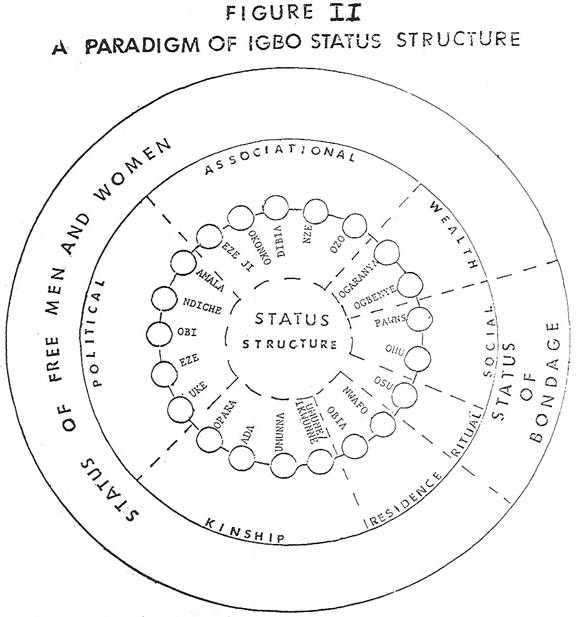
Igbo status structure is dichotomous at one frame of reference and
multi-layered in internal differentiation at the other frame. The dichotomy
lies in the distinction between the Diala or Amadi and the non-Diala
categories. The multi-layered status system falls into seven categories:
kinship, political, associational, wealth and poverty, ritual and residence
statuses.
Diala is a free born, full citizen, who enjoys an ascribed, generalized status
which implies no particular distinction or achievement for the individual
except his capacity to be called upon to enact or initiate important societal
roles, normally ritual in nature. However, Diala status confers a pan Igbo
citizenship in the sense that a Diala in one Igbo corporation is guaranteed the
same status in other corporations. In most communities, the status of Diala is
symbolized by the burial of his naval cord, preferably at the foot of an
economic tree, which for most areas, is the oil palm tree. To be a Diala is to
have the doors of title societies and other associations open to one. While the
Diala status opens the door to social climbing, one's place in the
stratification system depends on economic success and willingness to engage in
"social conversion".
Non-Diala status is reserved for the oppressed and dominated groups in Igbo
society. The generic term, Ohu (oru), applied to this group, is also misleading
sociologically unless it is further differentiated. Ohu is a slave. As the Igbo
conceived the status, a slave is a person whose links with his own corporation
has been severed forever. Slaves had some rights, and their treatment varied in
many Igbo communities "Not infrequently, a slave became the companion of
his master and was put in a position demanding great trustworthiness"
(Basden, 1921:109). In most communities, slaves were generally absorbed into
the lineage of their masters, and with this incorporation, it became tasteless
to mention the fact of their origin among people who had no right to know
(Uchendu, 1977).
Pawns are distinguished from slaves: In the fine status distinctions that the
Igbo make between the two, "slaves and pawns are referred to by a generic
term, Ohu, but pawns are often terminologically distinguished from ohu by a
descriptive term – nvu nvu aku (collateral for wealth)". Pawns enjoyed
special privileges and legal protection that slaves never had. They could not
be re-pawned by a creditor master; their natural death did not terminate the
debt obligations by their family; and since the pawn-master relationship was
contractual, the pawn was usually allowed a number of days in the week to
practise his own crafts or to hire out his labour to any employer, including
his master.
The system of ritual slavery practiced by many central and riverain Igbo
communities has been a subject of comments in both literary and academic
journals. Osu is a cult-slave tied to the service of the dedicator's deity. The
descendants of such a cult slave were also osu. The osu system was legally
abolished by the Eastern Nigerian Government in 1956. In a few communities, the
status of osu is ranked with that of ume (those who wither away), a social
category that is also considered ritually polluted, and on which we have
practically no ethnographic documentation. Osu and ume should have no place in
any civilization.
The
Seniority by birth order in the lineage is the normal basis for Opara and
Our discussion seems to have ignored women. In the kinship domain, distinction
is made between two categories of women: umu okpu, lineage women who may be
married, unmarried, divorced or widowed and ndom or ndinyom, or okporo alu alu,
who belongs to the lineage by marriage. In most communities, first wife ranks
highest no matter her age or other social disabilities. In the public domain,
the sex-linked roles. which clearly foster sex segregation, have a leveling
effect of leaving women and men to manage their own affairs. Although practices
vary, Igbo women have the freedom and the opportunity to engage in trade on
their own account. Wealthy Igbo women, in their role as "social
father", traditionally contracted a legal marriage with other women and
enjoyed all the rights and privileges of husband, except the role of a genitor.
The institution of gynaegamy, a term I coined for woman marriage (Uchendu,
1968), enables wealthy women to convert their wealth into one of the most
prestigious rights of Igbo society, the exercise of rights in the reproductive
powers of women. Those who confuse sex with marriage, no doubt protest this
institution. But marriage is not co-terminous with sex. While marriage is
associated with sex, and in fact, formally gives husband and wife mutual sexual
access, which cultures may define as exclusive or not, many societies still fall
short of this ideal.
The conversion Principle: We have so far considered the major ascribed
statuses. The Igbo are also known for their achieved status, a point emphasized
by all students of this society. In a very enterprising theory of social
structure and personality that combines historical, sociological and
psychological factors into one frame in an effort to uncover the determinants
of achievement motivation in
...among the Ibo, the acquisition of wealth led to political power. Thus,
status mobility was achieved... through the demonstration of economic skills of
an entrepreneurial sort. The ideal successful...Ibo appears to have been the
energetic and industrious farmer or trader who aggrandized himself personally
through productive or distributive activity (LeVine, 1966:33-37).
LeVine's occupational orientation hypothesis has support in Igbo ethnography. I
contend, however, that to understand the dynamics of the "associational
status" system in Igbo society, we have to apply the notion of
"social conversion", that is, how wealth is transformed in society.
The process by which the individual Igbo transforms his material wealth into
highly desired intangible symbols is what we call social conversion. The Igbo
lay a great emphasis on wealth in their stratification model. They distinguish
between Ogbenye or mbi (the poor), from aka ji aku (hand that command wealth)
or uba (the wealthy). The Igbo make clear status distinctions between wealth
(aku). They treat wealth and prestige as two different variables. For instance,
a person impoverished by costly title-taking may have no wealth but still
commands high prestige. The conversion process is at the heart of Igbo title
system which is the concrete structure or institution which mediates the social
conversion process. The conversion principle is applied to every occupation
that the Igbo could think of. It is a unidirectional process, never reversible.
A successful occupation leads to the acquisition of wealth which generates
pressure to convert it into prestigious symbols. While the occupations and
prestige institutions do vary among Igbo communities, the principle of
conversion is invariant.
Wealth is a social product. It is not an end in itself. Rather, it is viewed in
Igbo society as a means of achieving prestige; and prestige is the reward which
society bestows on those social climbers who use their wealth in ways approved
and most esteemed by their neighbors and communities. The object of wealth is
to further achievement both personal and communal. Traditionally, wealth was
not used for things that would not effect a positive change in status.
REGIONAL VARIATIONS IN IGBO SOCIAL STRUCTURE
Our review of Igbo social structure demonstrates its complexity, both in form
and content (Uchendu, 1991: 27-47). Variations in Igbo social structure can be
explained situational factors; and such variations are practically limited to
the kinship domain. We have noted that the attempt by Forde and Jones (1950) to
contour these variations by pointing out critical cultural traits was not
convincing. In a recent statement on the subject, I suggested that kinship is
the key diagnostic cultural trait to the variations in Igbo social structure
and isolated the rules of exogamy, endogamy and incest as critical variables.
The application of these variables revealed that a distinction must be made
between the Ikwu and the Umunna belts of kinship systems (Uchendu, 1994).
Two Kinship Belts: Umunna is a common term used in both belts but it is given a
different content in each. Both Umunna and Ikwu kinship belts share some
marriage features. Post-marital residence is patrilocal in both belts and the
kinship structure is differentially corporate. Marriage is legitimized by
bridewealth payment which is comparatively a token in Ikwu but high in the
Umunna belt
The Umunna kinship belt coincides with the strictly patrilineal areas of
Igboland, which is the whole Igbo territory less the eastern portion of the mid
The Ikwu kinship belt lies in the mid
The most important and therefore unique kinship feature of this belt is the
double descent system. In this kinship a person enjoys concurrent matrilineal
and patrilineal descent, his or her affiliation is unambiguously matrilineal
but movable and immovable personal property, some lineage lands, palm groves
and fish ponds are subject to partition between the matrilineal and patrilineal
groups. As can be predicted from the kinship structure, widow inheritance is
either absent or unimportant, the child bearing capacities of women are not
transferred at marriage, because they belong to their descent group and while
the socialization of the child is the formal responsibility of the
patrilineage, this may also be shared.
The patrilineage and the matrilineage are both corporate in character but while
residence in the matrilineage is highly decentralized, the patrilineage is
residentially concentrated in various villages. The lines of cleavages are
drawn by marriage and activated by death and other crises which draw interest
in sharp focus. Property rights, including the rights in women, are highly
focused on the matrilineage and the administration of these rights is in the
hands of the male descendants even though that women provide the seeds of
lineage continuity through children fathered and socialized by husbands who
come from different descent groups.
The kinship and marriage traditions of the Ikwu belt were identified by Darly
Forde in 1930s for the Yakurr of the
Features of the Double Descent System: Parenthood is a duality. If recognition
of descent were symmetrically accorded through both parents at each generation,
kinship ties would so "proliferate indefinitely in ever widening
aggregates" that we would need a computer to work it out. Human cultures
have tended to simplify this problem by adopting a limited number of principles
in the classification of their descent. These principles yield four varieties
of descent systems: bilateral, patrilineal, matrilineal and double descent. The
patrilineal descent system is far too common and so dominant that is
characteristics are not easily confused with those of other descent systems.
This is not so with the double descent system which combines both the features
of the matrilineal and patrilineal descent systems and vary its corporate
character so widely that its identification and classification have posed some
theoretical problems (Goody, 1961).
The patrilineal and matrilineal kinship systems have highly focused marriage
types and characteristics. David Schneider and Kathleen Gough (1962), in their
synopic survey, Matrilineal Kinship, suggest a set of "minimum conditions
or constants" which distinguish matriliny from other kinship types. The
constants are:
(a) affiliation is with the matrilineal descent unit.
(b) descent group exogamy is imperative.
(c) each child is the responsibility of a specified woman; and women in the
descent unit have the duty to promote and protect the reproductive capacities
of all women in the unit no matter their residence.
(d) men are in authority over women and children, no matter the descent system.
The Schneider-Gough analysis simply re-states and affirms the facts
characteristic of marriages in matrilineal systems, that is, the husband is to
exercise the rights in genetricem but the rights in personam are limited
because they are partitioned rights. The rights in a woman's reproductive
capacities are owned by her lineage, policed by her sisters but the fruits of
her womb descend not to the pater (physiological or social father), but to the
woman's lineage. The husband has a right of sexual access but the exercise of
this right may not be exclusive. The only exclusive right to the husband on
both sides of the middle
Descent poses a different theoretical problem where the father's role is more
important than the strength of the lineage in matters relating to women married
to their members. This is one of the unique features of the double descent
system which defines a kinship situation in which a person belongs to a pair of
unilineal groups, one based on the patrilineal, the other on the matrilineal,
mode of reckoning. This type of kinship embodies two corporate descent groups,
patrilineal and matrilineal, accompanied by "double inheritance" in
which a person inherits property both from patrilineal and matrilineal descent
groups simultaneously. Double descent groups in Igboland are property-holding
corporations and they are concentrated in the region we defined as the Ikwu
marriage belt. Forde and Jones (1950:52) list
Igbo Marriage Types: One important function of descent in corporate lineage
systems is to act as the guardian of the family estate. This is precisely what
it does in Igbo culture in which married life is the normal condition for both
men and women, and polygyny, the ideal.
Igbo marriage types are strongly linked to their kinship structures. The marriage
types that are structurally compatible with the patrilineal system and
therefore unique to the Umunna marriage belt include the Mmaji-Njoku marriage,
woman marriage, widow inheritance and wife exchange marriages. These marriages
reflect the high degree of incorporation achieved by wives into the lineage of
their husbands resulting from the acquisition at marriage of the reproductive
capacities of wives by husbands. On the other hand, certain marriage types are
unique to the Ikwu marriage belt, and they are marriage that are clearly taboo
in the patrilineal system. Nsugbe (1974:81) lists four such preferred
marriage-forms in the Ikwu marriage belt to include two varieties each of nwa
nna di and nwa nne di marriages.
(a) Nwa nna di marriage forms:
(i) FSD marriage: Ego marries the daughter of his male half-sibling, that is,
Ego’s wife is a close patrikin, the grand-daughter of Ego's own father.
(ii) FBD marriage: Ego marries the daughter of his father's male half-sibling,
the same woman whom Ego's father could marry.
(b) Nwa nne di marriage forms:
(i) FZD marriage: Ego marries the daughter of his father's female half-sibling,
in a situation where Ego's father and Ecro's father's half-sister are of the
same mother but of different fathers.
(ii) MBD marriage: Ego marries his mother's brother's daughter because both
husband and wife do not belong to the same matrilineage.
In the Umunna marriage belt, FSD, FBD, FZD and MBD marriages, would be an
abomination because they break the rule of patrilineage exogamy. However, in
the Ikwu marriage belt, the rules are reversed, the emphasis being on
matrilineage exogamy. "Whereas Ego cannot marry mother's sister's daughter
because both belong to the same matrilineage, he can marry mother's brother's
daughter because both husband and wife do not belong to the same
matrilineage" (Nsugbe, 1974:81).
"Woman marriage", for which I coined the term "gynaegamy",
is widely reported in
Gynaegamy gives us an important insight into gender issues in marriage. It is
an institution that is grossly misunderstood by our elite in the name of our
imported religions. Once the rights in marriage can be analytically
distinguished, the confusion as to which gender should do the
"marrying", be the husband, for instance, and whether marriage is
coterminous with sex or not, becomes irrelevant. In a gynaegamous marriage the
seed raiser or genitor is different from the genetrix and the social father.
The Judaeo-Christian tradition of marriage treats all the rights in a woman as
a "bundle of rights” and transfers them to the husband as an inseparable
bundle. Other civilizations don't. Before science advanced to the stage that
yielded test-tube babies and gave us surrogate mothers, Igbo civilization had
made it possible for wealthy and respectable Igbo women to play a husband role,
not as a legal fiction but as social and legal reality.
Widow inheritance is another marriage type that grows out of the logic of the
retention by the husband's lineage of the reproductive capacity of the wife. It
is a marriage type that is structurally inconsistent with the double descent or
matrilineal system. In either kinship system, a woman's reproductive capacities
are not transferred at marriage but retained by her descent unit.
Wife exchange has been reported for the Umunna marriage belt by Meek (1937:265)
and Uchendu (1965:51). It is based on the principle of strong patriliny and for
the reasons that explain other marriage types unique to the Umunna marriage
belt.
AHIAJOKU IN IGBO SOCIAL STRUCTURE
Whenever we touch upon sensitive institutions – and some think that Ahiajoku is
one such primitive deity that should be consigned to the museum of history – we
tend to strike a cord with many echoes. In fact, more often than not, what we
strike is not a chord but a discord, not a harmony but a disharmony because the
Ahiajoku deity appears to be a bundle of contradictions in its roles. It gives
prosperity and protection to yams, our most important prestige crop; eze ji, an
important title guild, functions in its name as it sets the annual farm
calendar; and Ahiajoku created and set the rules for the Mmaji and Njoku
marriage, the only prescriptive marriage in Igbo culture.
Ahiajoku is impossible to conceive outside the context of the yam crop. The yam
belt of the world stretches through the equatorial tropics with the edible yam
clustered around four distinct centres of origin: the Indo-Chinese peninsula;
The Yam Title: The Ezeji (yam title) tradition is widely shared in Igboland. It
is highly elaborated within what might be described as the "nuclear"
Igboland from which the title system diffused to other parts of our culture
area; and in this century, it was adopted across the
To be initiated into the yam title, the aspirant requires a long period of
indoctrination, re socialization and motivation by the lineage elders. The
aspirant would not only work hard on the farm, but needed the labour of a large
network of relatives, with his extended family showing leadership, dedication
and devotion. In the tradition of the Old Bende Division, which includes
Ngwaland, Ubakala, Umuopara, Ibeku, Ikwuano and other communities in Bende
area, an aspirant must exhibit in his barn at least one hundred stakes of the
"approved" yam type (ji efu) (this excludes all yams harvested more
than once in their growing cycle). The first group of people to
"inspect" the yams would be the elders of his extended family who had
taken the "first step" in the initiation process to the yam title. If
they are satisfied with the quantity and quality of the yams and are encouraged
by the number of collateral yams which are not in the prescribed list, the
elders would summon their "worthy" son to take the "first
step".
The "first step" in the initiation into eze ji guild was a purely
religious affair. It involved the dedication of a goat (eghu Ahiajoku) to the
yam deity who would be prayed to make the aspirant's efforts on the farm more
prosperous. For a large number of Igbo aspirants, the dedication of eghu Njoku
might be their first and last step to the coveted eze-jiship. They end up in a
status of liminality. For the more successful aspirants, their yam crops and
eghu Ahiajoku would show tremendous increases as they cultivated and
re-activated their potentially large and diverse groups of the extended family
networks who would add pageantry to a future ime ihe ji (yam title taking)
ceremonies.
Ime ihe ji could take off with a single title of Ihu iri or a double title of
Nnu. An aspirant who exhibited two hundred stakes of "approved” yams would
be awarded Ihu iri title; and he could qualify for a double Ihu iri title by
exhibiting two hundred stakes of ji efu and two hundred stakes of a pu ji (i.e
crested yam yam harvested more than once). The Nnu title was about the terminal
point of the yam title. Igbo status climbers who claimed a double Nnu title,
that is four hundred stakes of ji efu and four hundred stakes of apu ji, would
not be many in any community. I am not describing our modern Igbo society where
"suit-case" farmers, without farms, wives or extended family support
could depend on the market to provide yams for their yam titles.
The yam title creates for its holders an opportunity to be involved in an
exclusive but prescriptive hypergamic connubium popularly called Mmaji Njoku
marriage. It is a high status marriage restricted to the children of those who
had taken the yam title. Mmaji and Njokuji are carefully identified by diviners
at birth. Because of the serious extended family obligations they impose, no
parent would take the opinion of one diviner as final; second and third
opinions might be sought, with members of the extended family involved.
Mmaji, literally means the "yam’s knife", the knife that cuts .yams
into pieces. She is sociologically an uncommon child and a rare bride. She must
be the first wife of her husband, who must be of Njoku status by prescription.
If there is an Njokuji in the core extended family, he is formally allocated
the bridewealth from the "family," Mmaji, irrespective of the fact
that they might be of different fathers and mothers. The logic of Igbo
worldview assigns Njokuji and Mmaji ambiguous ritual statuses. Njokuji, a male
servitor of the yam deity, must assume a female role when mourning the death of
his father and dedicator. In that role, he must join his late father's wives in
the mourning room and eat with his left hand during the mourning period. To assume
these assigned roles, he would literally keep the yam barn under interdiction
until all his demands were met. Njokuji and Mmaji do not ordinarily make any
extraordinary demands on the extended family or society while alive; and as
individuals, they have no distinguishing marks that separate them from other
individuals. Paradoxically, they constitute a cultural threat at their
dedicator's death or at their own death. Their remains must be ritually
disposed of as prescribed by tradition when they die. Tradition prescribes and
cultural practices reaffirm that the skull of Njokuji and Mmaji must be
protected from rain and sunshine and rest on a pedestal in a house, as long as
the extended family lasted. Although there is no sacrifice made to the skulls of
Njokuji and Mmaji, they still impose a long-term responsibility on society.
Religious change, operating under a radically different logic and worldview,
has turned the responsibility imposed by Njokuji and Mmaji into an incompatible
and therefore totally unacceptable burden. The extended family ofo and Njokuji
and Mmaji are alike in one respect. They reaffirm the continuity of the
extended family. While the extended family ofo is highly decentralized, the
Njokuji and Mmaji are the products of chance, achieved through the yam title,
but selectively endowed, as "family estate". Both still symbolized to
Ndi-Igbo the continuity of culture and civilization.
CIVILIZATION IN IGBO CIVILIZATION
All civilizations are the products of intellectual culture; and they draw
inspiration and support from such a culture. By intellectual culture, I mean
the paradigms for understanding a people's cultural achievements. An
intellectual view of civilization is essentially idea-centered; it is a system
of ideas, a communicable intelligence identified with a given tradition.
Civilization is a symbol which cannot be understood in itself but must be taken
correlatively with what it is mean to convey. It stands for something other
than, or at least more than, what it immediately signifies. For instance,
extended family in Igbo culture is an illustration of a unit of social
organization which stands for more than a group of relatives. It is a concept
which opens the doors of Igbo civilization so that through it, we can truly
understand what it means to be Igbo.
Civilization is more than a symbol or an idea. It is also the ennoblement of
culture which may occur through one focal culture trait at the same time.
According to George Adams (1959:49-61) the idea of civilization demands that we
distinguish between “life as it is lived and life as it is observed".
Civilization is a supreme human achievement and it is constructed with the
"energies and the life of man". Life as lived is life felt from
within. Life as observed is the life of other living creatures. "The
observed and observable is objective and phenomenal, the home of evidence, of
verifiability of fact, the area to which description, prediction and scientific
hypotheses are relevant" (Adams, 1959 50). The observed civilization is
the "many diverse civilizations studied and surveyed by historians".
Most of these are dead. They have finished and completed their careers. They
now live in the museums and come to life through intellectual efforts which
re-enact their activities. When civilization is used as a "class
term" usually in the singular, it is civilization as observed"
usually in the singular, it is "civilization as observed" that is
meant.
Igbo civilization is "civilization as lived". It is a civilization
that is being lived and enacted, a civilization in the making, a civilization
that pursues certain ends, makes certain policies, practices its arts and
sciences and prescribes a morality and imposes a code of conduct. Civilization
as lived denotes the content of human life, its directional processes as well
as the structure, organization and machinery of its social system. Organization
is not a privileged prerogative of human societies, nor of civilization. A
chaotic society, like the one we in Nigeria are working hard to leave to our
children, does not mean lack of organization but rather one with a type of
organization which bars it from incorporating significant ideas and values,
such as equality of opportunity as opposed to equality of result, justice,
freedom and liberty for all.
Civilization is like a totem, ofo, ishi Njoku, ishi Mmaji – all containers and
vehicles of culturally significant values. As long as totemism or Njokuism; or
Mmajism endures, the totem remains a container adequate for its content and its
meaning. The content of which the totem is the bearer is not a "class
idea". It is an ideal. It provides a criterion by which to measure the
adequacy of the meaning which the totem embodies. Once the content of a totem
-- and it is sacred, awesome or numinous -- is disincorporated from the totem,
the search for a new totem, adequate for the meaning, begins all over again.
Under the colonial contact situation, our totems were discredited as bad
containers, no longer suitable for their contents; new meanings crowded out the
old meanings; and all meanings outgrew their visible embodiments (Adams,
1959:61). The challenge, and it is our challenge, is what symbols of
civilization should carry the meanings created by our living civilization.
The transformation of a civilization occurs when its "generative"
ideas and ideals are fundamentally changed. History and ethnology provide some
illustrations. The Greek Sophists and Protagoras gave us the insight that
"man is the measure of all things"; and that man as a creator of
culture, must artistically mould himself and society in conformity with his
beliefs and ideals. The classic Greek and traditional Chinese cultures made
aesthetic configuration a dominant aspect of their civilization.
In
The liberal educational tradition of the Greek cultural aristocracy found its
way to the Romans who transformed it into a universal human ideal, the ideal of
humanitas. The Middle Ages refined it into the “humanities" comprising the
trivium (grammar, rhetoric and logic) and the quadrivium (arithmetic, music,
geometry and astronomy). There have since been further transformations. In the
modern age of science and technology and amusement parks, aesthetic culture is
no longer an integrated pursuit of knowledge; it has ceased to be a total
vision of life or a "testament of beauty". It has become a luxury, an
ornament created to enable a few to escape from the vulgarities of daily life:
Bidney (1960:403) captures the irony of this development:
The major paradox of our contemporary democratic culture is the fact that our
education system is based upon abstract, aristocratic cultural values, whereas,
our social system is organized on democratic lines; and our scientific
technology is geared to material wealth and national power. The incompatibility
of our cultural ideals and practices is demonstrated by the social esteem in
which our educational system is held and the distrust of the educated man in
practical affairs.
If a dominant aesthetic cultural orientation is based on the theme that a
society is good when it is beautiful, a moralistic cultural orientation
subscribes to the view that a society is beautiful when it is organized
according to some dominant idea of the good that fits its "way of
life". The Medieval world provides some illustrations. While the ancient
Greeks cultivated the wise man, the philosopher in quest of rational wisdom;
the medieval world cultivated the saint, the righteous man, dedicated to a life
of ascetic holiness, a man but sometimes and reluctantly a woman, imbued with
faith in divine grace and love. Since life on earth was conceived as a
“pilgrim's progress", the whole process of living became of direct concern
to the
VALUE ORIENTATIONS: ANCHORS TO IGBO CIVILIZATION
The central values of Igbo culture are rooted in the social structure,
particularly in the extended family. Among such values are the importance
attached to mutual dependence; to lineage continuity; to a man as a value; to
life affirmation; and to a strong occupational orientation.
Mutual Dependence is a central value in Igbo culture, an attribute of an
inclusive kinship system inherent in the primary descent group whether
patrilineal or double descent. The other important attribute of this descent
stem is continuity. Every father-son or mother daughter of sister brother
relationship is link in an endless chain of the descent system. Enmeshed in a
network of continuous relationships, the individual is conditioned to orient
himself linearly, and in a secondary way, laterally within a well defined
kinship system. An individual's place in this line of descent is specific and
inalienable. While the obligations are mutual between parent and child, they
are not equal throughout the stages of each generational cycle. The child owes
the parent obedience, which is transformed into filial piety, a ritual
obligation at the death of the parent. The parent owes the child protection.
Succession to property, name and status is a fact of descent principle, not of
the arbitrariness of law or a testamentary will.
In a system where parent-child bond is dominant, the wife in a patrineal
society remains as much a stranger as the husband is in a matrilineal or double
descent system. The primary duty of a wife in a patrilineal society is to
provide members to her husband's lineage, and if she falls in this task, she is
easily dispensable. The same is true of the husband in a matrilineal system.
His primary function is to seed the continuity of his wife’s lineage.
The need for lineal continuity and horizontal solidarity in Igbo kinship system
tends to reduce individual privacy. Children participate in the adult world as
they grow up. Mutual dependence requires that children share the problems of
the adult, to empathize with family history, and to share in its prejudices.
Lineage Continuity: Deriving from the value orientation of mutual dependence is
lineage continuity. The lineage is seen as the building block of a peoplehood.
To maintain the lineage is a preoccupation reflected in the demands made in
prayer: more children and wives and general prosperity to support them are
usual refrains. Since women, as wives and daughters, are the vehicle of lineage
continuity, plural marriages are sanctioned everywhere. Furthermore, the
concept of paternity, which is central to the legitimacy of children, is given
a broad interpretation. A legitimate child is not necessarily fathered by the
social father, rather it is a child who can lay a claim to a social father and
social fatherhood is validated by bridewealth payment. This interpretation of
legitimacy places a premium value on marriage as an institution, particularly
on those processes of the marriage institution which are designed either to
transfer the potential offspring of a woman's womb from her husband or to
retain it in her lineage.
Man as Value: Following from mutual dependence, is the value placed on the
importance of man. Man is valued above things in Igbo society. The society
demanded, and still demands, a large family, a demand that makes polygyny a
desirable goal and the position of ancestors a dignified one. The emphasis on
man as the measure of value is not new in history; but the Igbo give it a
unique value. To live till the ripe age before one joins the ancestors is the
cherished wish everywhere. Unlike Asia which glorifies ascetic life and seeks
to withdraw from the mundane world, or the Western culture which accepts the
Judaeo-Christian worldview of a heaven as the last place for retirement for the
good, the Igba construction of the world is that reincarnation after death and
the need to join the living lineage, make the world of man and the world of the
dead a single universe providing an alternating abode for man.
Life Affirmation is an important Igbo value that supports the centrality of man
in the scheme of things. It does not mean that Igbo do not take their own life.
Suicide is not valued, and where it occurs, it is of a "protest"
type, designed to call attention to one’s social failure in this world. After a
suicide, a ritual remedy lets the living get on with their life.
Occupational Orientation: Central to work attitudes and the values they create,
is the occupational orientation manifest in a particular status system.
Exploring the thesis that certain occupational orientations, mandated by a
status system, provide greater incentives for status mobility than others,
LeVine (1966) calls our attention to the different cultural and value
implications of a "politically oriented" and "occupationally
oriented" status systems. Using the Hausa and the Igbo as illustration, he
observes:
The Hausa status system was politically oriented, where the Igbo one was
occupationnally oriented. Among the Hausa, political office led to wealth,
among the Igbo, the acquisition of wealth led to political power. The status
mobility was achieved in one instance (Hausa) through demonstrating capability
of playing a role in an authoritarian political system, and in the other
instance (Igbo) through the demonstration of economic skills of an
entrepreneurial sort. The ideal successful Hausa man seems, to have been the
office holder who faithfully supported his superior and rewarded his followers;
the Igbo ideal appears to have been the energetic and industrious farmer or
trader who aggrandized himself personally through productive or distributive
activity. By Igbo standards, the Hausa ideal was over dependent and confining
to the individual, by Hausa standards, the Igbo ideal was dangerously selfish
and anarchic (LeVine, 1966:36-37).
CONCLUDING REMARKS
Historians warn us against identifying civilization with any one individual
civilization, implying that civilization is not tied to one specific way of
life. Nor is it tied to one specific approach to understanding or method of
analysis. Abstract structures, like grande ideas, can lead to the explication
of the concrece event, and vice versa. Ezi na ulo which transforms itself into
ezi n'ulo is a concrete form of Igbo social system and it provides insights
into other structures of Igbo social life and the theories and organization of
such life. We can learn much about civilization and civilizations or
achievements of the human race on one hand and the individual achievements of
diverse populations on the other, by exploring at Marchall Sahlins (1983:518)
describes as "other times, her customs" according to "the
otherness of the suctoms". I have attempted to show that the
"otherness" of Igbo customs constitute an important civilization in
its own right and contributes to the pool of human civilization.
What can modern society, including
If man could learn from history
What lessons it might teach us!
But passion and party blind our eyes
And the light which experience gives
Is a lantern on the stern;
Which shines only on the waves behind us.
We live in a politically troubled society where the search for political models
consumes a lot of our scarce national resources and the energies of our rulers.
If we put aside our prejudices and let the "lantern shine" on
problems, we can easily learn four lessons from Igbo political culture, all
rooted in the operations of ezi na ulo. The first lesson is the idea of
politics as the mutual accommodation of differences; the second is the concept
of sovereign power as everybody’s business; the third lesson is the direct
consequence of the second lesson; and it is …rotation of, power and authority
among politically competing units. The fourth, is the primary of public state
and the importance of political discourse among individuals.
The management of diversity is an important challenge in every civilization.
Igbo-type society manages diversity through decentralization of power. It
teaches that the selective management of institutional and social diversity
does not lie in its suppression but rather in accommodating… This can be
achieved through the strategy of exploiting an existing "minimum
consensus" which is expanded" as mutual confidence and trust are
built up during a period of mutually beneficial interaction. The principle of
"expandable minimum" consensus leads to the…of politics as the mutual
accommodation of differences and to the concept of sovereign power as
everybody’s business, just as it is in the ezi na ulo. Following from the
central idea that the exercise of sovereignty is everybody's business, is the
idea that power must be shared. Like the Nigerian polity, Igbo polity was
concerned about political domination, but unlike
Mr. Chairman, this was not planned as a marathon lecture, nor is it a doctoral
thesis, in the mandarin tradition. Permit me, however, to end it the way it
started, with a story. There was an old Chinese sage who told a group of his
student his dream. "Last night", he said, "I dreamed I was a
butterfly flittering from blossom to blossom enjoying the delicious perfumes of
various flowers and sipping from their nectar. Then I woke and found myself a
tired old man". At this stage he paused and surveyed the reactions of his
students. "Now, tell me", he asked them, "Am I an old man who dreamed
he was a butterfly or am I a butterfly who is dreaming that he is an old
man?"
Let me rephrase the question, in the context of this Lecture. Am I an armchair
anthropologist creating civilizational roles for our extended family or is our
civilization giving us new insights into our extended family and other
institutions? Since the format of this Lecture does not permit a dialogue, may
I leave you with the Lecture and its puzzles.
Ochi agha, Oha n'eze!
Kam mii ya mma 'm na ovo.
Oge eruo 'la mgbe onye gburu agu ji afu ahia.
Ji fo ufo,
onu ala afo ufo.
Ikwu n’ibe, ndewo nu!
AGBAJA: for MY MUM
By OBU UDEOZO[MSOffice7],
slaughter kingdom
after our memory
dried
from counting the
perpetual hawk’s
goals against us:
kwashiorkor’s
hotline
to the yawning
soil
we swallowed life
in our bowels
to brave the
death daring lanes…
with the
foresight of camels
we banked
tomorrow
in our stomachs
lambs, limping
unto life’s devouring realms…
the eagle’s
splendour
is clarity in
flight
for a burden of
crumbs;
is supplication
for cheap arrests:
like Edozie’s Dad
who vanished
at the waterfront
into slaughter
kingdom;
severity has
auctioned us
unto the Maginot
Line of blind beggars…
My mum clutched
her breath
her fragility
groaned
a candlelight in
chaos
pain awoke her fresh
stitches
to cure the
community’s
salt, sugar and
stockfish sclerosis
and to evade that
wrestler
who molests
victims before their mothers:
kwashiorkor’s
hotline
to the yawning
soil
my Mother vowed
to kiss the blind spot;
our lone bridge
to salvation and harvest.
Zerubbabels
So we gambled on
towards hot
horizons
She, a
candlelight in chaos
and I,
at ten, a tendril
flavoured for
calamity’s claws;
plumbing the dark
trade route
of futility and
faith
pure Zerubbabels
for the harvest tide:
where bombs
germinate
in hoods of yam
tubers
and the foliage
hosts
death sprinkling
platoons,
or a sniper
coiled
at the ceiling of
an Akpaka tree
whose instant
fortune
nails men,
smouldering on the spot.
and roaring
afternoons,
snatch unwilling
folks
beyond
mortality’s curve
a perfect homage
to the genius of
a sage
and
whose marvellous
blockade
crowned salt
our first Bill
Gates
beyond our
tongues or memory
and made soap and
sausage
the fairy tale of
madmen;
starvation
bewitch our children
with the yuletide
of expiring tones;
and our elders
bargain with
death
in loud
hunger-propelled night songs…
Mozart and his
loyal wife
dancing away the cruel winter…
yet our lone
bridge
for salvation and
harvest
is the bunker
of my Mother’s
love
at every sorrow
station;
the compassion
She lends us,
with the nuclear
power of leopards.
a universe of
wolves
bowlfuls of sweat
calibrated our
rare retreats
and solitary
couriers
after eternities
of stealth steps
barter security
briefs in whispers
like a column of
ants
lacing their
highways with scarce perfume.
and the bereaved
farmlands
conscripted the
bush paths
molding each step
into a combat
as our bodies
punctured the bulrushes
like agu
ngwo
against the deaf
waists of palm trunks
and before
our murmuring
feet
succumbed to
gravity’s claims,
we staggered
after 3 nights upon
the brown
goddess;
Ezu Ebenebe
with her fierce
waters roaring
like a universe
of wolves…
Ezu Ebenebe
over this
bleeding bridge
the
snatched us from
the fire
of acids, razor
blades, koboko, rape
and sunset of the
Hottentots
upon our heels
Ezu Ebenebe
her amputated bridge
is a key hole of
suicidal Passovers
with her
fragment’s head
buried in the skies
and broken feet
in fierce waters
the ascent
for pilgrims
is crawling upon
a skyscraper
with red monsters
yawning at our feet…
- with our chi
alert
we awoke
upon the crown of
the barricade…
and after seven
strides
beyond the bridgehead,
with the voyage’s
halfway house
wrapped in our palms
we surrender
again to rest and rice:
a voyage
of long shadows
where a hair’s
misprint
upon that
barricade
mails victims
into the feast of
fierce waters…
a voyage
of long shadows
-after
such wahala
of ascents and assaults
the Di gbakwa
oku ladies
sold marriage,
manhood and fruits.
Divine Cup of
Wrath
a register
of cadavers
outside the
compass of trade routes:
in
yawning fabrics
or leaves
map the passage
rites
of pilgrims whose
luggage
eclipsed
in the fever of flight…
… roaring afternoons
snatch unwilling
folks
beyond
mortality’s curve
bullets pluck
persons
from the bulrushes
for the elephants’ feast;
and our elders
bargain with
death
in loud
hunger-propelled night songs
Mozart and his
loyal wife
dancing away the cruel winter…
we have indeed
drunk
the Divine cup of wrath
promised our
ancestors
the Jewish
Holocaust
and
is the same kolanut
offered our
blindness.
and the Bible
said:
“I swear by
myself; declares the LORD,
that Bozrah will
become a ruin and an
object of horror,
of reproach and of cursing;…”
Jeremiah 49:13
and Okigbo said:
“The drowsy heads of pods in barren farm lands witness it,
The homesteads abandoned in this century’s brush fire witness.
it:
The myriad eyes
of deserted corn cobs in burning barns witness
it:…”
- we endure
toxic echoes
of petulant
babies’
veiled and
expiring tones
for the sake of
their community’s head.
air raids
saturate us
with fatality and fear
their electric
birds
sow death in our
farmlands and
pillows
in tunnels and
bunkers
we rehearse the wisdom
of rodents
and the comfort
of ant-holes;
air raids
saturate us
with fatality and fear
and because we
cannot sow tomorrow in our soil
starvation
salutes us at day break.
Plaza of dreams
amidst
these chaos and
throes
for their
families;
certain Esthers
spread
their lives
towards death’s kingdom:
we trudged on
and after one
more night
the incense of
merchandise
sprayed pacifism
among debonair
shrubs
welcome to the
apple and ice cream
plaza of dreams;
Agbaja, the
palace
of
canteens of salt
and stockfish
with gold walking sticks;
china wares
scream in splendour;
eggs and butter laugh
in glittering stalls
where plump and
jocund traders
barter goods
and banters.
proud coins and
pounds currency
dance mkpokiti
in the palms and pockets
of merry merchants
and Edgar said,
“you can buy a planet there…”
the god of cash
autoclaved the city
from sirens, air
raids and bombs;
whereas our ambassadors
pant
under Houphet Boigny’s
conference table
at aeroplane’s
shadow
Agbaja plays
table tennis with peace.
and beyond the
insanity
of grenades and mortar
the Federal
troops and
freeze their weapons
in soccer
friendly matches
in the palace of
Agbaja
the apple and ice cream
plaza of dreams:
who can transpose
these luxuries
unto the tongues
of my famished folks
only the tapster’s
clout
can fly this market
to douse the
famine at home
had I wands of
noble wood!
after the seven
seas and seven terrains
with the Babylonian
capture
singing at our
feet
in Agbaja
only cash and
commodities speak
no minefields,
artillery fire or enemies…
we saw those who
saw those who saw them
and who now see
us and know that we know
that we are all
dwellers in this oasis of peace.
navigating our
funds
against commodities
for our neutron
world.
amidst huge
oceans of luxuries
we ponder
how
human bonds
crack at the terminus of pain:
nations,
villages, relations
mother and child
taste the death
of self love
compassion bleeds
like an atom torn;
in
families barter
cassava leaves, husks and kernels
by pecking order,
graft or knives
among families
mercy is monitored
to make hunger
sleep.
human bonds
crack at the terminus of pain
like the Medusa’s
Raft
whose passengers
aspirated the flesh
of expired colleagues
to postpone the
next
dirge
or the Daewoo’s
option
that tranquillize
the appetite
of children
before
feeding their parent’s fire
or the smug
Chinese couple’s
plea for the cake
of their baby’s corpse
to keep warm and awake.
human bonds
crack at the terminus of pain…
dance and
laughter
as we
ambassadors from
the palace of
hoist our antenna
homewards;
my Mother
declares me
her Samaritan
her encomiums
drag
tears from my eyes
and memories of
our
debt to her compassion
deluge me…
Mum:
your neurons
creak to feed and pander;
to our thirst and
thunder
your love
is blind to sacrifice
and danger
every second of
your leaping breath:
feeds patience,
prayers, hope,
discipline and
sunshine into our lives.
Mum:
I love you beyond the gold of words
Ijele
battalions await
your soup pots with fairy tales
we hibernate in
your dance, mercy
and laughter
I dream
to shoulder the skies
for your sake;
to paint, sculpt,
script
your face and compassion
into eternity’s mind.
-by Obu Udeozo.
THE GREATER
IGBO NATION—IDENTIFYING IGBO VARIANTS DURING THE ERA OF THE SLAVE TRADE
By Cultural
Education Institute of
Ishaq D.
Al-Sulaimani
THE GREATER IGBO NATION-- IDENTIFYING IGBO VARIANTS DURING THE ERA OF THE SLAVE
TRADE
I
INTRODUCTION
It is universally
recognized that Igbo is the correct spelling of the tribe that currently
comprises the majority of the inhabitants of southeastern Nigeria and of whom
are readily associated with the Biafran revolution, however during the time of
the Trans Atlantic Slave Trade the “Igbo Nation” was divided into a number of
sub-tribe variant identities which were most commonly expressed in the Egbo,
Egba Ebo and Ibo forms.
The contents of
this Chapter establishes the identity of the captives taken from
The majority of
Igbo intellectuals continue to teach that the Igbo variants such as the Ibo,
Ebo and Egbo are European corruptions of the exclusively indigenous and proper
Igbo. In defense of their claim they
often cite the words of James Africanus Beale Horton who states that the Igbo
spelling is the original of the nation, while avoiding his more detailed description
concerning the indigenous usages of Ibo, Ebo and Egbo as it relates to the
inhabitants of various towns and regions.
“Egbo, Igbo, Ebo
and Ibo are the various spellings met within books describing the race that
inhabits part of the coast. Amongst the
soft Isuama and Elugu the soft Ibo or Ebo is used but amongst the inhabitants
of the coast such as Bonny and Okrika the harsher name Egbo is prevalent. In the interior north of the territory the
nations are called Igbo which appears more the original name of the
inhabitants.” (Horton 1969:154)
The altering of the
name Igbo was initially implemented with the intent of establishing
independence from the “Greater Igbo entity”, while at the same time maintaining
the natural ancestral link with the main and originating body. The often hostile reaction and rejection on
the part of the Igbo towards the seceding Egbo, Ebo and Ibo gradually weakened
the bonds of brotherhood ultimately resulting in the emergence of such “non-Igbo”
tribes as the Efik, Ibibio and Oron of Calabar, the Egba and Igbo-Mina of
Yorubaland and the Ewe and Ga of Ghana and the Fongbe of Dahomey.
II
The altering of the
letters in a name to create an independent identity such as that of Egbo, Ebo
and Ibo which at some “ancient” point derived out of the original Igbo
continued after the Biafran War in regards to the Iwerre people as pointed out
by Professor Ben O. Nwabueze.
“It is well to note
that of the Igbo border communities in
Throughout this
presentation I will be using Igbo as an umbrella term describing the tribe in a
general sense and as a specific reference for the majority of the tribe
presently inhabiting Southeastern Nigeria and of whom are readily associated
with the Biafran revolution. Egbo will
primarily refer to the Efik and Ibibio also known as the
Egba will be used
to describe the largest Igbo descended tribe living in Yorubaland (
THE EGBO ARE
IGBO
The majority
of the captives taken to the
“Until three or
four decades ago there were many Efik and Ibibio communities which proudly laid
claims to Igbo origins but today would treat such suggestions as an
affront. Here we find the classic
example of the trick which time and political consciousness play on historical
writings.”
The explorer
William Balfour Baike writes in 1854 that the Efik mark was formerly the same
as that used by some Igbos but more recently they have adopted another.
Egbo captives
meaning those such as the Igbo descended Efik and Ibibio were targeted
throughout the entire period of the slave trade beginning with the Spanish and
Portuguese traders of the 16th century and continuing to arrive in
the
The Aro slave
trading network of Arochukwu first established itself in 1620 with the intent
of enslaving the Egbo tribes. In regards
to this task they settled in the most southeastern corner of .Igboland, lands
belonging to the semi-autonomous Egbo nation called Egbo-Shari. Once settled, the Aro began to emulate and
infiltrate the Egbo leaders in an attempt to deceitfully manipulate and
redirect their governing institutions into a slave trading operative.
The coastal Egbo
who were generally known to the slave traders as Calabaris provided the
majority of “Igbo descended” captives and were often referred to as KWA
IBO. The general tendency to associate
the Calabaris with “Igbo” is a result of the understanding that the Egbo tribes
were related to the “Greater Igbo Nation” and therefore Herskovits refers to
Calabari as a generic name for “Ibos” in the
In
The Egbo Society
communicates by using a secret Igbo writing system known as that of
Nsibidi. Nsibidi symbols were recently
discovered to be engraved on a number of African-American tombstones in
Egbo captives were so
numerous and dominant in
Douglas Chambers
recently published a book which discusses the alleged role of the Igbo in the
murder of President James Madison’s grandfather who was killed in
“What saves
also kills and what kills also saves.”
It is of interest
to note that James Africanus Beale Horton who clearly understood the proper
application and usage of the term Igbo and its sub-tribe variants such as the
Egbo, Ibo and Ebo chose to dominantly use the Egbo variant when speaking of the
tribe in general, while remaining in clear avoidance of using the Igbo
spelling. This is obviously a reflection
of his descendancy from coastal Egbo captives who were resettled in
“The Egboes
are considered the most imitative and emulative people in the whole of
“The
population of Egbo is unknown.”
(Horton
1969:157)
THE EBO ARE
IGBO
In accordance with
his origins in the Essaka
“The
“Deformity
is indeed unknown amongst us. I mean
that of shape. Numbers of natives of
Eboe in
The Ebo connection
to
“Ebo is a
“The Ebo
family of Isiskre still retains their ancestral Bini names.”
Those captives who
came to the
The word Ewe
derives from the Igbo name Eke. Eke in
the Igbo culture refers to the feminine, motherly or birth giving attributes of
the Supreme Deity Chineke. Through the
interchangeable nature of the letters v and w Ewe is also pronounced with the v
sound of Eve(Yeveh). It is from the life
giving Eke, Ewe or Eve that a female lamb is called a Ewe and the mother of all
humanity Eve.
Some reports
estimate that over 3 million Ewe were brought to the American South alone. Amongst the followers of African religions in
In 1967,
The other major
non-Akan Igbo descended tribe to be sold from
Captives arriving
in the
The presence of
Angolan captives in
With the abolition
of the slave trade Igboland experienced the largest population increase in all
of
THE IBO ARE
IGBO
Although
It is estimated
that by 1807, 80% of the captives destined for the
Beginning in the 16th
century when the Spanish and Portuguese were in charge of the slave trade, they
transported 15,000 slaves from
THE EGBA ARE
IGBO
Southwest Nigeria
is commonly referred to as “Yorubaland” which is home to a mosaic of distinct
tribes and tribal states who collectively form the present day Yoruba tribal
identity, however the original Yoruba designation exclusively referred to the
Oyo, a tribe who at one time lived amongst the Hausas in what is presently
Northern Nigeria. In fact the word
Yoruba is of Hausa origins.
Misrepresentations
of
“The fact
is that the earliest record we have of the use of the very name Yoruba was in
the Hausa Language and it seems to have applied to the people of the Alfinate
Oyo. Don Masani wrote a book on the
Muslim scholars of the Yarriba.”
Over the centuries
the Oyo were gradually driven southward where they in turn became the
conquerors of the indigenous people of “
Like the indigenous
forest dwelling Igbos, the present day Egbas are historically associated with
the Obas. In fact the name of the Egba
ruling council known as the Ogboni relates to the Igbo word Ogbonna which
indirectly refers to an elder.
The Wikipedia
Encyclopedia – “Yoruba”
“The
numerous Egba communities found in the forests below Oyo’s
(The Ogboni “Cult” played a central role in the Brazil slave
rebellion of 1809.)
In their initial
encounters the Oyo(Yoruba) were unable to penetrate the frightening Egba(Igbo)
as these intimidating masked forest dwellers mastered the art of instilling
fear into their opponents. In defense of
their homeland the Egba(Igbo) went further in raiding and burning down the
intruding Oyo(Yoruba) settlements in the town at
The Egba were first
defeated through the scheming of a woman named Moremi who allowed herself to be
captured as she used her beauty to seduce the Igbo(Egba) King into revealing
the secrets of the masked Egba warriors.
She later returned to the Oyo providing her countrymen with the
necessary information needed to finally conquer the Igbo(Egba) Kingdom. This defeat of the Igbo(Egba) is celebrated
every year at the annual Eid Festival of
In 1835, the Egba
declared themselves to be independent of the Oyo(Yoruba) and in response the
Oyo along with the Ijebu drove them out of
The tradition of
the masked Egba(Igbo) warriors is likewise documented in
EGBO – A secret
society at one time existing as a political bond between various towns
especially Eastern
In 1876, the
Scottish Presbyterian missionary Mary Slessor came to Calabar. According to the accountings of Ms. Slessor
in the “Igbo” dominated areas a secret society known as Egbo went around in
masks and beat people. She claimed to
have chased a group of Egbo and tore off a mask. The image of Mary Slessor would later appear
on the 10 pound British Monetary note.
(The Egbo/Egba warriors seem to have a problem or weakness in defending
themselves against foreign women. First
Moremi in the west informs her people to burn the masks of the Egba(Igbo)
warriors and later in the east Mary Slessor claims to have ripped a mask off of
an Egbo man.)
The Egba of
Abeokuta worship a deity called the Oro.
Oro is a god who resides in a bush.
In honor of Oro a sacred ceremony is performed at a secluded spot inside
the bush. This ceremony is called Igbo
Oro and is very similar to bush ceremonies observed by the Egbo Society of
Calabar. There are many similar
practices and rituals performed by both the Egba of “Yorubaland” and the Egbo
Society of the east. In this regard it
is of interest to note the name of the Biafran Officer from Ejagham(Calabar),
the formidable Captain Ndom Egba.
Although the
concept of Legba varies it began as an ancestral memorial designed to maintain
the Egba identity during times of persecution and hardship. Legba is also known as Eshu and relates to
the deity Isua which is honored in the Egbo Society as the Master of
Ceremonies. Legba was also activated in
the
The term Elegbara
is of great significance because not only does the name appear in the Americas
amongst Igbo descended captives meaning the Egba and the Mina tribes, but is
also the name of a tribe that lives on the Southern Sudanese, Northern Ugandan
border and of whom are likewise related to the Igbos of Nigeria as they are
known by the variant of Elegbara being called the Lugbara. When traveling in
Similar to the Igbo
of the east, the western Igbo descended Egba were always known to be
revolutionaries in continual revolt against the Colonial British authorities,
European missionaries and their traditional Yoruba enemies being primarily that
of the Oyo and Ijebu. In 1929 the Igbo
market women of the east led a tax revolt against the Colonial British
Government which became known as the Abia Women’s Tax Revolt. The Egba women carried out a similar tax
revolt in 1947 known as the Abeokuta Women’s Tax Revolt of Egba Market
Women. The Egba market women were led by
Fumilayo Ransome Kuti, a teacher and wife of a prominent Egba
educationalist. The protest of over
10,000 Egba women caused the governing authorities to abolish taxes on women
for several years and the Alake who conspired with the Colonial authorities
spent three years in exile in
Many of the
positive social and ethical traits which are often associated with the Igbo are
historically documented as being characteristic of the Egba as well. Robert Campbell who along with Martin Robison
Delaney signed a pact with Egba leaders for the right of resettlement of
African-Americans to “Egbaland” states that the Egba are the most industrious
people on the face of the earth. (Burton
1863:101)
James Africanus
Beale Horton concerning the Egba(Akus) “It must be admitted without question
that there are no people on the coast who are so hard working and so long
suffering in proportion to what they expect in return.” He also went on to say that the Egba as a
race are amongst the most industrious, persevering and hard working people on
the coast of
In terms of
education the Egba like the Igbo are deserving of great acclaim. The first Black-African to receive a Nobel Prize
in Literature was an Egba man named Wole Soyinka who like the Igbo actively
opposed the Nigerian Government during the Biafran War. Soyinka was detained by agents of the state
between 1967 and 1969. In this regard
Booker T. Washington whose middle name, Tanifeani, attests to Egba origins
should be noted as the founder of the famous Tuskegee Institute.
In
Olukwumu is spoken
in
In
The Egba who like
the Igbo were originally known as forest dwellers are acknowledged to have been
at one time living east of their present day location. The process which led to the vanquished links
of brotherhood between the Igbo and the Egba can be characterized by the often
strained relations that currently exist between some of the eastern and western
Igbo communities of today.
Biafran Nigerian
World Message Board-JAN. 6th 2004 Efulefu of Western Kind.
“… lately
some misguided Igbo people of Anioma/Ibusa (in short Western Igbo stock), have
been making anti-Igbo noises. I read
that a group of 419 purporting to represent Anioma and all Western Igbo issued
a statement disavowing their Igboness… If you are from
History not only
records the common origins of the Egba and the Igbo but their common destiny as
they are identified as two groups most devastated by the slave trade which is
expressed in the following;
“The Egba
have suffered more than any other nation in
“It is
stated that a dispersion of the Egba in the 1st quarter of the 17th
century scattered the exiled Egba to Sierra Leone, United States, Gambia
Fernando Po, Hausa, Borneo, Central Africa, The Fezzan, Egypt and even
Istanbul.” (Horton 1969:146)
“Igboland
was one of the areas most affected by the slave trade. Igbos were exported as slaves throughout the
whole period of the trade.” (Isichei 1973:45)
The Four African
Societies of Modern Cuba represent the various elements which comprise the Igbo
ancestry of African-Americans.
1. LUKUMI(EGBA) – The Lukumi Society whose
name derives from Akumi meaning those of the Akus who are the Igbo descended
Egba and their brethren the Ketu. They
are often mistakenly referred to as Yoruba, an estimated 275,000 were brought
to
2. ARARA(EBO) – The Arara Society pertains to the
Igbo descended Mina tribes who were designated to work the Gold Mines of Ghana
and of whom were sold to the
3. The Egbo Society(EGBO) – The Egbo
Society consists of the descendants of the coastal “Igbo Nation” of
Egbo-Shari. The present day Efik and
Ibibio are amongst the most prominent tribes to be historically associated with
the Egbo Society, however during the time of the slave trade the largest and
most powerful tribe within the Egbo nation were those known as the Kwa and thus
the Egbo Society was also known as AbaKwa(Abacua). The majority of the Kwa were sold to the
4. BAKONGO(IBO/EBO) – The
Bibliography
1. Afigbo,
A.E. Professor of
2. Baike, William
Balfour. Narrative of an Exploring
Voyage Up the Rivers Kwora and
3. Beckwith,
Carol and Angela Fisher. The African
Roots of Voodoo (National Geographics), August 2005 Issue, National
4. Blassingame,
John W. The Slave Community:
5. BriefHistory
fMozambique. www.dana.ucc.nau.edu/nms/history.html
6.
7. Chambers,
Douglas B. Murder at
8. Courlander,
Harold. A Treasury of African-American
Folklore. Crown Publishers,
9. Fisher,
Mel. The Last Slave Ships (Afro-Cuban
Identities).
www.melfisher.org/lastslaveships/cuba.html
10.
Gates, Jr., Henry Louis (Ed).
The Classic Slave Narratives. New
American Library,
11.
“God and One Are Always a Majority”. Mary Slessor: From Factory Girl to White
Queen. Glimpses Issue #128. Christian History Institute,
12.
Gonzales-Wippler, Migrene. Santeria The Religion: A Legacy of Faith Rites
and Magic Harmony.
13.
Goodwine, Marquetta (Ed).
The Legacy of Ibo Landing Gullah Roots of African-American Culture. Clarity Press,
14.
Greenberg, Kenneth (Ed).
Nat Turner, A Slave Rebellion in History and Memory.
15.
Herskovits, Melville J.
The Myth of the Negro Past.
Beacon Press,
16.
Horton, James Africanus Beale.
West African Countries and Peoples.
17.
Iliffe, John.
18.
Isichei, Elizabeth. A
History of the Igbo People. Macmillan
Publishers, 1976.
19.
Ibid. The Ibo People and the Europeans-The Genesis of a Relationship. Faber and Faber Publishers,
20. Lucas,
Olumide. The Religion of the
Yoruba. C.M.S. Workshop,
21.
Matibag, Eugenio.
Afro-Cuba Religious Experience. Cultural
Reflections in Narrative. University
Press of Florida-Gainesville, 1966.
22.
McMillan, Hugh (Frank Shapiro).
23.
Middleton, John. The
Lugbara of
24.
Morgan, Philip P. Slave
Counterpoint: Black Culture in the 18th Century
25.
www.secureworldwidelife.org/expeditions
26.
Nwabueze, Ben O., Professor.
The Igbos in the Context of Modern Government and Politics in
27.
Nwangu, Chido. Are We
Igbos or “Ibos”? www.usafricaonline.com/chido
28.
Obenge, Theophile.
29.
Odili, Ogechi. Igbo
Efulefo of the Western Kind.
www.messageboard.biafranigeriaworld.com
30.
31.
Onyebuchi, Amene, Esq.
32.
Smith, Robert. The
Kingdoms of the Yoruba.
33.
Talbot, Percy Amaury. In
the Shadows of the Bush. W. Heinemann,
34.
Time Atlas of the World 9th Edition. Times Books Publications 1994.
35.
Utsey, Shawn Ovie, PhD, Associate Professor, Department of
Psychology,
36.
Walvin, James. Making the
Black Atlantic
37.
Williams, William H.
Slavery and Freedom in
38.
Woods, Rachel Malcolm.
Cheering the Ancestors Home: African Ideograms in African-American
Cemeteries. Folk Art Messenger, Vol. 17,
No. 1, Spring/Summer 2004 Folk Art Society of America, Richmond Virginia.
Rediscovering Our
Lost Igbo Brethren
by Chukwurah Emeagwali
at Igbo Cultural Day
celebration
at
Ozi nkwado Ndi Igbo nke Ma'zi Chukwurah Emeagwali
degara Ndi Igbo bi na obodo Calgary,
Ndi b'anyi ndeewo nu O!
I felt honored when Ma'zi Kene Ufondu invited me to say a few
words to you.
As part of your celebration, I urge you to reflect and remember
the contributions of tens of millions of Diasporan Igbos (ndi bi n'Igbo Uzo,
nwanne di na mba) that left Ala Igbo a few centuries ago.
On Igbo Day, I remember Ma'zi Jubo Jubogha alias "Ja
Ja," the 12-year-old slave-boy that became King of Opobo (Eze n'Opobu
Igbo). Ma'zi Jubogha was summarily tried in a British court and found
guilty of "treaty breaking." For "blocking the highways of
trade," Ma'zi Jubogha was permanently exiled to
On Igbo Day, I salute Ma'zi Olaudah Equiano, another 12-year-old
slave-boy, for proudly writing: "I am Eboe" (Abu m Igbo). I thank
Ma'zi Equiano for providing us the earliest written account of the culture and
customs of Ndi Igbo. I thank Ma'zi Equiano for chronicling the horrific
injustices of slavery.
The following chant mourned the loss of young Olaudah:
Who are we looking for, who are we looking for?
It's Equiano we're looking for.
Has he gone to the stream? Let him come back.
Has he gone to the farm? Let him return.
It's Equiano we're looking for.
Ma'zi Equiano is an ichie, nna-mmuo (revered ancestor,
great spirit). Scholars immortalized this nwa'afo Igbo (true son of the
soil) with the title: "father of black literature."
On Igbo Day, I invoke the spirits of the ten heroic
"Eboe" men, women, and children of
"The water brought us; the water will take us away."
The act of courage and fierce resistance of the "Eboes"
to the condition of bondage is immortalized in the folklore and song of the
Gullah people of coastal
May the spirits of those "Lost Igbos" walk beside you,
whisper to you, and guide you in your quest for knowledge and wisdom.
Ma'zi Equiano described himself as a "stranger in a strange
land." As strangers in
Igbo Kwenu!